Chinese Small Property

-
Select format
-
- Publisher:
- Cambridge University Press
- Publication date:
- 06 October 2017
- 19 October 2017
- ISBN:
- 9781316810095
- 9781107176232
- 9781316628737
- Dimensions:
- (228 x 152 mm)
- Weight & Pages:
- 0.47kg, 230 Pages
- Dimensions:
- (229 x 152 mm)
- Weight & Pages:
- 0.34kg, 230 Pages
- Subjects:
- Socio-Legal Studies, Law and Economics, Law
You may already have access via personal or institutional login- Subjects:
- Socio-Legal Studies, Law and Economics, Law
Show more authors 
You may already have access via personal or institutional login
Book description
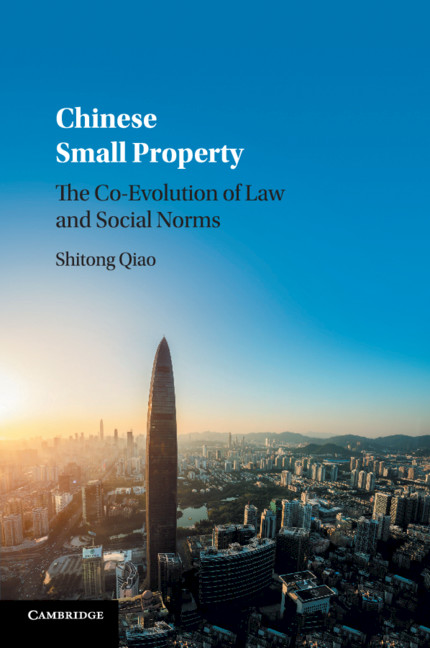
Small property houses provide living space to about eight million migrant workers, office space for start-ups, grassroots police stations and public schools; their contribution to the economic growth and urbanization of a city is immense. The interaction between the small property sector and the formal legal order has a long history and small property has become an established engine of social and legal change. Chinese Small Property presents vivid stories about how institutional entrepreneurs worked together to create an impersonal market outside of the formal legal system to support millions of transactions. Qiao uses an eleven-month fieldwork project in Shenzhen - China's first special economic zone that has grown to a mega city with over fifteen million people - to demonstrate this. A thorough and detailed investigation into small property rights in China, Chinese Small Property is an invaluable source of new information for students and scholars of the field.
Awards
Winner (for dissertation), 2017 Masahiko Aoki Award for Economics Paper, Center for Industrial Development and Environmental Governance
Reviews
‘Can a vibrant real estate market arise in a nation with a stunted legal system? Hernando de Soto famously thought not. Splendidly interweaving field findings with social-scientific theory, Shitong Qiao dismantles the de Soto thesis. In many Chinese cities, booming housing markets have rested largely on informal understandings.'
Robert Ellickson - Walter E. Meyer Professor of Property and Urban Law, Yale Law School
‘In this remarkable book, Shitong Qiao not only illustrates the intricacies of China's booming periurban land market but also demonstrates how Chinese peasants, together with newly urbanizing industrial workers, have fashioned extensive systems of informal ‘small property' commercial land transactions, in spite of a legal system that purportedly forbids them. Qiao's book offers a nuanced discussion of the relationships between law and social norms in Chinese land markets, along with a significant rejoinder to the view that dynamic land markets depend on formal systems of property law.'
Carol M. Rose - University of Arizona
‘A fascinating exploration of the lively housing market that arose in suburban Shenzhen outside the framework of formal law. Based on in-depth field research, Qiao documents the residential building boom, and he then assesses both the strengths and the ultimate limitations of extra-legal arrangements as engines of development.'
Susan Rose-Ackerman - Yale University, Connecticut
‘In this multi-disciplinary work, Qiao has taken Robert Ellickson's pioneering work on social norms and property rights from rural California to Shenzhen, China, one of the world's fastest growing, most complex urban markets. In doing so he has demonstrated that much of what we thought we knew about law, property rights, social norms, and development was incomplete at best and flat wrong at worst.'
Frank Upham - Wilf Family Professor of Property Law, New York University School of Law
'All in all, this book provides very valuable insights into the evolution of China’s property rights regime. It revisits several influential conventional theories and offers critical and valid scrutiny based on empirical findings in China. These insights are most likely applicable to other primitive property markets in developing countries too. The author advances the theoretical depth of existing literature and offers an analytical framework for further research worth doing by scholars of varying fields, including property law, comparative law, law and development, and law and economics.'
Weitseng Chen Source: ICON
Contents
Metrics
Full text views
Full text views helpTotal number of HTML views: 0
Total number of PDF views: 0 *
 Loading metrics...
* Views captured on Cambridge Core between #date#. This data will be updated every 24 hours.
Usage data cannot currently be displayed.
Accessibility standard: Unknown
Why this information is here
This section outlines the accessibility features of this content - including support for screen readers, full keyboard navigation and high-contrast display options. This may not be relevant for you.
Accessibility Information
Accessibility compliance for the HTML of this book is currently unknown and may be updated in the future.