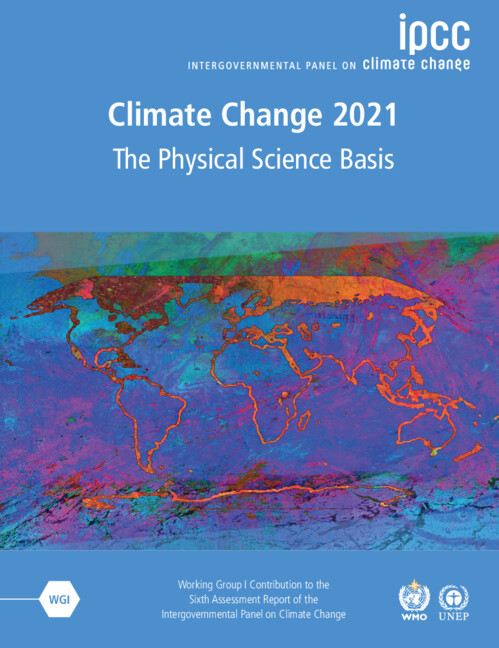
Climate Change 2021 – The Physical Science Basis

-
Select format
-
- Publisher:
- Cambridge University Press
- Publication date:
- 29 June 2023
- 06 July 2023
- ISBN:
- 9781009157896
- Creative Commons:
-
This content is Open Access and distributed under the terms of the Creative Commons Attribution licence CC-BY-NC-ND 4.0.


https://creativecommons.org/creativelicenses - Dimensions:
- Weight & Pages:
- Dimensions:
- Weight & Pages:
Open AccessYou have digital access to this book
Show more authors 
You have digital access to this book
Book description
The Working Group I contribution to the Sixth Assessment Report of the Intergovernmental Panel on Climate Change (IPCC) provides a comprehensive assessment of the physical science basis of climate change. It considers in situ and remote observations; paleoclimate information; understanding of climate drivers and physical, chemical, and biological processes and feedbacks; global and regional climate modelling; advances in methods of analyses; and insights from climate services. It assesses the current state of the climate; human influence on climate in all regions; future climate change including sea level rise; global warming effects including extremes; climate information for risk assessment and regional adaptation; limiting climate change by reaching net zero carbon dioxide emissions and reducing other greenhouse gas emissions; and benefits for air quality. The report serves policymakers, decision makers, stakeholders, and all interested parties with the latest policy-relevant information on climate change. Available as Open Access on Cambridge Core.
Contents
Full book PDFContents
-
Frontmatter
pp i-ii -
-
- You have access
- Open access
- Export citation
-
-
Contents
pp iii-iv -
-
- You have access
- Open access
- Export citation
-
-
Foreword, Preface and Dedication
pp v-vi -
-
- You have access
- Open access
- Export citation
-
-
Foreword
pp vii-viii -
-
- You have access
- Open access
- Export citation
-
-
Preface
pp ix-xiv -
-
- You have access
- Open access
- Export citation
-
-
Dedication
pp xv-xvi -
-
- You have access
- Open access
- Export citation
-
-
Summary for Policymakers
pp 1-2 -
-
- You have access
- Open access
- Export citation
-
-
SPM - Summary for Policymakers
pp 3-32 -
-
- You have access
- Open access
- Export citation
-
-
Technical Summary
pp 33-34 -
-
- You have access
- Open access
- Export citation
-
-
TS - Technical Summary
pp 35-144 -
-
- You have access
- Open access
- Export citation
-
-
Chapters
pp 145-146 -
-
- You have access
- Open access
- Export citation
-
-
1 - Framing, Context, and Methods
pp 147-286 -
-
- You have access
- Open access
- Export citation
-
-
2 - Changing State of the Climate System
pp 287-422 -
-
- You have access
- Open access
- Export citation
-
-
3 - Human Influence on the Climate System
pp 423-552 -
-
- You have access
- Open access
- Export citation
-
-
4 - Future Global Climate: Scenario-based Projections and Near-term Information
pp 553-672 -
-
- You have access
- Open access
- Export citation
-
-
5 - Global Carbon and Other Biogeochemical Cycles and Feedbacks
pp 673-816 -
-
- You have access
- Open access
- Export citation
-
-
6 - Short-lived Climate Forcers
pp 817-922 -
-
- You have access
- Open access
- Export citation
-
-
7 - The Earth’s Energy Budget, Climate Feedbacks and Climate Sensitivity
pp 923-1054 -
-
- You have access
- Open access
- Export citation
-
-
8 - Water Cycle Changes
pp 1055-1210 -
-
- You have access
- Open access
- Export citation
-
-
9 - Ocean, Cryosphere and Sea Level Change
pp 1211-1362 -
-
- You have access
- Open access
- Export citation
-
-
10 - Linking Global to Regional Climate Change
pp 1363-1512 -
-
- You have access
- Open access
- Export citation
-
-
11 - Weather and Climate Extreme Events in a Changing Climate
pp 1513-1766 -
-
- You have access
- Open access
- Export citation
-
-
12 - Climate Change Information for Regional Impact and for Risk Assessment
pp 1767-1926 -
-
- You have access
- Open access
- Export citation
-
-
A - Atlas
pp 1927-2058 -
-
- You have access
- Open access
- Export citation
-
-
Annexes
pp 2059-2060 -
-
- You have access
- Open access
- Export citation
-
-
AI - Annex I: Observational Products
pp 2061-2086 -
-
- You have access
- Open access
- Export citation
-
-
AII - Annex II: Models
pp 2087-2138 -
-
- You have access
- Open access
- Export citation
-
-
AIV - Annex IV: Modes of Variability
pp 2153-2192 -
-
- You have access
- Open access
- Export citation
-
-
AV - Annex V: Monsoons
pp 2193-2204 -
-
- You have access
- Open access
- Export citation
-
Metrics
Altmetric attention score
Full text views
Full text views helpTotal number of HTML views: 0
Total number of PDF views: 0 *
 Loading metrics...
* Views captured on Cambridge Core between #date#. This data will be updated every 24 hours.
Usage data cannot currently be displayed.
Accessibility standard: WCAG 2.0 AA
Why this information is here
This section outlines the accessibility features of this content - including support for screen readers, full keyboard navigation and high-contrast display options. This may not be relevant for you.
Accessibility Information
The PDF of this book conforms to version 2.0 of the Web Content Accessibility Guidelines (WCAG), ensuring core accessibility principles are addressed and achieves the intermediate (AA) level of WCAG compliance, covering a wider range of accessibility requirements.
Content Navigation
Table of contents navigation
Allows you to navigate directly to chapters, sections, or non‐text items through a linked table of contents, reducing the need for extensive scrolling.
Index navigation
Provides an interactive index, letting you go straight to where a term or subject appears in the text without manual searching.
Reading Order and Textual Equivalents
Single logical reading order
You will encounter all content (including footnotes, captions, etc.) in a clear, sequential flow, making it easier to follow with assistive tools like screen readers.
Short alternative textual descriptions
You get concise descriptions (for images, charts, or media clips), ensuring you do not miss crucial information when visual or audio elements are not accessible.
Full alternative textual descriptions
You get more than just short alt text: you have comprehensive text equivalents, transcripts, captions, or audio descriptions for substantial non‐text content, which is especially helpful for complex visuals or multimedia.