Climate, Clothing, and Agriculture in Prehistory

-
Select format
-
- Publisher:
- Cambridge University Press
- Publication date:
- 29 November 2018
- 13 December 2018
- ISBN:
- 9781108555883
- 9781108470087
- 9781108455190
- Dimensions:
- (228 x 152 mm)
- Weight & Pages:
- 0.78kg, 346 Pages
- Dimensions:
- (228 x 152 mm)
- Weight & Pages:
- 0.62kg, 342 Pages
- Subjects:
- Prehistory, Environmental History, History, Archaeology
You may already have access via personal or institutional login- Subjects:
- Prehistory, Environmental History, History, Archaeology
Show more authors 
You may already have access via personal or institutional login
Book description
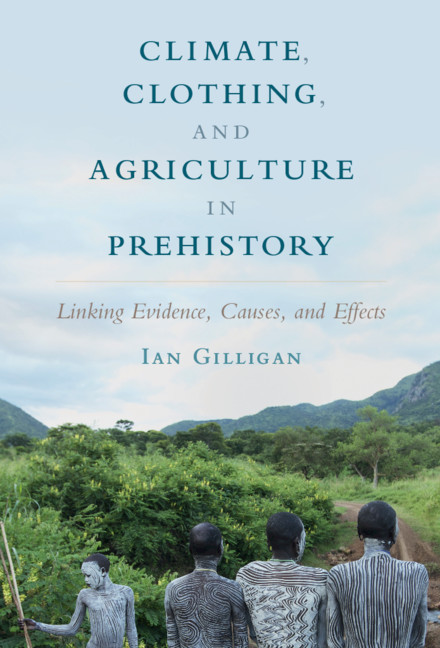
Clothing was crucial in human evolution, and having to cope with climate change was as true in prehistory as it is today. In Climate, Clothing, and Agriculture in Prehistory, Ian Gilligan offers the first complete account of the development of clothing as a response to cold exposure during the ice ages. He explores how and when clothes were invented, noting that the thermal motive alone is tenable in view of the naked condition of humans. His account shows that there is considerably more archaeological evidence for palaeolithic clothes than is generally appreciated. Moreover, Gilligan posits, clothing played a leading role in major technological innovations. He demonstrates that fibre production and the advent of woven fabrics, developed in response to global warming, were pivotal to the origins of agriculture. Drawing together evidence from many disciplines, Climate Clothing, and Agriculture in Prehistory is written in a clear and engaging style, and is illustrated with nearly 100 images.
Contents
Contents
-
Four - The Technology of Paleolithic Clothes
pp 66-79 -
-
- You have access
- HTML
- Export citation
-
Metrics
Altmetric attention score
Full text views
Full text views helpTotal number of HTML views: 0
Total number of PDF views: 0 *
 Loading metrics...
* Views captured on Cambridge Core between #date#. This data will be updated every 24 hours.
Usage data cannot currently be displayed.
Accessibility standard: Unknown
Why this information is here
This section outlines the accessibility features of this content - including support for screen readers, full keyboard navigation and high-contrast display options. This may not be relevant for you.
Accessibility Information
Accessibility compliance for the HTML of this book is currently unknown and may be updated in the future.