Confidence, Likelihood, Probability

-
Select format
-
- Publisher:
- Cambridge University Press
- Publication date:
- 05 March 2016
- 24 February 2016
- ISBN:
- 9781139046671
- 9780521861601
- Dimensions:
- (253 x 177 mm)
- Weight & Pages:
- 1.09kg, 511 Pages
- Dimensions:
- Weight & Pages:
You may already have access via personal or institutional login
Show more authors 
You may already have access via personal or institutional login
Book description
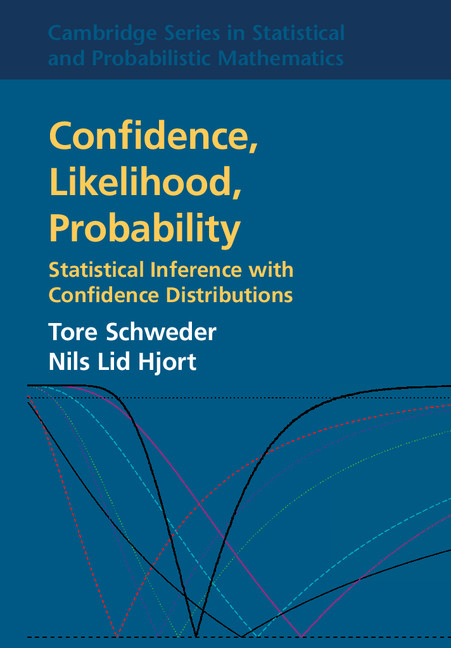
This lively book lays out a methodology of confidence distributions and puts them through their paces. Among other merits, they lead to optimal combinations of confidence from different sources of information, and they can make complex models amenable to objective and indeed prior-free analysis for less subjectively inclined statisticians. The generous mixture of theory, illustrations, applications and exercises is suitable for statisticians at all levels of experience, as well as for data-oriented scientists. Some confidence distributions are less dispersed than their competitors. This concept leads to a theory of risk functions and comparisons for distributions of confidence. Neyman–Pearson type theorems leading to optimal confidence are developed and richly illustrated. Exact and optimal confidence distribution is the gold standard for inferred epistemic distributions. Confidence distributions and likelihood functions are intertwined, allowing prior distributions to be made part of the likelihood. Meta-analysis in likelihood terms is developed and taken beyond traditional methods, suiting it in particular to combining information across diverse data sources.
Reviews
‘This book presents a detailed and wide-ranging account of an approach to inference that moves the discipline towards increased cohesion, avoiding the artificial distinction between testing and estimation. Innovative and thorough, it is sure to have an impact both in the foundations of inference and in a wide range of practical applications of inference.'
Nancy Reid - University Professor of Statistical Sciences, University of Toronto
‘I recommend this book very enthusiastically to any researcher interested in learning more about advanced likelihood theory, based on concepts like confidence distributions and fiducial distributions, and their links with other areas. The book explains in a very didactical way the concepts, their use, their interpretation, etc., illustrated by an impressive number of examples and data sets from a wide range of areas in statistics.’
Ingrid Van Keilegom - Université Catholique de Louvain
Contents
Contents
Metrics
Altmetric attention score
Full text views
Full text views helpTotal number of HTML views: 0
Total number of PDF views: 0 *
 Loading metrics...
* Views captured on Cambridge Core between #date#. This data will be updated every 24 hours.
Usage data cannot currently be displayed.
Accessibility standard: Unknown
Why this information is here
This section outlines the accessibility features of this content - including support for screen readers, full keyboard navigation and high-contrast display options. This may not be relevant for you.
Accessibility Information
Accessibility compliance for the PDF of this book is currently unknown and may be updated in the future.