Confucianism and Modern China

-
Select format
-
- Publisher:
- Cambridge University Press
- Publication date:
- 05 June 2015
- 01 January 2015
- ISBN:
- 9781316106570
- 9781108080361
- Dimensions:
- Weight & Pages:
- Dimensions:
- (216 x 140 mm)
- Weight & Pages:
- 0.4kg, 294 Pages
You may already have access via personal or institutional login
Show more authors 
You may already have access via personal or institutional login
Book description
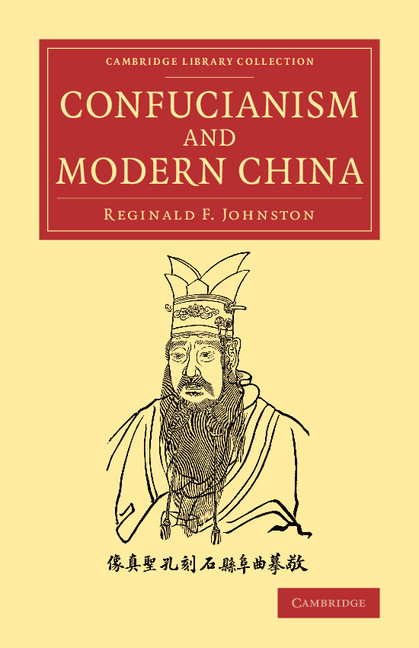
The British colonial administrator and scholar Sir Reginald Fleming Johnston (1874–1938) travelled extensively in the Far East, developing a deep interest in Chinese culture and spirituality. His fourteen-year posting to the relatively quiet port of Weihaiwei allowed him to indulge this interest and to travel to places not usually visited by Europeans. Well acquainted with the philosophy of Confucius, Johnston had happily quoted the Confucian classics in his court judgments at Weihaiwei. In 1918, he was appointed tutor to the young Puyi (1906–67), who had been China's last emperor before his forced abdication. This 1934 publication, developed from lectures, presents an accessible interpretation of the tenets and fortunes of Confucianism, notably the impact of the New Culture Movement on the philosophy's place in Chinese society. Among other works, Johnston's Buddhist China (1913) and Twilight in the Forbidden City (1934) are also reissued in this series.
Contents
Contents
Metrics
Altmetric attention score
Full text views
Full text views helpTotal number of HTML views: 0
Total number of PDF views: 0 *
 Loading metrics...
* Views captured on Cambridge Core between #date#. This data will be updated every 24 hours.
Usage data cannot currently be displayed.
Accessibility standard: Unknown
Why this information is here
This section outlines the accessibility features of this content - including support for screen readers, full keyboard navigation and high-contrast display options. This may not be relevant for you.
Accessibility Information
Accessibility compliance for the PDF of this book is currently unknown and may be updated in the future.