Skip to main content Accessibility help
×
    Show more authors
  • You may already have access via personal or institutional login
  • Select format
  • Publisher:
    Cambridge University Press
    Publication date:
    05 December 2011
    08 December 2011
    ISBN:
    9780511732256
    9781107000643
    9781107666443
    Dimensions:
    (228 x 152 mm)
    Weight & Pages:
    0.54kg, 276 Pages
    Dimensions:
    (229 x 152 mm)
    Weight & Pages:
    0.4kg, 276 Pages
You may already have access via personal or institutional login
  • Selected: Digital
    Add to cart View cart Buy from Cambridge.org

    Book description

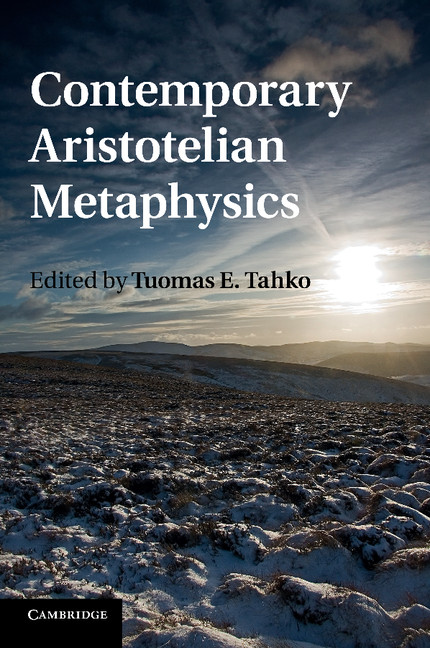
    Aristotelian (or neo-Aristotelian) metaphysics is currently undergoing something of a renaissance. This volume brings together fourteen essays from leading philosophers who are sympathetic to this conception of metaphysics, which takes its cue from the idea that metaphysics is the first philosophy. The primary input from Aristotle is methodological, but many themes familiar from his metaphysics will be discussed, including ontological categories, the role and interpretation of the existential quantifier, essence, substance, natural kinds, powers, potential, and the development of life. The volume mounts a strong challenge to the type of ontological deflationism which has recently gained a strong foothold in analytic metaphysics. It will be a useful resource for scholars and advanced students who are interested in the foundations and development of philosophy.

    Reviews

    '… this book makes a number of powerful and original contributions to the literature on contemporary Aristotelian metaphysics.'

    George Lăzăroiu Source: Review of Contemporary Philosophy

    '… this collection is undoubtedly a remarkable addition to scholarship. … Tahko has succeeded in providing a stimulating presentation of what metaphysics is, according to contemporary Aristotelian philosophers.'

    Luca Gili Source: Bryn Mawr Classical Review

    Refine List

    Actions for selected content:

    Select all | Deselect all
    • View selected items
    • Export citations
    • Download PDF (zip)
    • Save to Kindle
    • Save to Dropbox
    • Save to Google Drive

    Save Search

    You can save your searches here and later view and run them again in "My saved searches".

    Please provide a title, maximum of 40 characters.
    ×

    Contents

    • Chapter 1 - What is metaphysics?
      pp 8-25
    • View abstract

      Summary

      There are five main features that serve to distinguish traditional metaphysics from other forms of enquiry. They are: the aprioricity of its methods; the generality of its subject-matter; the transparency or 'non-opacity' of its concepts; its eidicity or concern with the nature of things; and its role as a foundation for what there is. In metaphysics these features come together in a single package and it is the package as a whole rather than any of the individual features that serves to distinguish metaphysics from other forms of enquiry. This chapter provides an account of these individual features and explains how they might come together to form a single reasonably unified form of enquiry. Metaphysics is not merely one form of enquiry among others, but one that is capable of providing some kind of basis or underpinning for other forms of enquiry.
    • Chapter 2 - In defence of Aristotelian metaphysics
      pp 26-43
    • View abstract

      Summary

      According to the author, Aristotelian metaphysics has more to do with Aristotle's philosophical methodology than his metaphysics. The core of this Aristotelian conception of metaphysics is the idea that metaphysics is the first philosophy. This chapter clarifies what this conception of metaphysics amounts to in the context of recent discussion on the methodology of metaphysics. It also identifies some methodological issues concerning the foundations of Aristotelian metaphysics. In the first section, the chapter compares the Aristotelian and what could be called a 'Quinean' conception of metaphysics. The second section considers the approach emerging from the critique by Ladyman and Ross; it aims to naturalize metaphysics. Finally, the chapter hints towards a programme for a rigorous methodology of Aristotelian metaphysics inspired by E. J. Lowe's work. According to this line of thought, metaphysics is primarily concerned with metaphysical possibility, which is grounded in essence.
    • Chapter 3 - Existence and quantification reconsidered
      pp 44-65
    • View abstract

      Summary

      This chapter talks about understanding quantifiers in natural language, and the thoughts expressed by using these words. The first section states the standard view; the problem that intentionality poses for this view is given in the second section. In the third, this problem is distinguished from problems about whether 'existence is a predicate' and whether there is a distinction between being and existence. The fourth section describes the current state of play about quantification. In the fifth section, the chapter argues that representation of the non-existent should not give us reason to change the standard way of understanding the semantics of quantifiers. The last section sketches how this interpretation should fit with an understanding of so-called 'existential' sentences. The chapter indirectly challenges the Quinean revisionary view. If we aim to give a systematic account of our actual thought and language, we have to make room for quantification over the nonexistent.
    • Chapter 4 - Identity, quantification, and number
      pp 66-82
    • View abstract

      Summary

      This chapter talks about the intimate connections between identity, quantification, and number. The precise relation between the uncountability thesis and the quantification and identity principles is not easy to establish. The falsity of any of the three principles (identity, quantification, and number) would appear to entail the uncountability thesis. Portions of stuff need not contrast in any way with their surroundings, and can have arbitrary boundaries. Peter Simons has proposed an argument suggesting that the truth conditions of certain sentences must appeal to uncountable things. The chapter argues that portions of gunk would be countable, and then goes on to define 'quasinumerical' descriptions. If the definitions of the quasinumerical descriptions make sense, there could be a population of beings who spoke a language identical to ours except that they use quasinumerical terms where we use genuine numerical ones. The chapter ends with an explanation on the number of things.
    • Chapter 5 - Ontological categories
      pp 83-93
    • View abstract

      Summary

      Metaphysics includes ontology and cosmology that are intertwined with one another. In particular, metaphysics seeks to develop a system of ontological categories which organizes everything that there is, or everything that there could be. The analytical task of providing a set of logically necessary and sufficient conditions for a meaningful well-formed predicate's properly expressing an ontological category differs from the ontological task of ascertaining the category to which ontological categories belong. This chapter elucidates the notion of an ontological category that makes use of the notion of a predicate's expressing or connoting a kind. It appears that Metaphysical disagreements are understood against the backdrop of at least three different conceptions of an ontological category. According to the first conception, a category must have an actual instance at some time. The second conception, a category possibly has an instance. The third conception, epistemically possible has an instance.
    • Chapter 6 - Are any kinds ontologically fundamental?
      pp 94-104
    • View abstract

      Summary

      E. J. Lowe regards kinds as ontologically fundamental although David Armstrong takes a reductive attitude towards natural kinds. This chapter examines Lowe's claim, and concludes that it is unwarranted. Lowe has an ontology of four categories, in which we have individual substances (objects, particulars), modes (property/relation instances, tropes), and two species of universal: attributes (non-substantial universals, properties/relations) and substantial universals (kinds). Lowe claims that his ontology has an advantage over Armstrong's when it comes to our understanding of the laws of nature. Lowe's account of laws does not provide a metaphysics that avoids the inference problem for Armstrong, and so does not give us an independent, metaphysical reason for adopting a category of kinds. The chapter argues that analogous metaphysical problems in accounting for the relationship of laws to particulars beset Lowe's four-category ontology as much as Armstrong's two category ontology.
    • Chapter 7 - Are four categories two too many?
      pp 105-125
    • View abstract

      Summary

      This chapter was originally written for an event honouring E. J. Lowe. The author considers Lowe a philosopher of the first rank, a philosopher who has resisted the idea that philosophical problems are to be addressed in ways that keep ontology at arm's length. Lowe's work is a fine example of what the Australians call ontological seriousness. The remarks presented in the chapter are meant less as objections to Lowe's 'four-category ontology' than as requests for clarification. Lowe and David Armstrong agree that universals depend on their instances; the instances are 'metaphysically prior' to the universals. The chapter presents Lowe's account of dispositionality. The discussion is concluded by mentioning three aspects of Lowe's view. First, according to Lowe kinds depend on attributes that characterize them. Second, Lowe tells us that kinds are characterized by attributes, properties, and relations regarded as universals. Third, is an instance of the salt kind.
    • Chapter 8 - Four categories – and more
      pp 126-139
    • View abstract

      Summary

      Jonathan Lowe has proposed that the four fundamental categories of things in the world are: substances, kinds, modes, and properties. In modern analytic philosophy, under the influence of predicate logic and its pioneers, this fourfold classification of things at the fundamental level was generally reduced to a twofold distinction between individual things and properties or attributes. Aristotle's categories are clearly intended to delimit the fundamentally different kinds of thing in the world: they are the supreme genera of being. The search for a good scheme of categories is a good place to start and pursue ontology. Fortunately, Lowe is one of the metaphysicians who are committed to the real-world relevance of their theories, and while the author does not see eye to eye on theory, he does agree substantially on the importance of the right attitude to metaphysics: realist, ambitious, yet realistically fallibilist, and above all, serious.
    • Chapter 9 - Neo-Aristotelianism and substance
      pp 140-155
    • View abstract

      Summary

      Neo-Aristotelianism in metaphysics is an extension of and/or in imitation of Aristotle's metaphysics. This chapter begins with a brief account of what Aristotle had to say about substance. It summarizes the features of Aristotle's metaphysics of substance that provide the basis for saying that a later philosopher defends a 'neo-Aristotelian' theory of substance. Chisholm also places the category of substance within a more general theory of categories, in much the same way that Aristotle did. Like both Aristotle and Chisholm, Jonathan Lowe's latest system of categories is intended to postulate what kinds of entities there are, and not just to represent what kinds of entities are epistemically possible. Aristotelian theories of substance both from those who would eliminate substances or reduce them to instances of some other ontological category or categories, and from metaphysical antirealists.
    • Chapter 10 - Developmental potential
      pp 156-173
    • View abstract

      Summary

      This chapter introduces, from an ontological point of view, the definition: development is a self-directed epigenetic process consisting of sequential phase changes, consequent on interaction of genome, epigenetic systems, and external environment, which transform a living thing into successive stages of an individual of its kind. A developmental potential is a type of capacity-developing capacity. The chapter undertakes to model an illustrative case, prenatal manifestation of human developmental potentials. It seeks a probabilistic model countenanceable not only within multipredicative monism, but when generalized, within rival ontological views on dispositions. We observe that acquisition of a capacity may occur gradually and involve the sequential acquisition of properties. We have introduced developmental potential as a capacity to develop a capacity, characterized such a capacity as a propensity, and related how a probability distribution may be said to project an organism's bounded set of such propensities.
    • Chapter 11 - The origin of life and the definition of life
      pp 174-186
    • View abstract

      Summary

      Paul Davies's principal thesis is that although nothing rules out the possibility of life having originated on some other planet, the oldest forms of life on Earth consist of bacteria and other micro-organisms which eat unappetizing substances like sulphur and hydrogen sulphide and live in scalding volcanic jets four kilometres down at the bottom of the sea. Davies's overall thesis is that the division between living and non-living beings coincides with the introduction of informational software in the form of the genetic code. The hardware is the DNA and RNA molecules; the software is the encoded message they convey to the protein-making factories, which assemble proteins out of amino acid components. A difference between DNA-based information, and the analog information suggested in this chapter to be underlying development, is that the former, based on nucleotide sequences, is one-dimensional, whereas the latter can be three-dimensional or four-dimensional.
    • Chapter 12 - Essence, necessity, and explanation
      pp 187-206
    • View abstract

      Summary

      Both Aristotle and Kit Fine, in their conception of the relation between essence and modality, rely on a distinction between what belongs to the essence of an object and what merely follows from the essence of an object. This chapter discusses Fine's way of drawing the distinction between what is part of the essence of an object and what merely follows from the essence of an object. It turns to Aristotle's account of the distinction between what belongs to the essence proper of a thing and what merely follows from the essence proper of a thing. In particular, as essences are the causal bedrock of Aristotle's metaphysics, so definitions, the linguistic counterparts of essences, are the explanatory bedrock of Aristotle's theory of demonstration. Both of these considerations strike me as important from the point of view of contemporary metaphysicians who are sympathetic to Fine's project of grounding modality in essence.
    • Chapter 13 - No potency without actuality: the case of graph theory
      pp 207-228
    • View abstract

      Summary

      Everything in the material universe is a mixture of act and potency. But the conclusion the author draws from his analysis of Alexander Bird and Randall Dipert seems a deal weaker, namely that if potency exists, so must actuality, but not necessarily wherever the potency is. In the infinite case, with a fairly narrow class of linear chains of directed edges, it might be possible for one to avoid any circularity at all and simply require a terminal actuality to preserve identity conditions all the way up the chain. To this the author makes the dialectical reply that the thesis of no potency without actuality has far more to be said in its favour than that the world is anything like the kind of restrictive, linear, directed infinite graph just supposed.
    • Chapter 14 - A neo-Aristotelian substance ontology: neither relational nor constituent
      pp 229-248
    • View abstract

      Summary

      Substance ontologies in the Aristotelian tradition are commonly thought of as being constituent ontologies, because they typically espouse the hylemorphic dualism of Aristotle's Metaphysics, a doctrine according to which an individual substance is always a combination of matter and form. A common presumption is that ontologies inspired by Aristotle are 'constituent' ontologies, whereas ones inspired by Plato are 'relational', a presumption founded on the notion that Aristotle's metaphysics is distinctively 'immanent' whereas Plato's is distinctively 'transcendent'. Hylemorphism certainly has many attractive features, and many advantages over the transcendent view. Aristotle articulates four-category ontology such as hylemorphic ontology, constituent ontology, relational ontology and transcendent ontology. The author concludes that the four-category ontology, properly understood, has to be excluded both from the class of relational ontologies and from that of constituent ontologies.

    Metrics

    Altmetric attention score

    Full text views

    Total number of HTML views: 0
    Total number of PDF views: 0 *

    Loading metrics...

    Book summary page views

    Total views: 0 *
    Loading metrics...

    * Views captured on Cambridge Core between #date#. This data will be updated every 24 hours.

    Usage data cannot currently be displayed.

    Accessibility standard: Unknown

    Why this information is here

    This section outlines the accessibility features of this content - including support for screen readers, full keyboard navigation and high-contrast display options. This may not be relevant for you.

    Accessibility Information

    Accessibility compliance for the PDF of this book is currently unknown and may be updated in the future.