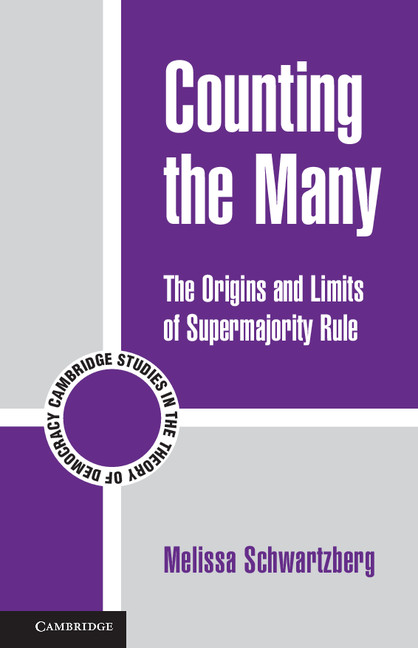
Counting the Many

-
Select format
-
- Publisher:
- Cambridge University Press
- Publication date:
- 05 June 2014
- 18 November 2013
- ISBN:
- 9781139013970
- 9780521198233
- 9780521124492
- Dimensions:
- (228 x 152 mm)
- Weight & Pages:
- 0.54kg, 252 Pages
- Dimensions:
- (228 x 152 mm)
- Weight & Pages:
- 0.3kg, 248 Pages
You may already have access via personal or institutional login- Series:
- Cambridge Studies in the Theory of Democracy (10)
Show more authors 
You may already have access via personal or institutional login
Book description
Supermajority rules govern many features of our lives in common: from the selection of textbooks for our children's schools to residential covenants, from the policy choices of state and federal legislatures to constitutional amendments. It is usually assumed that these rules are not only normatively unproblematic but necessary to achieve the goals of institutional stability, consensus, and minority protections. In this book, Melissa Schwartzberg challenges the logic underlying the use of supermajority rule as an alternative to majority decision making. She traces the hidden history of supermajority decision making, which originally emerged as an alternative to unanimous rule, and highlights the tensions in the contemporary use of supermajority rules as an alternative to majority rule. Although supermajority rules ostensibly aim to reduce the purported risks associated with majority decision making, they do so at the cost of introducing new liabilities associated with the biased judgments they generate and secure.
Awards
Winner, 2016 David and Elaine Spitz Prize, International Conference for the Study of Political Thought
Reviews
“As she did in her previous, remarkable book on entrenchment provisions, Democracy and Legal Change, Melissa Schwartzberg, in Counting the Many, shows us how little we really understand a widespread practice in modem constitutionalism, in this case supermajoritarianism. Combining sharp rational analysis and subtle historical research, Schwartzberg illuminates the origins of vote counting and the decision rules that developed along with it. Normatively, the book is courageous: Schwartzberg demonstrates in no uncertain terms that there is no justification compatible with democratic principles for supermajority requirements. Historically, the book is revelatory in several respects: for instance, Schwartzberg informs us that ‘one person, one vote’ was originally an aristocratic, not democratic, principle. Counting the Many is an excellent book that will enjoy an enormous scholarly and, hopefully, political impact.” – John P. McCormick, Professor of Political Science, University of Chicago
Contents
Contents
Metrics
Altmetric attention score
Full text views
Full text views helpTotal number of HTML views: 0
Total number of PDF views: 0 *
 Loading metrics...
* Views captured on Cambridge Core between #date#. This data will be updated every 24 hours.
Usage data cannot currently be displayed.
Accessibility standard: Unknown
Why this information is here
This section outlines the accessibility features of this content - including support for screen readers, full keyboard navigation and high-contrast display options. This may not be relevant for you.
Accessibility Information
Accessibility compliance for the PDF of this book is currently unknown and may be updated in the future.