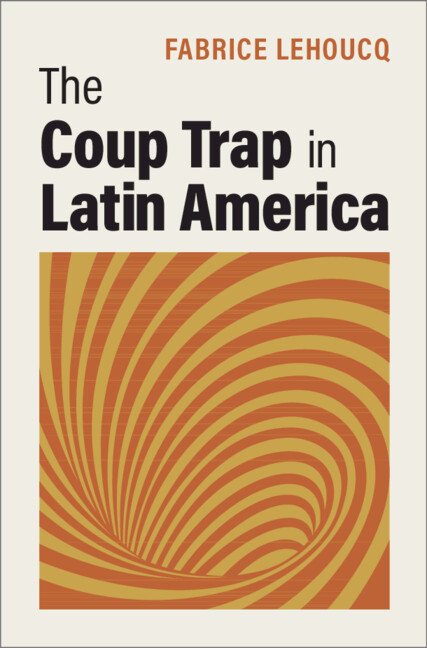
The Coup Trap in Latin America

-
Select format
-
- Publisher:
- Cambridge University Press
- Publication date:
- 14 May 2026
- 21 May 2026
- ISBN:
- 9781009749992
- 9781009750035
- 9781009750004
- Dimensions:
- (229 x 152 mm)
- Weight & Pages:
- 0.563kg, 312 Pages
- Dimensions:
- (229 x 152 mm)
- Weight & Pages:
- 0.509kg, 312 Pages
You may already have access via personal or institutional login
Show more authors 
You may already have access via personal or institutional login
Book description
Why do governments get overthrown? Why are many political systems chronically unstable? The Coup Trap in Latin America answers these questions by looking to the origins and dynamics of the military coup d'état that, since the late nineteenth century, have turned several Latin American political systems into some of the most unstable in the world. The book also explores how others escaped from chronic instability, either by constructing constitutional democracy (in Chile, Costa Rica, and Uruguay) or by establishing durable autocracies (in Mexico and Nicaragua). The Coup Trap in Latin America pioneers the use of statistical predictions to explain when military coups do and do not occur – and uses historical narratives to illustrate and develop these findings. The book provides an innovative explanation of the unconstitutional seizure of power, making it a valuable resource for political scientists, historians, sociologists, and readers interested in Latin American politics and history.
Reviews
‘Why have some Latin American countries experienced so many military coups? The Coup Trap in Latin America brings innovative new methods to an old and important question about dictatorship and democracy in the region. It also provides a compelling new answer. I highly recommend it.’
Steve Levitsky - David Rockefeller Professor of Latin American Studies, Harvard University
‘Fabrice Lehoucq’s revelatory The Coup Trap in Latin America is a splendid combination of imaginative conceptualization, compelling theory, and painstaking research. It draws on a comprehensive data set on the more than 320 attempts to topple regimes throughout Latin America by their own military forces since 1900, almost half of which succeeded. It also draws on equally painstaking work to establish narratives of how those coups were put together and how they succeeded or failed. It is an inspiring model of joining a big overall picture established by a quantitative analysis to a splendid collection of miniature portraits of individual coups that show the social processes that produce the statistical regularities, or that violate those regularities as actors take their time in actually making the coup the statistics predict or make a coup despite a negative prediction. It shows instability to be more than a regional statistical norm but a trap that is difficult to climb out of, making the rare cases of long-enduring democracy and even rarer cases of long-enduring authoritarianism especially worthy of explanation. This book challenges many claims in previous literature, on such things as the significance of economic circumstances or the role of foreign actors. It is also very engagingly written. I would expect anyone writing on coups from now on to be drawing on this exciting work, or to be grappling with debating it.’
John Markoff - Distinguished University Professor of Sociology, Emeritus, University of Pittsburgh
‘A highly original study, combining ambitious scope, meticulous detail, and thought-provoking conclusions. Lehoucq's deft deployment of dense empirical data alongside rigorous statistical analysis has produced a book from which even traditional – statistically shaky – historians will learn a lot about a key feature of modern Latin American politics.’
Alan Knight - Emeritus Professor of the History of Latin America, Oxford University
Contents
Contents
References
Metrics
Altmetric attention score
Full text views
Full text views helpTotal number of HTML views: 0
Total number of PDF views: 0 *
 Loading metrics...
* Views captured on Cambridge Core between #date#. This data will be updated every 24 hours.
Usage data cannot currently be displayed.
Accessibility standard: WCAG 2.0 A
Why this information is here
This section outlines the accessibility features of this content - including support for screen readers, full keyboard navigation and high-contrast display options. This may not be relevant for you.
Accessibility Information
The HTML of this book conforms to version 2.0 of the Web Content Accessibility Guidelines (WCAG), ensuring core accessibility principles are addressed and meets the basic (A) level of WCAG compliance, addressing essential accessibility barriers.
Content Navigation
Table of contents navigation
Allows you to navigate directly to chapters, sections, or non‐text items through a linked table of contents, reducing the need for extensive scrolling.
Index navigation
Provides an interactive index, letting you go straight to where a term or subject appears in the text without manual searching.
Reading Order and Textual Equivalents
Single logical reading order
You will encounter all content (including footnotes, captions, etc.) in a clear, sequential flow, making it easier to follow with assistive tools like screen readers.
Short alternative textual descriptions
You get concise descriptions (for images, charts, or media clips), ensuring you do not miss crucial information when visual or audio elements are not accessible.
Full alternative textual descriptions
You get more than just short alt text: you have comprehensive text equivalents, transcripts, captions, or audio descriptions for substantial non‐text content, which is especially helpful for complex visuals or multimedia.
Structural and Technical Features
ARIA roles provided
You gain clarity from ARIA (Accessible Rich Internet Applications) roles and attributes, as they help assistive technologies interpret how each part of the content functions.