
Skip to main content Accessibility help
×
  • Cited by 3
    • Show more authors
    • Open Access
      You have digital access to this book
    • Select format
    • Publisher:
      Cambridge University Press
      Publication date:
      27 October 2023
      09 November 2023
      ISBN:
      9781009265690
      9781009265706
      9781009265720
      Creative Commons:
      Creative Common License - CC Creative Common License - BY Creative Common License - NC Creative Common License - ND
      This content is Open Access and distributed under the terms of the Creative Commons Attribution licence CC-BY-NC-ND 4.0.
      https://creativecommons.org/creativelicenses
      Dimensions:
      (229 x 152 mm)
      Weight & Pages:
      0.756kg, 428 Pages
      Dimensions:
      (229 x 152 mm)
      Weight & Pages:
      0.612kg, 350 Pages
    Open Access
    You have digital access to this book
    Selected: Digital
    View content
    Add to cart View cart Buy from Cambridge.org

    Book description

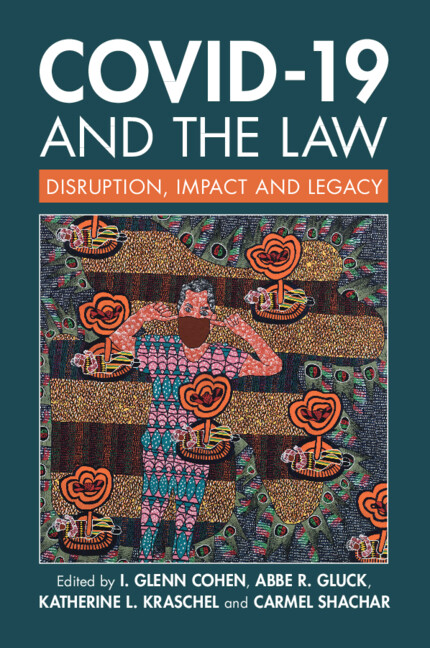
    The COVID-19 pandemic has had an enduring effect across the entire spectrum of law and policy, in areas ranging from health equity and racial justice, to constitutional law, the law of prisons, federal benefit programs, election law and much more. This collection provides a critical reflection on what changes the pandemic has already introduced, and what its legacy may be. Chapters evaluate how healthcare and government institutions have succeeded and failed during this global 'stress test,' and explore how the US and the world will move forward to ensure we are better prepared for future pandemics. This timely volume identifies the right questions to ask as we take stock of pandemic realities and provides guidance for the many stakeholders of COVID-19's legal legacy. This book is also available as Open Access on Cambridge Core.

    Reviews

    ‘COVID-19 and the Law offers a critical reflection on the successes and failures of the health system, as well as the law and ethics that undergird it. Edited by world class scholars at Harvard and Yale, this book offers crucial lessons on how we can be better prepared for the next pandemic, which is all but inevitable. With more than a million deaths in the US, and still counting, why was the response so weak? This book probes this crucial question through the multidisciplinary lens of law, medicine, science, and politics. This book must be on the essential reading list of anyone who wants to understand this unprecedented pandemic, and how it will impact our future.’

    Lawrence Gostin - O’Neill Professor of Global Health Law, Georgetown University and Director, WHO Collaborating Center on National and Global Health Law

    Refine List

    Actions for selected content:

    Select all | Deselect all
    • View selected items
    • Export citations
    • Download PDF (zip)
    • Save to Kindle
    • Save to Dropbox
    • Save to Google Drive

    Save Search

    You can save your searches here and later view and run them again in "My saved searches".

    Please provide a title, maximum of 40 characters.
    ×

    Contents

    Full book PDF

    Page 1 of 2


    • COVID-19 and the Law
      pp i-ii
    • COVID-19 and the Law - Title page
      pp iii-iii
    • Disruption, Impact and Legacy
    • Copyright page
      pp iv-iv
    • Dedication
      pp v-vi
    • Contents
      pp vii-x
    • Figures
      pp xi-xii
    • Tables
      pp xiii-xiv
    • Contributors
      pp xv-xviii
    • Acknowledgments
      pp xix-xx
    • Introduction
      pp 1-10
    • Part I - The Health Care System That COVID-19 Encountered
      pp 11-86
    • Introduction
      pp 13-16
    • 1 - COVID-19 and Clinical Ethics
      pp 17-27
    • Reflections on New York’s 2020 Spring Surge
    • 2 - Patients First, Public Health Last
      pp 28-41
    • Part II - COVID-19, Disparities, and Vulnerable Populations
      pp 87-140
    • Introduction
      pp 89-90
    • 8 - Access to Scarce Interventions
      pp 116-128
    • Age and Disability
    • 9 - Humane and Resilient Long-Term Care
      pp 129-140
    • A Post-COVID-19 Vision
    • Part III - Government Response and Reaction to COVID-19
      pp 141-218
    • Prologue
      pp 143-148
    • Introduction
      pp 149-152
    • 10 - Federalism, Leadership, and COVID-19
      pp 153-166
    • Evolving Lessons for the Public’s Health
    • 11 - COVID-19 Reveals the Fiscal Determinants of Health
      pp 167-178
    • 12 - Legislating a More Responsive Safety Net
      pp 179-192
    • 13 - Eradicating Pandemic Health Inequities
      pp 193-205
    • Health Justice in Emergency Preparedness

    Page 1 of 2


    Metrics

    Altmetric attention score

    Full text views

    Total number of HTML views: 0
    Total number of PDF views: 0 *
    Loading metrics...

    Book summary page views

    Total views: 0 *
    Loading metrics...

    * Views captured on Cambridge Core between #date#. This data will be updated every 24 hours.

    Usage data cannot currently be displayed.

    Accessibility standard: WCAG 2.0 A

    Why this information is here

    This section outlines the accessibility features of this content - including support for screen readers, full keyboard navigation and high-contrast display options. This may not be relevant for you.

    Accessibility Information

    The HTML of this book conforms to version 2.0 of the Web Content Accessibility Guidelines (WCAG), ensuring core accessibility principles are addressed and meets the basic (A) level of WCAG compliance, addressing essential accessibility barriers.

    Content Navigation
    Table of contents navigation

    Allows you to navigate directly to chapters, sections, or non‐text items through a linked table of contents, reducing the need for extensive scrolling.

    Index navigation

    Provides an interactive index, letting you go straight to where a term or subject appears in the text without manual searching.

    Reading Order and Textual Equivalents
    Single logical reading order

    You will encounter all content (including footnotes, captions, etc.) in a clear, sequential flow, making it easier to follow with assistive tools like screen readers.

    Short alternative textual descriptions

    You get concise descriptions (for images, charts, or media clips), ensuring you do not miss crucial information when visual or audio elements are not accessible.

    Full alternative textual descriptions

    You get more than just short alt text: you have comprehensive text equivalents, transcripts, captions, or audio descriptions for substantial non‐text content, which is especially helpful for complex visuals or multimedia.

    Visualised data also available as non‐graphical data

    You can access graphs or charts in a text or tabular format, so you are not excluded if you cannot process visual displays.
