Cryptic Species

-
Select format
-
- Publisher:
- Cambridge University Press
- Publication date:
- 01 September 2022
- 08 September 2022
- ISBN:
- 9781009070553
- 9781316513644
- Dimensions:
- (254 x 203 mm)
- Weight & Pages:
- 0.89kg, 324 Pages
- Dimensions:
- Weight & Pages:
You may already have access via personal or institutional login- Subjects:
- Life Sciences, Evolutionary Biology, Ecology and Conservation, Zoology
Show more authors 
You may already have access via personal or institutional login
Book description
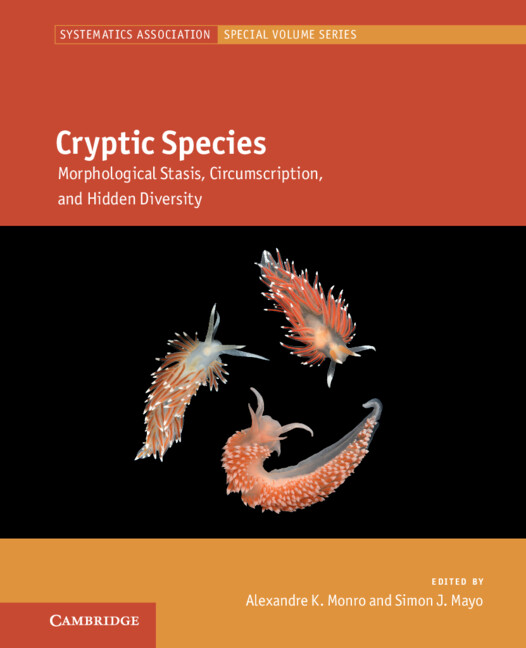
Cryptic species are organisms which look identical, but which represent distinct evolutionary lineages. They are an emerging trend in organismal biology across all groups, from flatworms, insects, amphibians, primates, to vascular plants. This book critically evaluates the phenomenon of cryptic species and demonstrates how they can play a valuable role in improving our understanding of evolution, in particular of morphological stasis. It also explores how the recognition of cryptic species is intrinsically linked to the so-called 'species problem', the lack of a unifying species concept in biology, and suggests alternative approaches. Bringing together a range of perspectives from practicing taxonomists, the book presents case studies of cryptic species across a range of animal and plant groups. It will be an invaluable text for all biologists interested in species and their delimitation, definition, and purpose, including undergraduate and graduate students and researchers.
Reviews
‘This is rewarding reading for evolutionary biologists and geneticists, and perhaps also for philosophers … Recommended.'
M. Gochfeld Source: Choice
Contents
Contents
Metrics
Altmetric attention score
Full text views
Full text views helpTotal number of HTML views: 0
Total number of PDF views: 0 *
 Loading metrics...
* Views captured on Cambridge Core between #date#. This data will be updated every 24 hours.
Usage data cannot currently be displayed.
Accessibility standard: Unknown
Why this information is here
This section outlines the accessibility features of this content - including support for screen readers, full keyboard navigation and high-contrast display options. This may not be relevant for you.
Accessibility Information
Accessibility compliance for the HTML of this book is currently unknown and may be updated in the future.