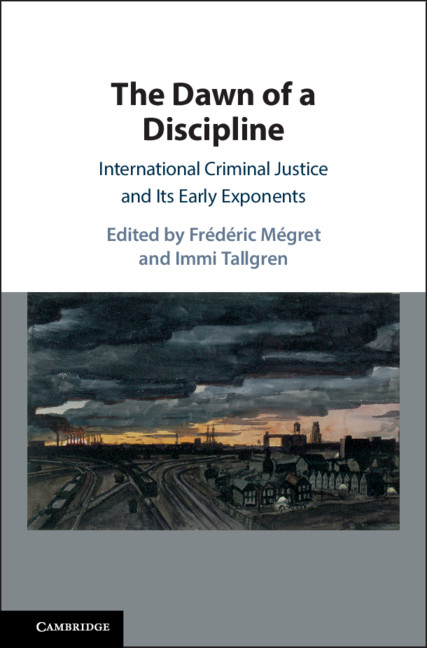

The history of international criminal justice is often recounted as a series of institutional innovations. But international criminal justice is also the product of intellectual developments made in its infancy. This book examines the contributions of a dozen key figures in the early phase of international criminal justice, focusing principally on the inter-war years up to Nuremberg. Where did these figures come from, what did they have in common, and what is left of their legacy? What did they leave out? How was international criminal justice framed by the concerns of their epoch and what intuitions have passed the test of time? What does it mean to reimagine international criminal justice as emanating from individual intellectual narratives? In interrogating this past in all its complexity one does not only do justice to it; one can recover a sense of the manifold trajectories that international criminal justice could have taken.
‘This book examines the contributions of a dozen key figures in the early phase of international criminal justice, focusing principally on the inter-war years up to Nuremberg [also] … this book helps to understand that policy changes may be more often than not the result of influential key figures who need to be identified.’
Dr. Hans-Wolfgang Micklitz Source: Journal of Consumer Policy
Loading metrics...
* Views captured on Cambridge Core between #date#. This data will be updated every 24 hours.
Usage data cannot currently be displayed.
This section outlines the accessibility features of this content - including support for screen readers, full keyboard navigation and high-contrast display options. This may not be relevant for you.
Accessibility compliance for the HTML of this book is currently unknown and may be updated in the future.
