
Skip to main content Accessibility help
×
  • Cited by 4
    • Show more authors
    • You may already have access via personal or institutional login
    • Select format
    • Publisher:
      Cambridge University Press
      Publication date:
      10 September 2021
      23 September 2021
      ISBN:
      9781108986182
      9781108833653
      9781108986540
      Dimensions:
      (216 x 140 mm)
      Weight & Pages:
      0.39kg, 196 Pages
      Dimensions:
      (216 x 140 mm)
      Weight & Pages:
      0.27kg, 196 Pages
    You may already have access via personal or institutional login
  • Selected: Digital
    Add to cart View cart Buy from Cambridge.org

    Book description

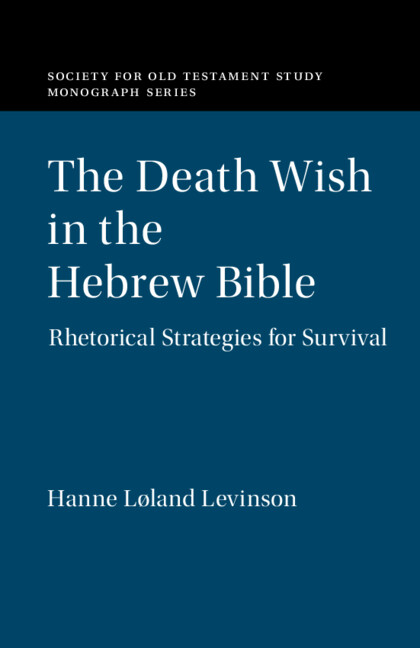
    This is the first book to systematically investigate the texts in the Hebrew Bible in which a character expresses a wish to die. Contrary to previous scholarship on these texts that assumed these death wishes were simply a desire to escape suffering, Hanne Løland Levinson employs narrative criticism and conversation analysis, together with diachronic methods, to carefully hear each death-wish text in its literary context. She demonstrates that death wishes embody powerful, multi-faceted rhetorical strategies. Grouping the death-wish texts into four main rhetorical strategies of negotiation, expression of despair and anger, longing to undo one's existence, and wishing for a different reality, Løland Levinson portrays the complex reasons why characters in the Hebrew Bible wish for death. She concludes that the death wishes navigate the tension between longing for death and fighting for survival - a tension that many live with also today as they attempt to claim agency and autonomy in life.

    Awards

    Winner, 2023 Scott Award for Best Book on the Hebrew Bible, Canadian Society of Biblical Studies

    Reviews

    ‘A very welcome addition to biblical studies, Hanne Løland Levinson’s The Death Wish in the Hebrew Bible addresses a well-known motif that has never been given full and proper study. This fresh and insightful study avoids the pitfall of taking death wishes at face value and instead recognizes their rhetorical functions: death wish as a negotiation strategy; death wishes expressed in despair or anger; wishing away one’s birth; and death wishes as wishful thinking. The book is very well constructed and executed; the writing is lovely. It also contributes to the contemporary social conversation about the end of life, especially in noting how the expression of a death wish may not communicate a simple wish for one’s death, but a desire for help or an expression of deep pain or traumatic loss. Thoughtful; and most highly recommended.’

    Mark S. Smith - Princeton Theological Seminary

    ‘The book is a highly readable discussion of a fascinating topic, and full of precise and nuanced insights into the texts.’

    Marian Kelsey Source: Journal for the Study of the Old Testament

    'Levinson has clearly demonstrated the rhetorical goals of utterances about death, and this remains an important contribution … an important and worthwhile study.'

    David G. Firth Source: Society of Biblical Literature

    '… an important and worthwhile study.’

    David G. Firth Source: Review of Biblical Literature

    ‘[This] is a gem of a book. Despite its weighty subject, it provides easy reading on a relatable topic that helps us better understand why biblical characters express the desire to die and why we continue to use similar expressions in contemporary life to communicate despair, frustration, and anger, but also as a rhetorical strategy that works to change our circumstances. … Despite its morbid topic, Hanne Løland Levinson offers a fascinating, accessible, and even enjoyable analysis of biblical death-wish texts.’

    Amy Kalmanofsky Source: AJS Review: The Journal of the Association for Jewish Studies

    ‘This study is the result of Hanne Løland Levinson’s intense, and personal, work on texts that daringly express human’s lament and prayer when experiencing distress and challenges. … The work fits well into the current debates around biblical characters’ emotions. The analytical approach avoids hasty psychological speculations about the characters’ feelings. Using detailed assessments of how conversations can be interpreted and a range of methods, the complexity of such expressive conversations is highlighted.’

    Martina Weingärtner Source: Theologische Literaturzeitung (ThLZ)

    Refine List

    Actions for selected content:

    Select all | Deselect all
    • View selected items
    • Export citations
    • Download PDF (zip)
    • Save to Kindle
    • Save to Dropbox
    • Save to Google Drive

    Save Search

    You can save your searches here and later view and run them again in "My saved searches".

    Please provide a title, maximum of 40 characters.
    ×

    Contents

    Metrics

    Altmetric attention score

    Full text views

    Total number of HTML views: 0
    Total number of PDF views: 0 *
    Loading metrics...

    Book summary page views

    Total views: 0 *
    Loading metrics...

    * Views captured on Cambridge Core between #date#. This data will be updated every 24 hours.

    Usage data cannot currently be displayed.

    Accessibility standard: Unknown

    Why this information is here

    This section outlines the accessibility features of this content - including support for screen readers, full keyboard navigation and high-contrast display options. This may not be relevant for you.

    Accessibility Information

    Accessibility compliance for the HTML of this book is currently unknown and may be updated in the future.
