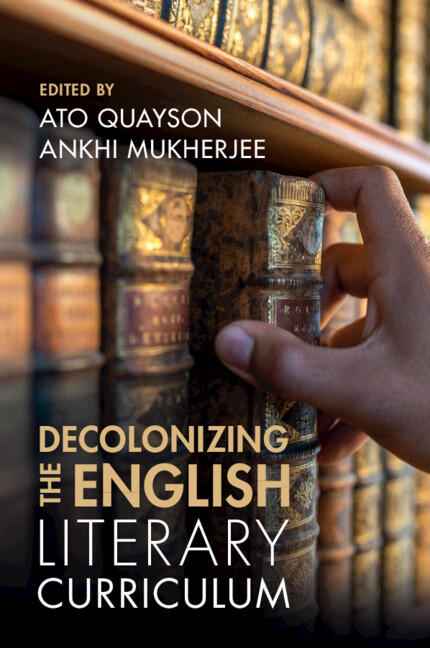
Decolonizing the English Literary Curriculum

-
Select format
-
- Publisher:
- Cambridge University Press
- Publication date:
- 02 November 2023
- 09 November 2023
- ISBN:
- 9781009299985
- 9781009299954
- 9781009299961
- Creative Commons:
-
This content is Open Access and distributed under the terms of the Creative Commons Attribution licence CC-BY-NC 4.0.


https://creativecommons.org/creativelicenses - Dimensions:
- (229 x 152 mm)
- Weight & Pages:
- 0.87kg, 542 Pages
- Dimensions:
- (229 x 152 mm)
- Weight & Pages:
- 0.77kg, 534 Pages
Open AccessYou have digital access to this book
Show more authors 
You have digital access to this book
Book description
George Floyd's death on May 25th 2020 marked a watershed in reactions to anti-Black racism in the United States and elsewhere. Intense demonstrations around the world followed. Within literary studies, the demonstrations accelerated the scrutiny of the literary curriculum, the need to diversify the curriculum, and the need to incorporate more Black writers. Decolonizing the English Literary Curriculum is a major collection that aims to address these issues from a global perspective. An international team of leading scholars illustrate the necessity and advantages of reform from specific decolonial perspectives, with evidence-based arguments from classroom contexts, as well as establishing new critical agendas. The significance of Decolonizing the English Literary Curriculum lies in the complete overhaul it proposes for the study of English literature. It reconnects English studies, the humanities, and the modern, international university to issues of racial and social justice. This book is also available as Open Access on Cambridge Core.
Reviews
‘Broad in its geographical and historical scope and drawing on the expertise of scholars from all the continents, Decolonizing the English Literary Curriculum will be the primer for English literary studies for many years to come. The book stands out for its diversity of perspectives, its expansive understanding of different forms of decoloniality, and its range of critical references.’
Simon Gikandi - Class of 1943 University Professor of English, Princeton University
‘Recommended.’
L. Zhang Source: CHOICE
Contents
Full book PDFContents
-
Decolonizing the English Literary Curriculum
pp i-ii -
-
- You have access
- Open access
- HTML
- Export citation
-
-
Decolonizing the English Literary Curriculum - Title page
pp iii-iii -
-
- You have access
- Open access
- HTML
- Export citation
-
-
Copyright page
pp iv-iv -
-
- You have access
- Open access
- HTML
- Export citation
-
-
Contents
pp v-vii -
-
- You have access
- Open access
- HTML
- Export citation
-
-
Contributors
pp viii-ix -
-
- You have access
- Open access
- HTML
- Export citation
-
-
Acknowledgments
pp x-x -
-
- You have access
- Open access
- HTML
- Export citation
-
-
Introduction
pp 1-20 -
-
-
- You have access
- Open access
- HTML
- Export citation
-
-
Part I - Identities
pp 21-146 -
-
- You have access
- Open access
- HTML
- Export citation
-
-
Chapter 1 - Decolonizing the University
pp 23-41 -
-
-
- You have access
- Open access
- HTML
- Export citation
-
-
Chapter 2 - Decolonizing the English Department in Ireland
pp 42-59 -
-
-
- You have access
- Open access
- HTML
- Export citation
-
-
Chapter 3 - First Peoples, Indigeneity, and Teaching Indigenous Writing in Canada
pp 60-79 -
-
-
- You have access
- Open access
- HTML
- Export citation
-
-
Chapter 4 - Decolonizing Literary Pedagogies in Australia and Aotearoa New Zealand
pp 80-109 -
-
-
- You have access
- Open access
- HTML
- Export citation
-
-
Chapter 5 - Genders, Sexualities, and Decolonial Methodologies
pp 110-126 -
-
-
- You have access
- Open access
- HTML
- Export citation
-
-
Chapter 6 - Black British Literature Decolonizing the Curriculum
pp 127-146 -
-
-
- You have access
- Open access
- HTML
- Export citation
-
-
Part II - Methodologies
pp 147-280 -
-
- You have access
- Open access
- HTML
- Export citation
-
-
Chapter 7 - Theories of Anthologizing and Decolonization
pp 149-166 -
-
-
- You have access
- Open access
- HTML
- Export citation
-
-
Chapter 8 - Confabulation as Decolonial Pedagogy in Singapore Literature
pp 167-184 -
-
-
- You have access
- Open access
- HTML
- Export citation
-
-
Chapter 9 - Marxism, Postcolonialism, and the Decolonization of Literary Studies
pp 185-199 -
-
-
- You have access
- Open access
- HTML
- Export citation
-
-
Chapter 10 - Against Ethnography
pp 200-213 - On Teaching Minority Literature
-
-
-
- You have access
- Open access
- HTML
- Export citation
-
-
Chapter 11 - Orality, Experiential Learning, and Decolonizing African Literature
pp 214-235 -
-
-
- You have access
- Open access
- HTML
- Export citation
-
-
Chapter 12 - Vernacular English in the Classroom
pp 236-255 - A New Geopolitics of the English Language
-
-
-
- You have access
- Open access
- HTML
- Export citation
-
-
Chapter 13 - Reading for Justice
pp 256-280 - On the Pleasures and Pitfalls of a Decolonizing Pedagogy
-
-
-
- You have access
- Open access
- HTML
- Export citation
-
-
Part III - Interdisciplinarity and Literary Studies
pp 281-346 -
-
- You have access
- Open access
- HTML
- Export citation
-
-
Chapter 14 - Literature, Human Rights Law, and the Return of Decolonization
pp 283-299 -
-
-
- You have access
- Open access
- HTML
- Export citation
-
-
Chapter 15 - Decolonizing Literary Interpretation through Disability
pp 300-314 -
-
-
- You have access
- Open access
- HTML
- Export citation
-
-
Chapter 16 - Decolonizing the Bible as Literature
pp 315-330 -
-
-
- You have access
- Open access
- HTML
- Export citation
-
-
Chapter 17 - Decolonizing Literature
pp 331-346 - A History of Medicine Perspective
-
-
-
- You have access
- Open access
- HTML
- Export citation
-
-
Part IV - Canon Revisions
pp 347-505 -
-
- You have access
- Open access
- HTML
- Export citation
-
-
Chapter 18 - Decolonizing the Medieval Literary Curriculum
pp 349-366 -
-
-
- You have access
- Open access
- HTML
- Export citation
-
-
Chapter 19 - The Decolonial Imaginary of Borderlands Shakespeare
pp 367-385 -
-
-
- You have access
- Open access
- HTML
- Export citation
-
Metrics
Altmetric attention score
Full text views
Full text views helpTotal number of HTML views: 0
Total number of PDF views: 0 *
 Loading metrics...
* Views captured on Cambridge Core between #date#. This data will be updated every 24 hours.
Usage data cannot currently be displayed.
Accessibility standard: WCAG 2.2 AAA
Why this information is here
This section outlines the accessibility features of this content - including support for screen readers, full keyboard navigation and high-contrast display options. This may not be relevant for you.
Accessibility Information
The HTML of this book complies with version 2.2 of the Web Content Accessibility Guidelines (WCAG), offering more comprehensive accessibility measures for a broad range of users and attains the highest (AAA) level of WCAG compliance, optimising the user experience by meeting the most extensive accessibility guidelines.
Content Navigation
Table of contents navigation
Allows you to navigate directly to chapters, sections, or non‐text items through a linked table of contents, reducing the need for extensive scrolling.
Index navigation
Provides an interactive index, letting you go straight to where a term or subject appears in the text without manual searching.
Reading Order and Textual Equivalents
Single logical reading order
You will encounter all content (including footnotes, captions, etc.) in a clear, sequential flow, making it easier to follow with assistive tools like screen readers.
Short alternative textual descriptions
You get concise descriptions (for images, charts, or media clips), ensuring you do not miss crucial information when visual or audio elements are not accessible.
Full alternative textual descriptions
You get more than just short alt text: you have comprehensive text equivalents, transcripts, captions, or audio descriptions for substantial non‐text content, which is especially helpful for complex visuals or multimedia.
Visualised data also available as non‐graphical data
You can access graphs or charts in a text or tabular format, so you are not excluded if you cannot process visual displays.
Visual Accessibility
Use of high contrast between text and background colour
You benefit from high‐contrast text, which improves legibility if you have low vision or if you are reading in less‐than‐ideal lighting conditions.
Structural and Technical Features
ARIA roles provided
You gain clarity from ARIA (Accessible Rich Internet Applications) roles and attributes, as they help assistive technologies interpret how each part of the content functions.