
Skip to main content Accessibility help
×
  • Cited by 15
    • Show more authors
    • You may already have access via personal or institutional login
    • Select format
    • Publisher:
      Cambridge University Press
      Publication date:
      06 August 2009
      04 May 2000
      ISBN:
      9780511496967
      9780521652391
      9780521027212
      Dimensions:
      (228 x 152 mm)
      Weight & Pages:
      0.57kg, 300 Pages
      Dimensions:
      (228 x 152 mm)
      Weight & Pages:
      0.467kg, 300 Pages
    You may already have access via personal or institutional login
  • Selected: Digital
    Add to cart View cart Buy from Cambridge.org

    Book description

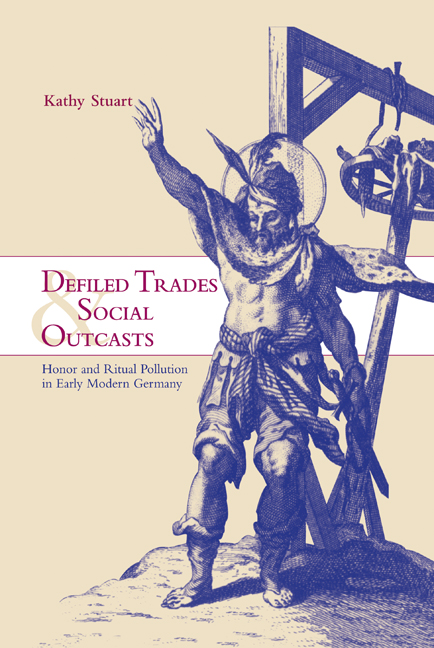
    This book presents a social and cultural history of 'dishonourable people' (unehrliche Leute), an outcast group in early modern Germany. Executioners, skinners, grave-diggers, shepherds, barber-surgeons, millers, linen-weavers, sow-gelders, latrine-cleaners, and bailiffs were among the 'dishonourable' by virtue of their trades. This dishonour was either hereditary, often through several generations, or it arose from ritual pollution whereby honourable citizens could become dishonourable by coming into casual contact with members of the outcast group. The dishonourable milieu of the city of Augsburg from the sixteenth to the eighteenth centuries is reconstructed to show the extent to which dishonour determined the life-chances and self-identity of dishonourable people. The book then investigates how honourable estates interacted with dishonourable people, and how the pollution anxieties of early modern Germans structured social and political relations within honourable society.

    Awards

    Winner of the Hans Rosenberg Biennial Book prize for 2000

    Reviews

    'This is a splendid book, carefully honed over several years, beautifully written, and a delight to read.'

    David Warren Sabean Source: Journal of Social History

    'Rarely has an anthropologically informed study been joined with such careful attention to local judicial records.This is an excellent book.'

    H. C. Erik Midelfort Source: The American Historical Review

    '… Kathy Stuart has written an important and original book that deserves to be read by a wide circle of scholars.'

    R. Po-chia Hsia Source: Central European History

    'This award-winning monograph represents a major contribution to our understanding of marginal groups and artisanal culture through its functional analysis of the mechanisms of prejudice.'

    David Lederer Source: German History

    Refine List

    Actions for selected content:

    Select all | Deselect all
    • View selected items
    • Export citations
    • Download PDF (zip)
    • Save to Kindle
    • Save to Dropbox
    • Save to Google Drive

    Save Search

    You can save your searches here and later view and run them again in "My saved searches".

    Please provide a title, maximum of 40 characters.
    ×

    Contents

    Metrics

    Altmetric attention score

    Full text views

    Total number of HTML views: 0
    Total number of PDF views: 0 *
    Loading metrics...

    Book summary page views

    Total views: 0 *
    Loading metrics...

    * Views captured on Cambridge Core between #date#. This data will be updated every 24 hours.

    Usage data cannot currently be displayed.

    Accessibility standard: Unknown

    Why this information is here

    This section outlines the accessibility features of this content - including support for screen readers, full keyboard navigation and high-contrast display options. This may not be relevant for you.

    Accessibility Information

    Accessibility compliance for the PDF of this book is currently unknown and may be updated in the future.
