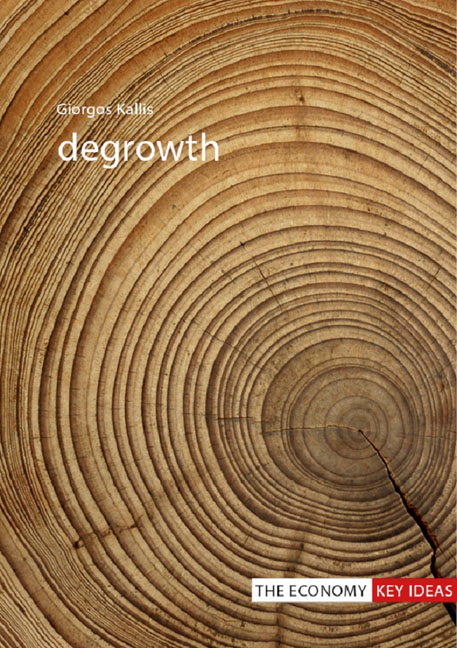
Degrowth

-
Select format
-
- Publisher:
- Agenda Publishing
- Publication date:
- 09 August 2023
- 30 June 2018
- ISBN:
- 9781911116813
- 9781911116790
- 9781911116806
- Dimensions:
- Weight & Pages:
- Dimensions:
- Weight & Pages:
- Series:
- The Economy Key Ideas
Show more authors 
You may already have access via personal or institutional login
Book description
The term 'degrowth' has emerged within ecological and other heterodox schools of economics as a critique of the idea (and ideology) of economic growth. Degrowth argues that economic growth is no longer desirable - its costs exceed its benefits - and advocates a transformation of economies so that they produce and consume less, differently and better.
Giorgos Kallis provides a clear and succinct guide to the central ideas of degrowth theory and explores what it would take for an economy to transition to a position that enables it to prosper without growth. The book examines how mainstream conceptualizations of the economy are challenged by degrowth theory and how degrowth draws on a multifaceted network of ideas across disciplines to shed new light on the economic process. The central claims of the degrowth literature are discussed alongside some key criticisms of them. Whether one agrees or disagrees with degrowth's critique of economic growth, Kallis shows how it raises fundamental questions about the workings of capitalism that we can no longer afford to ignore.
Contents
Contents
Metrics
Altmetric attention score
Full text views
Full text views helpTotal number of HTML views: 0
Total number of PDF views: 0 *
 Loading metrics...
* Views captured on Cambridge Core between #date#. This data will be updated every 24 hours.
Usage data cannot currently be displayed.
Accessibility standard: Unknown
Why this information is here
This section outlines the accessibility features of this content - including support for screen readers, full keyboard navigation and high-contrast display options. This may not be relevant for you.
Accessibility Information
Accessibility compliance for the PDF of this book is currently unknown and may be updated in the future.