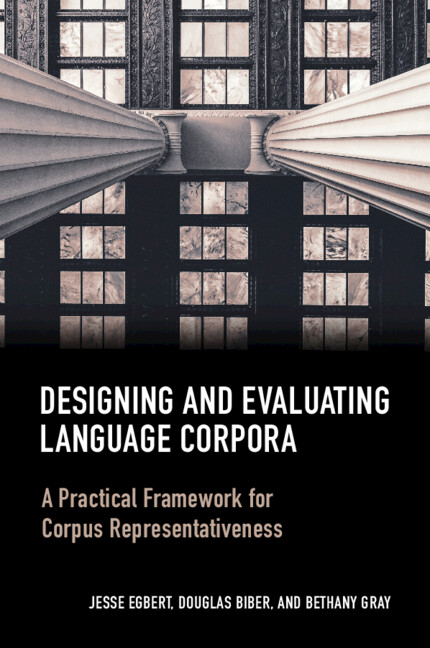
Designing and Evaluating Language Corpora

-
Select format
-
- Publisher:
- Cambridge University Press
- Publication date:
- 07 April 2022
- 14 April 2022
- ISBN:
- 9781316584880
- 9781107151383
- 9781316605882
- Dimensions:
- (228 x 152 mm)
- Weight & Pages:
- 0.57kg, 300 Pages
- Dimensions:
- (228 x 152 mm)
- Weight & Pages:
- 0.44kg, 318 Pages
- Subjects:
- Research Methods in Linguistics, Language and Linguistics
You may already have access via personal or institutional login- Subjects:
- Research Methods in Linguistics, Language and Linguistics
Show more authors 
You may already have access via personal or institutional login
Book description
Corpora are ubiquitous in linguistic research, yet to date, there has been no consensus on how to conceptualize corpus representativeness and collect corpus samples. This pioneering book bridges this gap by introducing a conceptual and methodological framework for corpus design and representativeness. Written by experts in the field, it shows how corpora can be designed and built in a way that is both optimally suited to specific research agendas, and adequately representative of the types of language use in question. It considers questions such as 'what types of texts should be included in the corpus?', and 'how many texts are required?' – highlighting that the degree of representativeness rests on the dual pillars of domain considerations and distribution considerations. The authors introduce, explain, and illustrate all aspects of this corpus representativeness framework in a step-by-step fashion, using examples and activities to help readers develop practical skills in corpus design and evaluation.
Reviews
‘A valuable guide for corpora users and designers, a must-read before beginning the process of corpora selection and design.’
Ana Abigahil Flores Hernández and Pauline Moore Source: Tertium Linguistic Journal
Contents
Contents
Metrics
Altmetric attention score
Full text views
Full text views helpTotal number of HTML views: 0
Total number of PDF views: 0 *
 Loading metrics...
* Views captured on Cambridge Core between #date#. This data will be updated every 24 hours.
Usage data cannot currently be displayed.
Accessibility standard: Unknown
Why this information is here
This section outlines the accessibility features of this content - including support for screen readers, full keyboard navigation and high-contrast display options. This may not be relevant for you.
Accessibility Information
Accessibility compliance for the HTML of this book is currently unknown and may be updated in the future.