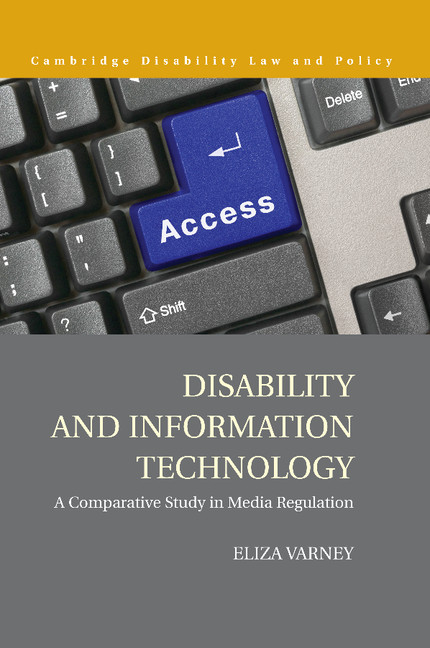
Disability and Information Technology

-
Select format
-
- Publisher:
- Cambridge University Press
- Publication date:
- 05 March 2013
- 11 March 2013
- ISBN:
- 9781139017947
- 9780521191616
- 9781107502895
- Dimensions:
- (228 x 152 mm)
- Weight & Pages:
- 0.53kg, 306 Pages
- Dimensions:
- (229 x 152 mm)
- Weight & Pages:
- 0.8kg, 314 Pages
- Subjects:
- Socio-Legal Studies, Law, Human Rights
You may already have access via personal or institutional login- Subjects:
- Socio-Legal Studies, Law, Human Rights
Show more authors 
You may already have access via personal or institutional login
Book description
Disability and Information Technology examines the extent to which regulatory frameworks for information and communication technologies (ICTs) safeguard the rights of persons with disabilities as citizenship rights. It adopts a comparative approach focused on four case studies: Canada, the European Union, the United Kingdom and the United States. It focuses on the tension between social and economic values in the regulation of ICTs and calls for a regulatory approach based on a framework of principles that reflects citizenship values. The analysis identifies challenges encountered in the jurisdictions examined and points toward the rights-based approach advanced by the UN Convention on the Rights of Persons with Disabilities as a benchmark in protecting the rights of persons with disabilities to have equal access to information. The research draws on a wealth of resources, including legislation, cases, interviews, consultation documents and responses from organisations representing persons with disabilities.
Contents
Contents
Metrics
Altmetric attention score
Full text views
Full text views helpTotal number of HTML views: 0
Total number of PDF views: 0 *
 Loading metrics...
* Views captured on Cambridge Core between #date#. This data will be updated every 24 hours.
Usage data cannot currently be displayed.
Accessibility standard: Unknown
Why this information is here
This section outlines the accessibility features of this content - including support for screen readers, full keyboard navigation and high-contrast display options. This may not be relevant for you.
Accessibility Information
Accessibility compliance for the HTML of this book is currently unknown and may be updated in the future.