
Skip to main content Accessibility help
×
  • Cited by 10
    • Show more authors
    • You may already have access via personal or institutional login
    • Select format
    • Publisher:
      Cambridge University Press
      Publication date:
      11 January 2024
      01 February 2024
      ISBN:
      9781009445504
      9781009445559
      9781009445535
      Dimensions:
      (229 x 152 mm)
      Weight & Pages:
      0.465kg, 216 Pages
      Dimensions:
      (229 x 152 mm)
      Weight & Pages:
      0.32kg, 216 Pages
    You may already have access via personal or institutional login
  • Selected: Digital
    Add to cart View cart Buy from Cambridge.org

    Book description

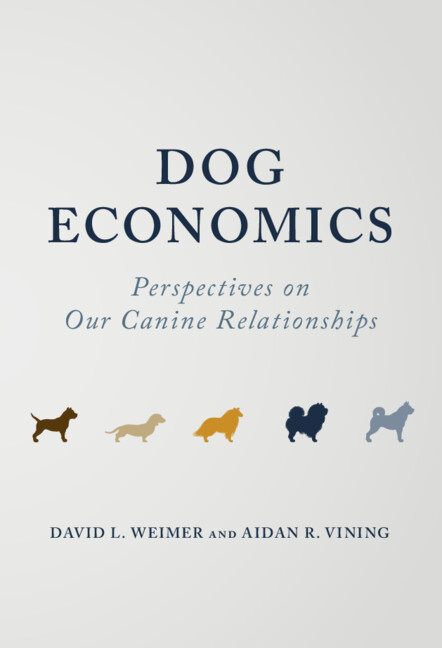
    Archaeologists, anthropologists, and evolutionary biologists study the origins of our relationship with dogs and how it has evolved over time. Sociologists and legal scholars study the roles of dogs in the modern family. Veterinarian researchers address the relationship in the context of professional practice, yet economists have produced scant scholarship on the relationship between humans and dogs. Dog Economics applies economic concepts to relationships between people and dogs to inform our understanding of their domestication. It interprets their contemporary role as both property and family members and explores factors that affect the demand for dogs as well as market failures of the American puppy market. Offering economic perspectives on our varied relationships with dogs, this book assesses mortality risks and addresses end-of-life issues that commonly arise. It develops a framework for classifying canine occupations, considers the impact of pet insurance on euthanasia, and assesses the social value of guide dogs.

    Reviews

    ‘An engaging book that innovatively applies economics to understanding human interactions with dogs. In a time when bridging species boundaries is critical for a deep appreciation of contemporary life, Dog Economics offers thought-provoking insights into government and business connections to animal policy issues, from canine healthcare to working dogs.’

    Jerry Mitchell - Professor of Public Policy, Baruch College, The City University of New York

    ‘Weimer and Vining illustrate the rich insights that economic theory can provide about our relationships with dogs. This approach does not lead them to promote an inhumane perspective that reduces dogs to expendable commodities. Instead, they illustrate how the application of economic theory can improve the lives of both humans and dogs, by helping us appreciate what dogs bring to the table and helping us design policies that could promote their wellbeing.’

    Stéphane Lavertu - Professor of Public Policy, John Glenn College of Public Affairs, The Ohio State University

    ‘Dog Economics provides a long overdue examination of the economics surrounding pet ownership. Weimer and Vining present what is by far the most comprehensive and insightful analysis into the economic aspects of every decision impacting the lives and well-being of dogs. Pet owners will appreciate the accessibility with which the book provides valuable insights that are of practical relevance.’

    W. Kip Viscusi - University Distinguished Professor of Law, Economics, and Management, Vanderbilt University

    Refine List

    Actions for selected content:

    Select all | Deselect all
    • View selected items
    • Export citations
    • Download PDF (zip)
    • Save to Kindle
    • Save to Dropbox
    • Save to Google Drive

    Save Search

    You can save your searches here and later view and run them again in "My saved searches".

    Please provide a title, maximum of 40 characters.
    ×

    Contents

    Metrics

    Altmetric attention score

    Full text views

    Total number of HTML views: 0
    Total number of PDF views: 0 *
    Loading metrics...

    Book summary page views

    Total views: 0 *
    Loading metrics...

    * Views captured on Cambridge Core between #date#. This data will be updated every 24 hours.

    Usage data cannot currently be displayed.

    Accessibility standard: Unknown

    Why this information is here

    This section outlines the accessibility features of this content - including support for screen readers, full keyboard navigation and high-contrast display options. This may not be relevant for you.

    Accessibility Information

    Accessibility compliance for the HTML of this book is currently unknown and may be updated in the future.
