
Skip to main content Accessibility help
×
  • Cited by 11
    • Show more authors
    • You may already have access via personal or institutional login
    • Select format
    • Publisher:
      Cambridge University Press
      Publication date:
      08 September 2022
      15 September 2022
      ISBN:
      9781009127882
      9781009123389
      9781009125697
      Dimensions:
      (229 x 152 mm)
      Weight & Pages:
      0.58kg, 298 Pages
      Dimensions:
      (229 x 152 mm)
      Weight & Pages:
      0.434kg, 298 Pages
    You may already have access via personal or institutional login
  • Selected: Digital
    Add to cart View cart Buy from Cambridge.org

    Book description

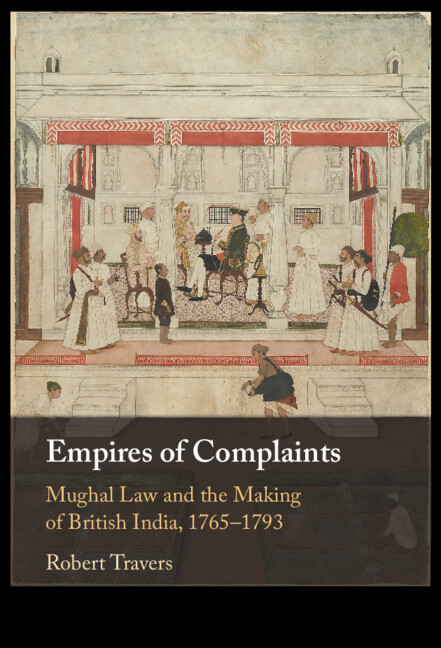
    In this deeply researched and revealing account, Robert Travers offers a new view of the transition from Mughal to British rule in India. By focusing on processes of petitioning and judicial inquiry, Travers argues that the East India Company consolidated its territorial power in the conquered province of Bengal by co-opting and transforming late Mughal, Persianate practices of administering justice to petitioning subjects. Recasting the origins of the pivotal 'Permanent Settlement' of the Bengal revenues in 1793, Travers explores the gradual production of a new system of colonial taxation and civil law through the selective adaptation and reworking of Mughal norms and precedents. Drawing on English and Persian sources, Empires of Complaints reimagines the origins of British India by foregrounding the late Mughal context for colonial state-formation, and the ways that British rulers reinterpreted and reconstituted Persianate forms of statecraft to suit their new empire.

    Awards

    Honorable Mention, 2023 J. Willard Hurst Book Prize, Law & Society Assocation

    Reviews

    ‘A remarkable book that frames the history of the colonial state in the Persianate Mughal world. Travers has done a great service to eighteenth-century history in his subtle invocation of the Mughal political practice of petitioning to understand the wheels of law and justice in early colonial India. A brilliant non-Euro-centric gaze on the making of colonial India.'

    Seema Alavi - Delhi University

    ‘Deeply researched and carefully argued, this masterful study tracks the influence of Mughal legal practices and Indian petitioners on the emerging colonial state. A must read for anyone interested in the history of property and credit, legal writing, and British imperial policies in South Asia.'

    Lauren Benton - Yale University

    ‘This is a path-breaking piece of scholarship that offers a rare bridge between the pre-colonial and the colonial in South Asian history. Using a wealth of Persian materials in addition to better-known colonial sources, the book reconceives East India Company rule in late eighteenth-century Bengal as a Persianate empire, showing how Mughal governance practices, laws and ideologies continued to be adopted and repurposed by the incoming colonial regime.'

    Nandini Chatterjee - University of Exeter

    ‘… an enriching and essential read for all scholars interested in South Asian legal history but also more broadly in the history of modern South Asia.’

    Priyasha Saksena Source: Rechtsgeschichte - Legal History

    Refine List

    Actions for selected content:

    Select all | Deselect all
    • View selected items
    • Export citations
    • Download PDF (zip)
    • Save to Kindle
    • Save to Dropbox
    • Save to Google Drive

    Save Search

    You can save your searches here and later view and run them again in "My saved searches".

    Please provide a title, maximum of 40 characters.
    ×

    Contents

    Metrics

    Altmetric attention score

    Full text views

    Total number of HTML views: 0
    Total number of PDF views: 0 *
    Loading metrics...

    Book summary page views

    Total views: 0 *
    Loading metrics...

    * Views captured on Cambridge Core between #date#. This data will be updated every 24 hours.

    Usage data cannot currently be displayed.

    Accessibility standard: Unknown

    Why this information is here

    This section outlines the accessibility features of this content - including support for screen readers, full keyboard navigation and high-contrast display options. This may not be relevant for you.

    Accessibility Information

    Accessibility compliance for the HTML of this book is currently unknown and may be updated in the future.
