Equilibrium and Rationality

-
Select format
-
- Publisher:
- Cambridge University Press
- Publication date:
- 18 March 2010
- 28 January 1998
- ISBN:
- 9780511663727
- 9780521593526
- 9780521038027
- Dimensions:
- (228 x 152 mm)
- Weight & Pages:
- 0.5kg, 250 Pages
- Dimensions:
- (228 x 152 mm)
- Weight & Pages:
- 0.387kg, 252 Pages
You may already have access via personal or institutional login
Show more authors 
You may already have access via personal or institutional login
Book description
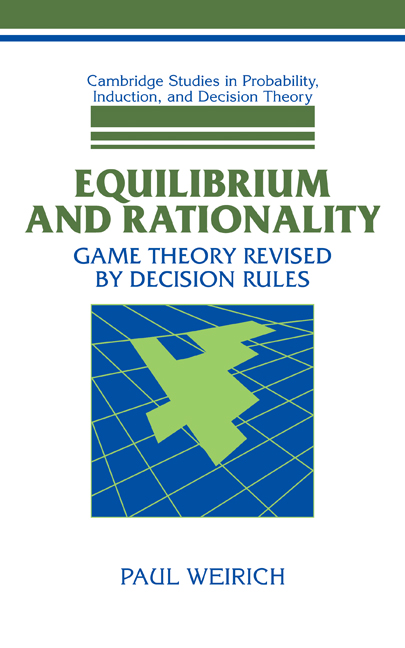
This book represents a major contribution to game theory. It offers this conception of equilibrium in games: strategic equilibrium. This conception arises from a study of expected utility decision principles, which must be revised to take account of the evidence a choice provides concerning its outcome. The argument for these principles distinguishes reasons for action from incentives, and draws on contemporary analyses of counterfactual conditionals. The book also includes a procedure for identifying strategic equilibria in ideal normal-form games. In synthesizing decision theory and game theory in a powerful way this book will be of particular interest to all philosophers concerned with decision theory and game theory as well as economists and other social scientists.
Reviews
‘All in all the book is a true tour de force; it is one of the deepest and best-argued game-theoretical treatises I have ever read.’
Wlodek Rabinowicz - University of Uppsala
Contents
Contents
Metrics
Full text views
Full text views helpTotal number of HTML views: 0
Total number of PDF views: 0 *
 Loading metrics...
* Views captured on Cambridge Core between #date#. This data will be updated every 24 hours.
Usage data cannot currently be displayed.
Accessibility standard: Unknown
Why this information is here
This section outlines the accessibility features of this content - including support for screen readers, full keyboard navigation and high-contrast display options. This may not be relevant for you.
Accessibility Information
Accessibility compliance for the PDF of this book is currently unknown and may be updated in the future.