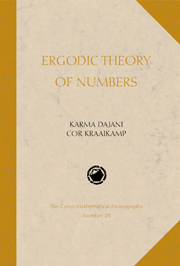
Ergodic Theory of Numbers

-
The digital format of this book is no longer available to purchase from Cambridge Core. Other formats may be available.
-
Select format
-
- Publisher:
- Mathematical Association of America
- Publication date:
- 05 June 2014
- 01 June 2002
- ISBN:
- 9781614440277
- 9780883850343
- Dimensions:
- Weight & Pages:
- 00kg,
- Dimensions:
- Weight & Pages:
- Subjects:
- Mathematics, Number Theory
- Series:
- Carus Mathematical Monographs
You may already have access via personal or institutional login- Subjects:
- Mathematics, Number Theory
- Series:
- Carus Mathematical Monographs
Show more authors 
You may already have access via personal or institutional login
Book description
Ergodic Theory of Numbers is an introduction to the ergodic theory behind common number expansion, like decimal expansions, continued fractions, and many others. However, its aim does not stop there. For undergraduate students with sufficient background knowledge in real analysis and graduate students interested in the area, it is also an introduction to a "dynamical way of thinking." The questions studied here are dynamical as well as number theoretical in nature, and the answers are obtained with the help of ergodic theory. Attention is focused on concepts like measure-preserving, ergodicity, natural extension, induced transformations, and entropy. These concepts are then applied to familiar expansions to obtain old and new results in an elegant and straightforward manner. What it means to be ergodic and the basic ideas behind ergodic theory will be explained along the way. The subjects covered vary from classical to recent, which makes this book appealing to researchers as well as students.
Contents
Contents
Metrics
Altmetric attention score
Full text views
Full text views helpTotal number of HTML views: 0
Total number of PDF views: 0 *
 Loading metrics...
* Views captured on Cambridge Core between #date#. This data will be updated every 24 hours.
Usage data cannot currently be displayed.
Accessibility standard: Unknown
Why this information is here
This section outlines the accessibility features of this content - including support for screen readers, full keyboard navigation and high-contrast display options. This may not be relevant for you.
Accessibility Information
Accessibility compliance for the PDF of this book is currently unknown and may be updated in the future.