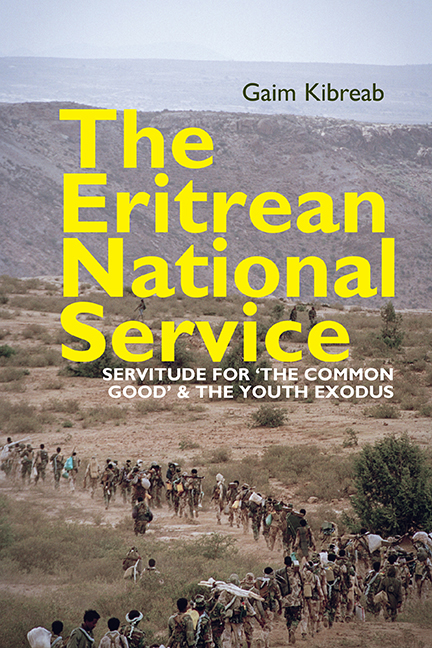
The Eritrean National Service

-
Select format
-
- Publisher:
- Boydell & Brewer
- Publication date:
- 11 August 2017
- 11 August 2017
- ISBN:
- 9781787440203
- Dimensions:
- Weight & Pages:
- Dimensions:
- Weight & Pages:
- Series:
- Eastern Africa Series
- Subjects:
- Law, Human Rights
You may already have access via personal or institutional login- Series:
- Eastern Africa Series
- Subjects:
- Law, Human Rights
Show more authors 
You may already have access via personal or institutional login
Book description
The Eritrean National Service (ENS) lies at the core of the post-independence state, not only supplying its military, but affecting every aspect of the country's economy, its social services, its public sector and its politics. Over half the workforce are forcibly enrolled into it by the government, driving the country's youth to escape national service by seeking employment and asylum elsewhere. Yet how did the ENS, which began during the 1961-91 liberation struggle as part of the idea of the "common good" - in which individual interests were sacrificed in pursuit of the grand scheme of independence and the country's development - degenerate into forced labour and a modern form of slavery? And why, when Eritrea no longer faces existential threat, does the government continue to demand such service from its citizens? This book provides for the first time an in-depth and critical scrutiny of the ENS's achievements and failures and its overarching impact on the social fabric of Eritrea. The author discusses the historical backdrop to the ENS and the rationales underlying it; its goals and objectives; its transformative effects, as well as its impact on the country's defence capability, national unity, national identity construction and nation-building. He also analyses the extent to which the national service functions as an effective mechanism of transmitting the core values of the liberation struggle to the conscripts and through them to the rest of country's population. Finally, the book assesses whether the core aims and objectives of the ENS proclaimed by various governments have been or are in the process of being accomplished and, drawing on the testimony of the hitherto voiceless conscripts themselves, its impact on their lives and livelihoods. GAIM KIBREAB is Professor of Research and Director of Refugee Studies, School of Law and Social Science, London South Bank University. He is the author of Eritrea: A Dream Deferred (James Currey, 2009) and People on the Edge in the Horn (James Currey, 1996).
Contents
Contents
Metrics
Full text views
Full text views helpTotal number of HTML views: 0
Total number of PDF views: 0 *
 Loading metrics...
* Views captured on Cambridge Core between #date#. This data will be updated every 24 hours.
Usage data cannot currently be displayed.
Accessibility standard: Unknown
Why this information is here
This section outlines the accessibility features of this content - including support for screen readers, full keyboard navigation and high-contrast display options. This may not be relevant for you.
Accessibility Information
Accessibility compliance for the PDF of this book is currently unknown and may be updated in the future.