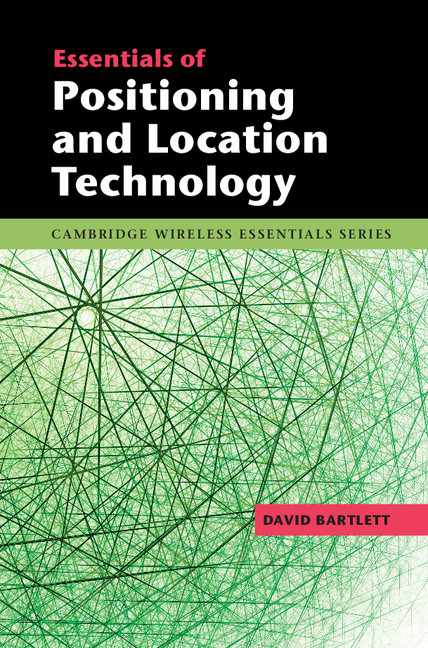
Essentials of Positioning and Location Technology

-
Select format
-
- Publisher:
- Cambridge University Press
- Publication date:
- 05 April 2013
- 18 April 2013
- ISBN:
- 9780511843860
- 9781107006218
- Dimensions:
- (228 x 152 mm)
- Weight & Pages:
- 0.45kg, 212 Pages
- Dimensions:
- Weight & Pages:
You may already have access via personal or institutional login
Show more authors 
You may already have access via personal or institutional login
Book description
Mystified by locating and positioning technologies? Need to get the best from your location system? This guide is invaluable for understanding how the positions and movements of objects can be measured and used for real-world applications. From it, you'll learn how to optimise and manage system performance by working with parameters such as velocity, orientation, time, proximity and direction, and consider not only accuracy, but also reliability, integrity, response time and uncertainty. Packed with practical examples, this concise book gives you an overview of terrestrial radiolocation techniques, including comparative system architectures and real-world performance and limitations. It describes inertial navigation principles and techniques, including low-cost MEMS sensors for consumer products, and a range of applications, such as those benefiting from hybrid positioning techniques.
Contents
Contents
Metrics
Altmetric attention score
Full text views
Full text views helpTotal number of HTML views: 0
Total number of PDF views: 0 *
 Loading metrics...
* Views captured on Cambridge Core between #date#. This data will be updated every 24 hours.
Usage data cannot currently be displayed.
Accessibility standard: Unknown
Why this information is here
This section outlines the accessibility features of this content - including support for screen readers, full keyboard navigation and high-contrast display options. This may not be relevant for you.
Accessibility Information
Accessibility compliance for the PDF of this book is currently unknown and may be updated in the future.