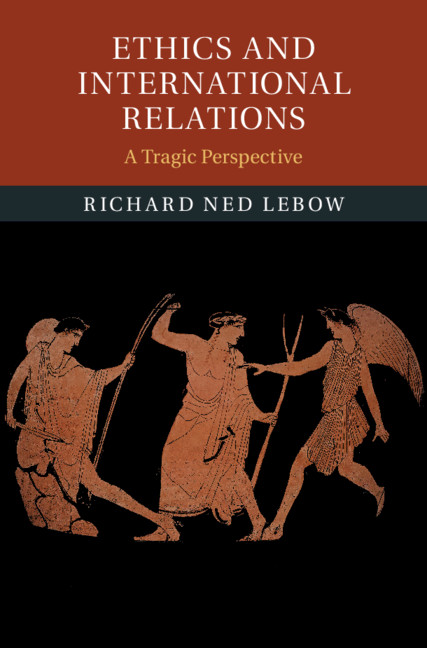
Ethics and International Relations

-
Select format
-
- Publisher:
- Cambridge University Press
- Publication date:
- 10 September 2020
- 01 October 2020
- ISBN:
- 9781108918763
- 9781108843461
- 9781108825160
- Dimensions:
- (229 x 152 mm)
- Weight & Pages:
- 0.46kg, 216 Pages
- Dimensions:
- (229 x 152 mm)
- Weight & Pages:
- 0.31kg, 216 Pages
You may already have access via personal or institutional login
Show more authors 
You may already have access via personal or institutional login
Book description
Lebow demonstrates that foreign policies consistent with generally accepted ethical norms are more likely to succeed, and those at odds with them to fail. Constructing original data sets and analyzing multiple case studies, Lebow makes an empirical case for ethics in international relations. His approach looks to create a productive dialogue between those who ask primarily 'ought' questions and those who pose 'is' questions. The former want to establish appropriate criteria for the behaviour of state and non-state actors and the discourses that lead to their policy decisions, whereas scholars who pose 'is' questions are concerned with how political actors behave and the principles and assumptions that might explain their behaviour. Lebow bridges the gap between 'is' and 'ought' questions by making an instrumental argument in favour of ethical foreign policy. He examines policymaking as well as policy, offering ethical guidelines for policymaking that are likely to result in more successful policies.
Reviews
‘Ethical foreign policy can be good foreign policy, and in this comprehensive and provocative study full of historical and cross-national cases, Lebow shows how tragedy can be the corrective that ensures both.'
Brent J. Steele - Professor, Political Science Department, The University of Utah
'The study of ethics in International Relations is becoming ever more important and central to the discipline. Richard Ned Lebow makes a characteristically insightful and original contribution to this field in Ethics and International Relations: A Tragic Perspective. Building on his earlier work The Tragic Vision of Politics, Lebow broadens the scope of his inquiry by relating his tragic understanding of ethics to contemporary policy making. Lebow encourages the reader to rethink the relationship between politics and ethics, arguing that a tragic ethos serves to guide effective policy making and as a vital means to identify and correct policy that has gone astray.'
Sean Molloy - Reader in International Relations, University of Kent
‘This is an important contribution to international relations studies, with foreign policy decision-making in particular focus … Recommended.’
S. R. Silverburg Source: Choice
Contents
Contents
Metrics
Altmetric attention score
Full text views
Full text views helpTotal number of HTML views: 0
Total number of PDF views: 0 *
 Loading metrics...
* Views captured on Cambridge Core between #date#. This data will be updated every 24 hours.
Usage data cannot currently be displayed.
Accessibility standard: Unknown
Why this information is here
This section outlines the accessibility features of this content - including support for screen readers, full keyboard navigation and high-contrast display options. This may not be relevant for you.
Accessibility Information
Accessibility compliance for the HTML of this book is currently unknown and may be updated in the future.