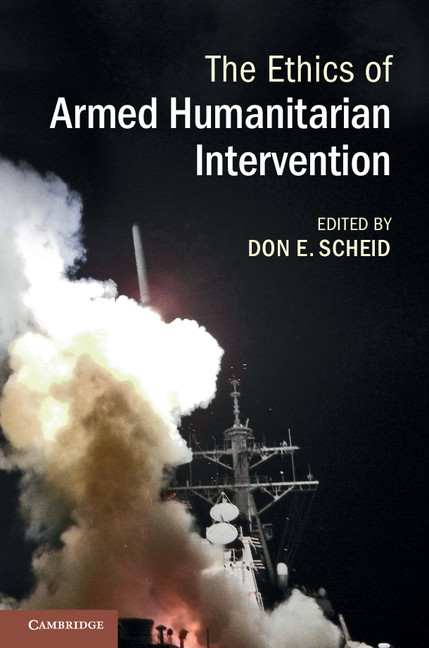
The Ethics of Armed Humanitarian Intervention

-
Select format
-
- Publisher:
- Cambridge University Press
- Publication date:
- 05 June 2014
- 24 April 2014
- ISBN:
- 9781139567589
- 9781107036369
- 9781107610675
- Dimensions:
- (228 x 152 mm)
- Weight & Pages:
- 0.54kg, 294 Pages
- Dimensions:
- (228 x 152 mm)
- Weight & Pages:
- 0.43kg, 294 Pages
You may already have access via personal or institutional login
Show more authors 
You may already have access via personal or institutional login
Book description
The question of military intervention for humanitarian purposes is a major focus for international law, the United Nations, regional organizations such as NATO, and the foreign policies of nations. Against this background, the 2011 bombing in Libya by Western nations has occasioned renewed interest and concern about armed humanitarian intervention (AHI) and the doctrine of Responsibility to Protect (RtoP). This volume brings together new essays by leading international, philosophical, and political thinkers on the moral and legal issues involved in AHI, and contains both critical and positive views of AHI. Topics include the problem of abuse and needed limitations, the future viability of RtoP and some of its problematic implications, the possibility of AHI providing space for peaceful political protest, and how AHI might be integrated with post-war justice. It is an important collection for those studying political philosophy, international relations, and humanitarian law.
Reviews
‘… a useful collection of insightful perspectives and important contributions to AHI debates.’
Amanda Cawston Source: The Philosophical Quarterly
Contents
Contents
References
, The Question of Intervention: Statements by the Secretary-General of the United Nations Kofi Annan (New York: United Nations, Department of Public Information, 1999).
, Two Concepts of Sovereignty, Annual Report to General Assembly, Press Release SG/SM/7136, GA/9596 (September 20, 1999).
, We the Peoples: The Role of the United Nations in the Twenty-first Century, Millennium Report of the Secretary-General, UN document A/54/2000 (March 2000).
, A More Secure World: Our Shared Responsibility, Report of the Secretary-General’s High-level Panel on Threats, Challenges and Change (New York: United Nations, 2004).
, In Larger Freedom: Towards Development, Security and Human Rights for All, Report of the Secretary-General, UN document A/59/2005 (March 21, 2005).
2005 World Summit Outcome, UN General Assembly Resolution, UN document A/60/1 (October 24, 2005).
UN Security Council Resolution 1674, UN document S/Res/1674 (April 28, 2006).
Implementing the Responsibility to Protect, Report of the Secretary-General, UN document A/63/677 (January 12, 2009).
Early Warning, Assessment and the Responsibility to Protect, Report of the Secretary-General, UN document A/64/846 (July 14, 2010).
UN Security Council Resolution 1970, UN document S/Res/1970 (February 26, 2011).
UN Security Council Resolution 1973, UN document S/Res/1973 (March 17, 2011).
, The Battle for Libya: Killing, Disappearances and Torture (London: Amnesty International Ltd., September 13, 2011).
and , The Libyan Revolution: Roots of the Rebellion, Parts I, II, and III (Washington, DC: Institute for the Study of War, September 2011).
, , and , The Libyan Revolution: The Tide Turns, Part IV (Washington, DC: Institute for the Study of War, November 2011).
and (co-chairs), The Responsibility to Protect, Report of the International Commission on Intervention and State Sovereignty (Ottawa: International Development Research Centre, December 2001).
The US Army Stability Operations Field Manual: US Army Field Manual No. 3–07 (US Government: US Army, 2008).
US Special Inspector General, Hard Lessons: The Iraq Reconstruction Experience (Washington, DC: US Independent Agencies and Commissions, 2009).
, Intervention to Stop Genocide and Mass Atrocities, Council Special Report No. 49 (New York: Council on Foreign Relations, October 2009).
, The Evolution of the Doctrine and Practice of Humanitarian Intervention (The Hague: Kluwer Law International, 1999).
, Somalia Operations: Lessons Learned (Washington, DC: National Defense University Press, 1995).
and , A Liberal Theory of International Justice (Oxford University Press, 2009).
, Imperialism, Sovereignty and the Making of International Law (Cambridge University Press, 2005).
, The Question of Intervention: Statements by the Secretary-General (United Nations, 1999).
(with ), Interventions: A Life in War and Peace (New York: Penguin Press, 2012).
, Eyewitness to a Genocide: The UN and Rwanda (Ithaca, New York: Cornell University Press, 2003).
, Global Politics and the Responsibility to Protect: From Words to Deeds (London and New York: Routledge, 2011).
, A Responsibility to Protect (London: Polity Press, 2009).
, A Journey: My Political Life (New York: Knopf, 2010).
, M.J. Tooley (trans.), Six Books of the Commonwealth (1576) (Oxford: Basil Blackwell, 1967), Book I, Chapter 8. Available at:
, American Foreign Policy and Post-War Reconstruction: Comparing Japan and Iraq (London and New York: Routledge, 2012).
, International Law and the Use of Force by States (Oxford: Clarendon Press, 1974).
, Principles of Public International Law, 6th edn. (Oxford University Press, 2003).
, Human Rights, Legitimacy, & the Use of Force (Oxford University Press, 2010).
, Justice Beyond Borders: A Global Political Theory (Oxford University Press, 2005).
, Occupation: The Politics and Practices of Military Conquers (London: Routledge, 1992).
, International Criminal Law, 2nd edn. (Oxford University Press, 2008).
and (eds.), Ethics and Foreign Intervention (Cambridge University Press, 2003).
, Just War or Just Peace? Humanitarian Intervention and International Law (Oxford University Press, 2001).
and , Why Not Kill Them All? The Logic and Prevention of Political Mass Murder (Princeton University Press, 2006).
, Waging Modern War: Bosnia, Kosovo, and the Future of Combat (New York: Public Affairs Press, 2001).
and , Learning from Somalia: The Lessons of Armed Humanitarian Intervention (Lexington, Massachusetts: Westview Press, 1997).
and , Shake Hands with the Devil: The Failure of Humanity in Rwanda (New York: Carroll & Graf Publishers/Random House, 2004)
, The Ethics of Armed Humanitarian Intervention, no. 45 (Washington, DC: United States Institute of Peace, 2002).
, Thucydides (Princeton University Press, 1984).
, The Moral Warrior: Ethics and Service in the US Military (Albany, New York: State University of New York Press, 2004).
, Shake Hands with the Devil: The Failure of Humanity in Rwanda (New York: Carroll & Graf Publishers/Random House, 2004).
(ed.), Enforcing Restraint: Collective Intervention in Internal Conflicts (New York: Council on Foreign Relations Press, 1993).
, , , and , International Law (St. Paul: West Group, 2001).
and (eds.), The Iraqi Aggression Against Kuwait: Strategic Lessons and Implications for Europe (Boulder, Colo.: Westview Press, 1996).
, The Death and Life of Germany: An Account of the American Occupation (St. Louis: University of Missouri Press, 1999).
, War, Aggression, and Self-Defense, 4th edn. (Cambridge University Press, 2005).
and (eds.), The United Nations’ Role in Nation-Building (Washington, DC: RAND, 2007).
and Lal, Rollie, America’s Role in Nation-Building: From Germany to Iraq (Washington, DC: RAND, 2003).
, Insurrection and Interventions: The Two Faces of Sovereignty (Cambridge University Press, 2012).
, Baker, Jean Harvey, and Hold, Michael F., Civil War and Reconstruction (New York: W.W. Norton, 2000).
, Targeting Civilians in War (Ithaca, New York: Cornell University Press, 2008).
, Liberal Peace: Selected Essays (London and New York: Routledge, 2012).
, Striking First: Preemption and Prevention in International Conflict, edited with commentaries by (Princeton University Press, 2008).
, Ways of War and Peace (New York and London: W.W. Norton, 1997).
, Atrocity, Punishment and International Law (Cambridge University Press, 2007).
, Closing the Books: Transitional Justice in Historical Perspective (New York: Cambridge University Press, 2004).
, The Responsibility to Protect: Ending Mass Atrocity Crimes Once and For All (Washington, DC: Brookings Institution Press, 2008).
and , Defending Humanity: When Force is Justified and Why (Oxford and New York: Oxford University Press, 2008).
, The Ethics of War and Peace: An Introduction (London and New York: Routledge, 2011).
, Doing Good and Doing Well: An Examination of Humanitarian Intervention (Westport, Conn.: Praeger, 1999).
and (eds.), Philosophical Dimensions of Public Policy, Policy Studies Review Annual, Vol. 13 (Piscataway, NJ: Transaction Publishers, 2002).
, Responsibility to Protect: A Legal and Human Rights Based Perspective (Oslo: NUPI, 2008).
, Moral Dilemmas of Modern War: Torture, Assassination, and Blackmail in an Age of Asymmetric Conflict (Cambridge University Press, 2010).
, The Rights of War and Peace, 3 vols., edited by (Indianapolis: Liberty Fund, 2005).
, , and , The Federalist Papers, edited by (New York: Penguin Group, 1961).
, Sandstorm: Libya in the Time of Revolution (New York: Penguin Press, 2012).
, Democracy by Force: US Military Intervention in the Post-Cold War World (Cambridge University Press, 2000).
, , , and , Criminal Deterrence and Sentence Severity: An Analysis of Recent Research (Oxford: Hart Publishing, 1999).
, Leviathan, edited by (Cambridge University Press, 1991).
, The Ethics and Politics of Humanitarian Intervention (South Bend, Ind.: Notre Dame University Press, 1996).
, Virtual War: Kosovo and Beyond (New York: Metropolitan Books, 2000).
, Morality and Contemporary Warfare (New Haven: Yale University Press, 1999).
, The Power of Deliberation (Oxford University Press, 2011).
, Genocide: A Comprehensive Introduction (London and New York: Routledge, 2010).
, Groundwork for the Metaphysics of Morals (1785), translated by (New York: Macmillan, 1990).
, The Metaphysics of Morals (1797), translated by (Cambridge University Press, 1991).
, Perpetual Peace and Other Essays, translated by (Indianapolis and Cambridge: Hackett Publishing, 1983).
and (eds.), The Routledge Handbook of the Responsibility to Protect (New York: Routledge, 2012).
and (eds.), From Desolation to Reconstruction: Iraq’s Troubled Journey (Waterloo, Ontario: CIGI, 2010).
and , A Choice for Peace? The Story of the Forty-One Days of Mediation in Kenya (New York: International Peace Institute, 2009).
, The Transformation of Political Community (Cambridge: Polity Press, 1998).
Jr., Perspectives on Humanitarian Military Intervention (Berkeley Public Policy Press, 2001).
Jr. and (eds.), Case Studies in Military Ethics, 3rd edn. (Boston: Pearson/Longman, 2010).
, UN Security Council: Practice and Promise (New York and London: Routledge, 2006).
, Judgment at Tokyo: The Japanese War Crimes Trials (Lexington, Kentucky: University Press of Kentucky, 2001).
, Saviors and Survivors: Darfur, Politics and the War on Terror (New York: Pantheon, 2009).
, After War Ends: A Philosophical Perspective (Cambridge University Press, 2012).
and (eds.), Morality, Jus Post Bellum, and International Law (Cambridge University Press, 2012).
, Battle Cry of Freedom: The Civil War Era (Oxford University Press, 2003).
, The Marshall Plan (New York: HarperCollins, 1987).
, A People Betrayed: The Role of the West in Rwanda’s Genocide (New York: Zed Books, 2000).
, Cosmopolitan Justice (Boulder: Westview Press, 2002).
and , The Battle for the Arab Spring: Revolution, Counter-Revolution and the Making of a New Era (New Haven and London: Yale University Press, 2012).
, Human Rights: Concept and Context (Peterborough, Ontario: Broadview Press, 2002).
, Introduction to International Studies (Oxford University Press, 2012).
, The Morality of War (Peterborough, Ontario: Broadview Press, 2006).
, War and International Justice: A Kantian Perspective (Waterloo, Ontario: Wilfrid Laurier University Press, 2000).
, Humanitarian Intervention and the Responsibility to Protect: Who Should Intervene? (Oxford University Press, 2010).
, Nuremburg: Infamy on Trial (New York: Penguin, 1995).
, World Poverty and Human Rights, 2nd edn. (Cambridge: Polity Press, 2008).
, Rwanda: History of a Genocide (New York: Columbia University Press, 1995).
, The Just War: Force and Political Responsibility (Lanham, Md.: Rowman & Littlefield, 2002).
, The Law of Peoples (Cambridge, Massachusetts: Harvard University Press, 1999).
, Slaughterhouse: Bosnia and the Failure of the West (New York: Touchstone, 1995).
and (eds.), Documentation on the Laws of War, 3rd edn. (Oxford University Press, 2000).
, War and Self-Defense (Oxford: Clarendon Press, 2002).
, An Introduction to the International Criminal Court (Cambridge University Press, 2001).
, Aftermath of War: Americans and the Remaking of Japan, 1945–1952 (Kent, Ohio: Kent State University Press, 1989).
, Fighting to the Finish: The Politics of War Termination in America and Japan (Ithaca, New York: Cornell University Press, 1989).
, International Law, 5th edn. (Cambridge University Press, 2003).
, Basic Rights: Subsistence, Affluence and US Foreign Policy, 2nd edn. (Princeton University Press, 1996).
, The Elements of Politics (New York: Macmillan, 1908).
, The Scourging of Iraq: Sanctions, Law and Natural Justice, 2nd edn. (London and New York: Macmillan/St. Martins, 1998).
, Wired for War: The Robotics Revolution and Conflict in the Twenty-first Century (New York: Penguin Press, 2009).
, One World: The Ethics of Globalization, 2nd edn. (New Haven and London: Yale University Press, 2004).
, , and , Army Professionalism, Military Ethics, and Officership in the 21st Century (Carlisle, Pennsylvania: Army War College Strategic Studies Institute, 1999).
, The Law of Armed Conflict: International Humanitarian Law in War (Cambridge University Press, 2010).
, The Ends of Harm: The Moral Foundations of Criminal Law (Oxford University Press, 2011).
, Transitional Justice (Oxford University Press, 2002).
, Humanitarian Intervention: An Inquiry into Law and Morality, 3rd edn. (New York: Transnational Publishers, 2005).
, A Philosophy of International Law (Boulder, Colorado: Westview Press, 1998).
, Hope and Memory: Lessons from the Twentieth Century, translated by (Princeton University Press, 2003).
, Statebuilding and Justice Reform: Post-Conflict Reconstruction in Afghanistan (London and New York: Routledge, 2010).
, Final Solutions: Mass Killing and Genocide in the Twentieth Century (Ithaca, New York: Cornell University Press, 2004).
, Three Ways of Thought in Ancient China (London: George Allen & Unwin, 1939).
, Arguing about War (New Haven and London: Yale University Press, 2004).
, Just and Unjust Wars: A Moral Argument with Historical Illustrations (New York: Basic Books, 1977).
, Spheres of Justice: A Defense of Pluralism and Equality (Oxford: Basil Blackwood, 1983).
, Thick and Thin: Moral Argument at Home and Abroad (New Haven: Yale University Press, 1994).
, The Invisible Constitution of World Politics (Cambridge University Press, 2008).
, Humanitarian Intervention (Cambridge: Polity Press, 2007).
, At Home in the World: Canada’s Global Vision for the 21st Century (New York: HarperCollins, 2004).
(ed.), Humanitarian Intervention and International Relations (Oxford University Press, 2003).
, Saving Strangers: Humanitarian Intervention in International Society (Oxford University Press, 2000).
, Plan of Attack (New York: Simon & Schuster, 2004).
, A Vulcan’s Tale: How the Bush Administration Mismanaged the Reconstruction of Afghanistan (Washington, DC: Brookings Institute, 2011).
, , Kimaro, Sadikiel, Lyons, Terrence, and Rothchild, Donald, Sovereignty as Responsibility: Conflict Management in Africa (Washington, DC: The Brookings Institution, 1996).
, “Two Concepts of Sovereignty,” The Economist (September 16, 1999).
, “Forcing a People to be Free,” Philosophy & Public Affairs 35, no. 4 (2007), 359–400.
and , “The Principled Case for Employing Private Military and Security Companies in Interventions for Human Rights Purposes,” Journal of Applied Philosophy 29 (2012), 1–18.
, “Building a Republican Peace: Stabilizing States After War,” International Security 30, no. 4 (2006), 87–112.
, “Jus Post Bellum,” Philosophy & Public Affairs 32, no. 4 (fall 2004), 384–412.
, “International Law and the War with Iraq,” Melbourne Journal of International Law 4, no. 2 (2003), 497–521.
, “Kosovo and the Advent of Sovereignty as Responsibility,” Journal of Intervention and Statebuilding 3, no. 2 (2009), 163–84.
, “Libya and the Responsibility to Protect: The Exception and the Norm,” Ethics & International Affairs 25, no. 3 (Fall 2011), 263–69.
, “Motives, Outcomes, Intent and the Legitimacy of Humanitarian Intervention,” Journal of Military Ethics 3, no. 3 (2004), 216–32.
, “The Responsibility to Protect – Five Years On,” Ethics & International Affairs 24, no. 2 (2010), 143–69.
, “The Responsibility to Protect and the Problem of Military Intervention,” International Affairs 84, no. 4 (2008), 625–30.
, “Responsibility to Protect or Trojan Horse? The Crisis in Darfur and Humanitarian Intervention after Iraq,” Ethics & International Affairs 19, no. 2 (2005), 31–54.
and , “The New Politics of Protection? Côte d’Ivoire, Libya, and the Responsibility to Protect,” International Affairs 87, no. 4 (2011), 825–50.
, “Collateral Benefit,” Social Philosophy & Policy 23 (2006), 218–30.
, “Reciprocity, Stability and Intervention: The Ethics of Disequilibrium,” in and (eds.), Ethics and Foreign Intervention (Cambridge University Press, 2003), 53–71.
, “The Internal Legitimacy of Humanitarian Intervention,” Journal of Political Philosophy 7, no. 1 (1999), 71–87.
, “Justice and Charity,” Ethics 97, no. 3 (1987), 558–75.
and , “The Preventive Use of Force: A Cosmopolitan Institutional Proposal,” Ethics & International Affairs 18, no. 1 (2004), 1–22.
, “Human Rights and the Rights of States: Terry Nardin on Non-Intervention,” International Political Science Review 18, no. 1 (1997), 27–37.
, “Immaculate War: Constraints on Humanitarian Intervention,” Ethics & International Affairs 14 (2000), 55–65.
, “The Idea of a Legitimate State,” Philosophy & Public Affairs 28, no. 1 (Winter 1999), 3–45.
and , “NATO’s Victory in Libya: The Right Way to Run An Intervention,” Foreign Affairs 91, no. 2 (2012), 2–7.
, “International Rescue and Mediated Consequences,” Ethics & International Affairs 26, no. 3 (Fall 2012), 335–53.
, “A Few Words on Mill, Walzer and Nonintervention,” Ethics & International Affairs 23, no. 4 (Winter 2009), 349–69.
, “Human Rights, Command Responsibility and Walzer’s Just War Theory,” Philosophy & Public Affairs 11, no. 4 (Fall 1982), 354–71.
and , “The Responsibility to Protect,” Foreign Affairs 81, no. 6 (November/December 2002), 99–110.
, “Selectivity, Imperfect Obligations and the Character of Humanitarian Morality,” in and (eds.), Human Rights and Military Intervention (Aldershot: Ashgate, 2002), 132–49.
, “Mandatory Rescue Killings,” Journal of Political Philosophy 15, no. 4 (2007), 363–84.
, “Humanitarian Intervention: A Forum,” The Nation (July 14, 2003).
, “The Ethics of Intervention in Self-Determination Struggles,” in and (eds.), Ethics and Foreign Intervention (Cambridge University Press, 2003), 143–67.
, “Constructing Norms of Humanitarian Intervention,” in (ed.), The Culture of National Security: Norms and Identity in World Politics (New York: Columbia University Press, 1996), 153–85.
and , “International Norm Dynamics and Political Change,” International Organization 52, no. 4 (1998), 887–917.
, “The Evolution of International Norms,” International Studies Quarterly 40, no. 3 (1996), 363–89.
, “Kant, International Law, and the Problem of Humanitarian Intervention,” Journal of International Political Theory 6, no. 1 (2010), 1–22.
, “The Doctrine of Double Effect,” in and (eds.), A Companion to Applied Ethics (Oxford: Blackwell, 2003), 464–74.
and , “The Imperative to Rebuild: Assessing the Normative Case for Postconflict Reconstruction,” Ethics & International Affairs 23, no. 2 (Summer 2009), 121–46.
, “Syria and the Responsibility to Protect,” Global Responsibility to Protect 4, no. 4 (2012).
, “Marx on Internationalism and War,” Philosophy & Public Affairs 7, no. 4 (1978), 346–69.
, “The Antecedents of ‘Sovereignty as Responsibility’,” European Journal of International Relations 17, no. 2 (2011), 233–55.
, “Responses: A Summing Up,” in , L, and (eds), Ethics and Humanity: Themes from the Philosophy of Jonathan Glover (Oxford University Press, 2010), 37–281.
, “Humanitarian Intervention and Pretexts for War,” American Journal of International Law 100 (2006), 107–41.
, “The Justice of Intervention,” Review of International Studies 13 (1987), 133–46.
, “R2P: Sovereignty and Intervention After Libya,” World Politics Review (June 28, 2011).
, “R2P and Natural Disasters,” in and (eds.), The Routledge Handbook of the Responsibility to Protect (New York: Routledge, 2012), 141–51.
, “The Humanitarian Intervention Debate,” in and (eds.), Humanitarian Intervention: Ethical, Legal, and Political Dimensions (Cambridge University Press, 2003), 15–52.
and , “The Responsibility to Protect as International Crimes Prevention,” Global Responsibility to Protect 4 (2012), 33–66.
, “New Contingencies, Old Roles,” Joint Forces Quarterly 2 (Autumn 1993), 38–43.
, “The Paradox of Riskless Warfare,” Philosophy & Public Policy Quarterly, 22, no. 3 (2002), 2–8.
, “Is Armed Humanitarian Intervention to Stop Mass Killing Morally Obligatory?” Public Affairs Quarterly (July 2001), 173–92.
, “Kelsen’s Pure Science of Law,” in (ed.), International Law: Being the Collected Papers of Hersch Lauterpacht (Cambridge University Press, 1975), 404–36.
, “On a Samaritan Duty of Humanitarian Intervention,” in and (eds.), New Wars and New Soldiers: Ethical Challenges in the Modern Military (Farnham: Ashgate, 2011), 87–101.
, , and , “Warriors as Peacekeepers: Features of the Somalia Experience and PTSD,” Journal of Consulting and Clinical Psychology 65, no. 6 (1997), 1001–10.
, “Intervention and Civilization: Some Unhappy Lessons of the Kosovo War,” in and (eds.), Global Justice and Transnational Politics: Essays on the Moral and Political Challenges of Globalization (Cambridge, Massachusetts: MIT Press, 2002), 79–115.
, “Just War and Human Rights,” Philosophy & Public Affairs 9, no. 2 (Winter 1980), 160–81.
and , “Mental Torture: A Critique of Erasures in US Law,” The Georgetown Law Journal 100 (2012), 823.
Jr., “Agency After Virtue: A Defense of Kantian Constructivism,” International Philosophical Quarterly 28, no. 3 (September 1988), 293–311.
“From Jus ad Bellum to Jus ad Pacem: Re-Thinking Just-War Criteria for the Use of Military Force for Humanitarian Ends,” in and (eds.), Ethics and Foreign Intervention (Cambridge University Press, 2003), 72–96.
“Moral Order and the Constraints of Agency: Toward a New Metaphysics of Morals,” in (ed.), New Essays in Metaphysics (Albany, New York: State University of New York Press, 1987), 117–39.
, “The Principle of Just Cause,” in (ed.), War: Essays in Political Philosophy (Cambridge University Press, 2008), 49–66.
, “What the World Got Wrong in Côte D’Ivoire,” Foreign Policy (April 29, 2011).
, “Humanitarian Intervention, Consent, and Proportionality,” in , , and (eds.), Ethics and Humanity: Themes from the Philosophy of Jonathan Glover (Oxford University Press, 2010), 44–72.
, “The Just Distribution of Harm Between Combatants and Noncombatants,” Philosophy & Public Affairs 38, no. 4 (Fall 2010), 342–79.
, “Pacifism and Moral Theory,” Diametros 23 (2010), 3–20.
, “Punishing Genocidaires: A Deterrent Effect or Not?” Human Rights Review 8, no. 4 (2007), 319–39.
, “A Few Words on Non-Intervention,” Fraser’s Magazine (December 1859). Reprinted in Essays on Politics and Culture by John Stuart Mill, edited by (Garden City, New York: Doubleday Anchor Books, 1963). Available at: .
, “Distributing Responsibilities,” Journal of Political Philosophy 9, no. 4 (2001), 453–71.
, “War Has Almost Ceased to Exist: An Assessment,” Political Science Quarterly 124, no. 2 (2009), 297–321.
, “Agent-Relative Morality,” in (ed.), The Doctrine of Double Effect: Philosophers Debate a Controversial Moral Principle (Notre Dame, Indiana: University of Notre Dame Press, 2001), 41–49.
, “Humanitarian Intervention: The Early Years,” Symposium on the Norms and Ethics of Humanitarian Intervention (University of California–Irvine: Center for Global Peace and Conflict Studies, May 2000).
, “Jus Post Bellum,” Journal of Social Philosophy 32 (2002), 117–37.
, “Justice After War,” Ethics & International Affairs 16, no. 1 (2002), 43–56.
, “High-Fliers: Who Should Bear the Risk of Humanitarian Intervention?” in and (eds.), New Wars and New Soldiers: Ethical Challenges in the Modern Military (Farnham, UK: Ashgate, 2011), 69–86.
, “Rethinking Humanitarian Intervention,” International Political Science Review 18, no. 1 (1997), 49–69.
, “The Ethics of Humanitarian Intervention in Libya,” Ethics & International Affairs 25, no. 3 (Fall 2011), 271–77.
, “Just War Theory and the Privatization of Military Force,” Ethics & International Affairs 22 (2008), 143–62.
, “Outsourcing the Responsibility to Protect: Humanitarian Intervention and Private Military and Security Companies,” International Theory 2 (2010), 1–31.
, “An Institutional Approach to Humanitarian Intervention,” Public Affairs Quarterly 6 (1992), 89–103.
, “The Responsibility to Protect and the Logic of Rights,” in and (eds.), From Rights to Responsibilities: Rethinking Interventions for Humanitarian Purposes, PSIS Special Study 7 (Geneva: Programme for Strategic and International Security Studies, 2006).
, “The Legality of Pro-Democratic Invasion,” American Journal of International Law 78 (1984), 645–50.
, “Atrocity Crimes Framing the Responsibility to Protect,” Case Western Reserve Journal of International Law 40, no. 1 (2008), 111–35.
, “Conditional Sovereignty,” Res Publica 8, no. 1 (1999), 1–7.
, “Eroding Sovereignty: The Advance of Principle,” in and (eds.), The Morality of Nationalism (New York and Oxford: Oxford University Press, 1997), 340–59.
, “‘Let Whatever Is Smoldering Erupt’? Conditional Sovereignty, Reviewable Intervention, and Rwanda 1994,” in , , and (eds.), Between Sovereignty and Global Governance: The State, Civil Society and the United Nations (New York: St. Martin’s, 1998), 60–84.
, “Mediating Duties,” Ethics 98, no. 4 (July 1988), 687–704.
, “Bystanders to Poverty,” in , , and (eds.), Ethics and Humanity: Themes from the Philosophy of Jonathan Glover (Oxford University Press, 2010), 185–201.
, “Humanitarian Intervention: An Overview of the Ethical Issues,” Ethics & International Affairs 12, no. 1 (1998), 63–79.
and , “Trials and Errors: Principle and Pragmatism in Strategies of International Justice,” International Security 28, no. 3 (2003/2004), 5–44.
, “The Duty to Protect,” in and (eds.), NOMOS XLVII: Humanitarian Intervention (New York and London: New York University Press, 2006), 84–116.
, “The Liberal Case for Humanitarian Intervention,” in and (eds.), Humanitarian Intervention: Ethical, Legal and Political Dilemmas (Cambridge University Press, 2003), 93–129.
, “Right to Intervene or Duty to Assist?” in (ed.), Human Rights, Human Wrongs, The Oxford Amnesty Lectures 2001 (Oxford University Press, 2003), 28–48.
, “The True Costs of Humanitarian Intervention,” Foreign Affairs 90, no. 6 (November/December 2011), 60–73.
, “Humanitarian Intervention in the 1990s and Beyond: An International Law Perspective,” in (ed.), World Orders in the Making: Humanitarian Intervention and Beyond (London: Macmillan, 1998), 200.
, “Deterrence, Democracy, and the Pursuit of International Justice During Conflict,” Ethics & International Affairs 24, no. 2 (2010), 191–211.
, “The Asymmetry of Legitimacy,” Law and Philosophy 31 (2012), 565–92.
, “The Case Against Our Attack on Libya,” The New Republic (March 20, 2011).
, “The Moral Standing of States: A Response to Four Critics,” Philosophy & Public Affairs 9, no. 3 (Spring 1980), 209–29.
, “Halting Atrocities in Kenya,” in Great Decisions (New York: Foreign Policy Association, 2010), 17–30.
, “The Sunset of Humanitarian Intervention? The Responsibility to Protect in a Unipolar Era,” Security Dialogue 35, no. 2 (2004), 135–53.
, “Civilian Protection in Libya: Putting Coercion and Controversy Back into RtoP,” Ethics & International Affairs 25, no. 3 (Fall 2011), 255–62.
, “Who Should Act? Collective Responsibility and the Responsibility to Protect,” in and (eds.), The Routledge Handbook of the Responsibility to Protect (New York and Oxford: Routledge, 2012), 103–14.
and , “Humanitarian Intervention Comes of Age: Lessons from Somalia to Libya,” Foreign Affairs 90, no. 6 (November/December 2011), 48–59.
and , “Justifying the Iraq War as a Humanitarian Intervention: The Cure is Worse Than the Disease,” in and (eds.), The Iraq Crisis and World Order: Structural, Institutional and Normative Challenges (Tokyo: UN University Press, 2006), 444–63.
and , “Jus Post Bellum: Just War Theory and the Principles of Just Peace,” International Studies Perspective 7 (2006), 309–20.
, “Performance-Enhancing Technologies and Moral Responsibility in the Military,” The American Journal of Bioethics 8, no. 2 (2008), 28–38.
Metrics
Full text views
Full text views helpTotal number of HTML views: 0
Total number of PDF views: 0 *
 Loading metrics...
* Views captured on Cambridge Core between #date#. This data will be updated every 24 hours.
Usage data cannot currently be displayed.
Accessibility standard: Unknown
Why this information is here
This section outlines the accessibility features of this content - including support for screen readers, full keyboard navigation and high-contrast display options. This may not be relevant for you.
Accessibility Information
Accessibility compliance for the PDF of this book is currently unknown and may be updated in the future.