The Ethics of ESG

-
Select format
-
- Publisher:
- Cambridge University Press
- Publication date:
- 27 December 2025
- 22 January 2026
- ISBN:
- 9781009594912
- 9781009594875
- Dimensions:
- (229 x 152 mm)
- Weight & Pages:
- 0.586kg, 300 Pages
- Dimensions:
- Weight & Pages:
- Subjects:
- Business Ethics, Governance, Management
You may already have access via personal or institutional login- Subjects:
- Business Ethics, Governance, Management
Show more authors 
You may already have access via personal or institutional login
Book description
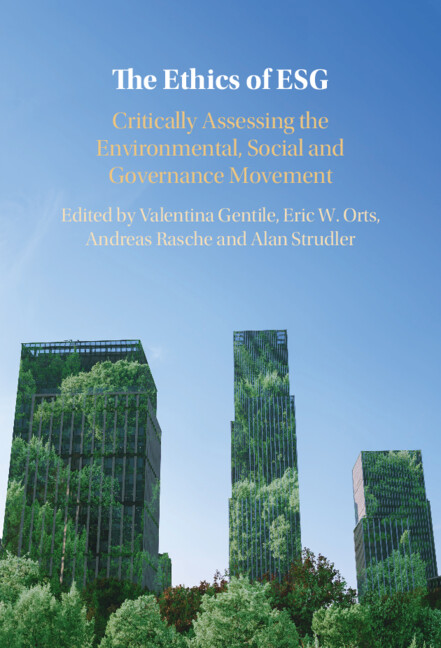
In recent years, new forms of investment have been created to direct funds towards companies performing well according to predefined environmental, social, and governance (ESG) indicators. This volume addresses moral, political, and legal questions about the legitimacy of ESG as a management and investment strategy. Some chapters argue that ESG strategies should focus on creating real-life impacts on morally significant problems, such as climate change, human rights violations, and corporate corruption. Other chapters instead examine the possibility that the long-term feasibility of ESG limits its moral ambitions, requiring ESG to be regarded as only a set of devices for minimizing risk in a way that protects financial gain. The book contributes a much-needed understanding of ethical interpretations of the ESG movement, which are likely to drive future social, political and legal developments.
Reviews
‘In a world where ESG is both celebrated and contested, The Ethics of ESG offers a timely and critical examination of its evolving landscape. Valentina Gentile, Eric W. Orts, Andreas Rasche, and Alan Strudler bring together leading voices in law and business to explore ESG's theoretical roots, ethical dimensions, and practical challenges (with much nuance and insight). This book is essential reading for scholars, policymakers, investors, and business leaders who seek to better understand ESG-one of the most pressing corporate governance issues of our time.'
Dorothy S. Lund - Columbia 1982 Alumna Professor of Law, Columbia Law School, New York
‘Once heralded as key to driving investment and business decisions to be in line with broader environmental and societal goals, the ESG movement is now widely debated – with questions about its content, effectiveness, and ideology. At this critical moment, The Ethics of ESG is a much-needed intervention. This book provides one of the most wide-ranging and sustained analyses of the theoretical and philosophical underpinnings of the practice of ESG. It brings together in one volume the latest thinking of leading scholars from a variety of disciplines, covering critical topics from a variety of perspectives. Those concerned about ESG may not agree with everything they read in this book, but they – and the future of the environment and society – will be better for having engaged with it.'
Nien-he Hsieh - Kim B. Clark Professor of Business Administration, Harvard Business School
‘This book is a welcome breath of fresh air and an honest assessment of ESG, what has become for many a ‘social movement' that should not be questioned. But as we watch the near death of the idea, these timely chapters do just that, examining the misalignment between what ESG has been trying to measure and what it is trying to achieve. These authors provide a fervent hope that we can move to the world ‘beyond ESG' and really get down to the business of addressing both the financial and the ethical dimensions of the climate crisis.'
Andrew J. Hoffman - Holcim (US) Professor of Sustainable Enterprise, Ross School of Business, University of Michigan
‘ESG attracts a lot of attention. Some is positive: hundreds of billions of dollars are invested in ESG funds worldwide. Some is negative: many US states have enacted anti-ESG laws. But we still don't have a good grip on what ESG is, and what it could be. Is it just a way for corporations to protect shareholders' profits from environmental, social, and governance risks? Or is it a new way of doing business that promises to solve pressing social problems, possibly at shareholders' expense? Is ESG here to stay or a passing fad? This volume brings together leading scholars in law, management, and business ethics to explore these questions. It constitutes the state of the art in ESG scholarship, and is required reading for anyone who wants to understand the current debate, or to make a contribution to it.'
Jeffrey Moriarty - Professor and Executive Director Hoffman Center for Business Ethics, Bentley University
Contents
Contents
Metrics
Altmetric attention score
Full text views
Full text views helpTotal number of HTML views: 0
Total number of PDF views: 0 *
 Loading metrics...
* Views captured on Cambridge Core between #date#. This data will be updated every 24 hours.
Usage data cannot currently be displayed.
Accessibility standard: Missing or limited accessibility features
Why this information is here
This section outlines the accessibility features of this content - including support for screen readers, full keyboard navigation and high-contrast display options. This may not be relevant for you.
Accessibility Information
The HTML of this book is known to have missing or limited accessibility features. We may be reviewing its accessibility for future improvement, but final compliance is not yet assured and may be subject to legal exceptions. If you have any questions, please contact accessibility@cambridge.org.
Content Navigation
Table of contents navigation
Allows you to navigate directly to chapters, sections, or non‐text items through a linked table of contents, reducing the need for extensive scrolling.
Index navigation
Provides an interactive index, letting you go straight to where a term or subject appears in the text without manual searching.
Reading Order and Textual Equivalents
Single logical reading order
You will encounter all content (including footnotes, captions, etc.) in a clear, sequential flow, making it easier to follow with assistive tools like screen readers.
Full alternative textual descriptions
You get more than just short alt text: you have comprehensive text equivalents, transcripts, captions, or audio descriptions for substantial non‐text content, which is especially helpful for complex visuals or multimedia.
Visualised data also available as non‐graphical data
You can access graphs or charts in a text or tabular format, so you are not excluded if you cannot process visual displays.
Visual Accessibility
Use of colour is not sole means of conveying information
You will still understand key ideas or prompts without relying solely on colour, which is especially helpful if you have colour vision deficiencies.