The Evolution of Modern States

-
Select format
-
- Publisher:
- Cambridge University Press
- Publication date:
- 05 June 2012
- 19 July 2010
- ISBN:
- 9780511762185
- 9780521196703
- 9780521145466
- Dimensions:
- (234 x 156 mm)
- Weight & Pages:
- 0.54kg, 288 Pages
- Dimensions:
- (234 x 156 mm)
- Weight & Pages:
- 0.41kg, 288 Pages
You may already have access via personal or institutional login
Show more authors 
You may already have access via personal or institutional login
Book description
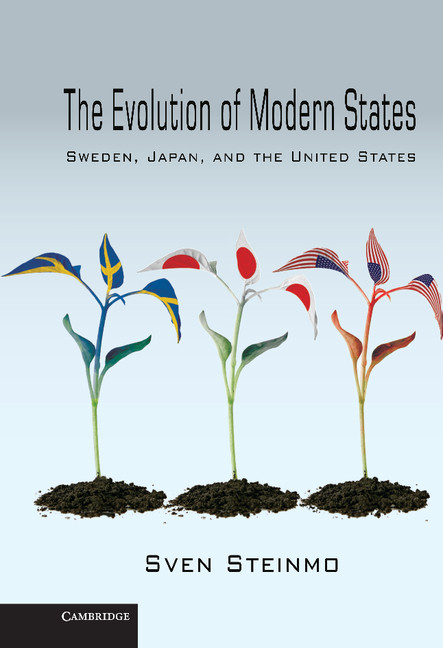
The Evolution of Modern States, first published in 2010, is a significant contribution to the literatures on political economy, globalization, historical institutionalism, and social science methodology. The book begins with a simple question: why do rich capitalist democracies respond so differently to the common pressures they face in the early twenty-first century? Drawing on insights from evolutionary theory, Sven Steinmo challenges the common equilibrium view of politics and economics and argues that modern political economies are best understood as complex adaptive systems. The book examines the political, social, and economic history of three different nations - Sweden, Japan, and the United States - and explains how and why these countries have evolved along such different trajectories over the past century. Bringing together social and economic history, institutionalism, and evolutionary theory, Steinmo thus provides a comprehensive explanation for differing responses to globalization as well as a new way of analyzing institutional and social change.
Reviews
“Taking the evolution of complex adaptive systems as its starting point, Steinmo invites us to rethink what we think we know about the issues of globalization and institutional change. In doing so the continued success of Sweden, the prolonged stagnation of Japan, and the hidden costs of the American model become all become explicable within the same framework of analysis.”
– Mark Blyth, Brown University
“This engaging and powerful book is of vital importance. It explains clearly why the march of globalization has not led to a ‘race to the bottom’ where developed countries are obliged to lower their welfare provision. It is also a pioneering example of the application of evolutionary theory in the social sciences, showing among other things that evolution means neither market liberalism nor ultimate uniformity. Enhanced by illuminating country studies, it encourages an optimism both for the fruitful development of evolutionary ideas and the survival of modern welfare states.”
– Geoffrey M. Hodgson, University of Hertfordshire
“Why have capitalist democracies remained welfare states with distinct tax systems and economic policy profiles, despite the effects of globalization and the subsequent transformation of their political economies? To tackle this puzzle, Sven Steinmo has examined the critical cases of Sweden, Japan, and the United States. His logic of evolutionary narratives illuminates the subtle mixture of divergences and parallels, continuity and change in the varying trajectories experienced by the three nations.”
– Junko Kato, University of Tokyo
“Sven Steinmo has chosen an important and difficult question to answer regarding the diverse evolutionary paths of different modern states. Comparing Sweden, Japan and the US is an ingenious strategy and his findings are very thought provoking and important.”
– Elinor Ostrom, Indiana University
“Steinmo gives us a book that is bold in its conceptualization, challenging in its choice of cases, and rich in comparative insights. It challenges the underpinnings of a predictive and linear political science and demonstrates convincingly that different political systems, like the many species in nature, do not respond to phenomena like universal phenomena such as globlalization by becoming similar; rather they adapt in discreet ways that retain much of their long standing distinctiveness. A product of ‘big think,’ this book will generate serious debates across the field of comparative politics.”
– T.J. Pempel, University of California, Berkeley
Contents
Contents
Metrics
Altmetric attention score
Full text views
Full text views helpTotal number of HTML views: 0
Total number of PDF views: 0 *
 Loading metrics...
* Views captured on Cambridge Core between #date#. This data will be updated every 24 hours.
Usage data cannot currently be displayed.
Accessibility standard: Unknown
Why this information is here
This section outlines the accessibility features of this content - including support for screen readers, full keyboard navigation and high-contrast display options. This may not be relevant for you.
Accessibility Information
Accessibility compliance for the PDF of this book is currently unknown and may be updated in the future.