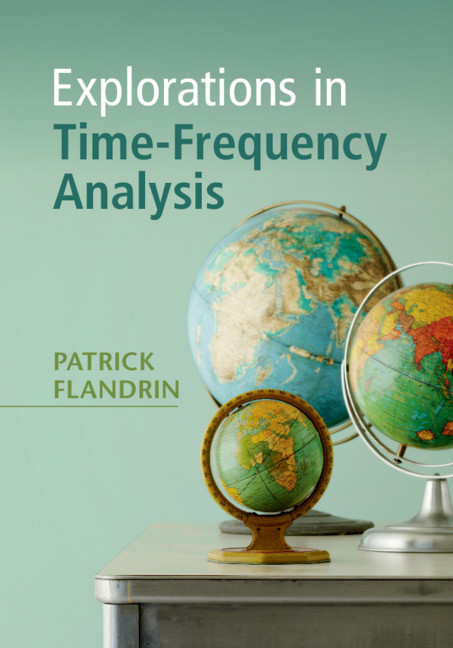
Explorations in Time-Frequency Analysis

-
Select format
-
- Publisher:
- Cambridge University Press
- Publication date:
- 22 August 2018
- 06 September 2018
- ISBN:
- 9781108363181
- 9781108421027
- Dimensions:
- (247 x 174 mm)
- Weight & Pages:
- 0.61kg, 226 Pages
- Dimensions:
- Weight & Pages:
You may already have access via personal or institutional login
Show more authors 
You may already have access via personal or institutional login
Book description
An authoritative exposition of the methods at the heart of modern non-stationary signal processing from a recognised leader in the field. Offering a global view that favours interpretations and historical perspectives, it explores the basic concepts of time-frequency analysis, and examines the most recent results and developments in the field in the context of existing, lesser-known approaches. Several example waveform families from bioacoustics, mathematics and physics are examined in detail, with the methods for their analysis explained using a wealth of illustrative examples. Methods are discussed in terms of analysis, geometry and statistics. This is an excellent resource for anyone wanting to understand the 'why and how' of important methodological developments in time-frequency analysis, including academics and graduate students in signal processing and applied mathematics, as well as application-oriented scientists.
Reviews
‘This fascinating book is a thoroughly researched treatise of the analysis of signals in the 2D time-frequency plane … The book contains a wealth of useful information about the subject, which is hard to find in other texts.’
Sven Treitel Source: The Leading Edge
Contents
Contents
-
2 - Small Data Are Beautiful
pp 9-20 -
-
- You have access
- Export citation
-
Metrics
Altmetric attention score
Full text views
Full text views helpTotal number of HTML views: 0
Total number of PDF views: 0 *
 Loading metrics...
* Views captured on Cambridge Core between #date#. This data will be updated every 24 hours.
Usage data cannot currently be displayed.
Accessibility standard: Unknown
Why this information is here
This section outlines the accessibility features of this content - including support for screen readers, full keyboard navigation and high-contrast display options. This may not be relevant for you.
Accessibility Information
Accessibility compliance for the PDF of this book is currently unknown and may be updated in the future.