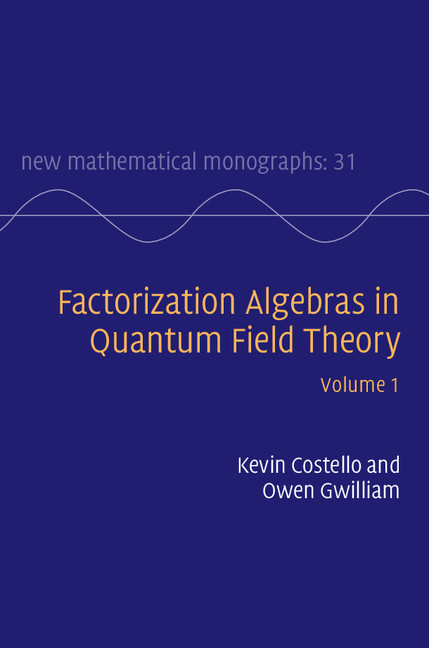
Factorization Algebras in Quantum Field Theory

-
Select format
-
- Publisher:
- Cambridge University Press
- Publication date:
- 19 January 2017
- 15 December 2016
- ISBN:
- 9781316678626
- 9781107163102
- Dimensions:
- (228 x 152 mm)
- Weight & Pages:
- 0.75kg, 398 Pages
- Dimensions:
- Weight & Pages:
You may already have access via personal or institutional login
Volume 1
Show more authors 
You may already have access via personal or institutional login
Book description
Factorization algebras are local-to-global objects that play a role in classical and quantum field theory which is similar to the role of sheaves in geometry: they conveniently organize complicated information. Their local structure encompasses examples like associative and vertex algebras; in these examples, their global structure encompasses Hochschild homology and conformal blocks. In this first volume, the authors develop the theory of factorization algebras in depth, but with a focus upon examples exhibiting their use in field theory, such as the recovery of a vertex algebra from a chiral conformal field theory and a quantum group from Abelian Chern-Simons theory. Expositions of the relevant background in homological algebra, sheaves and functional analysis are also included, thus making this book ideal for researchers and graduates working at the interface between mathematics and physics.
Reviews
'Because the subject of this book touches many advanced leading theories of quantum physics which utilize heavily mathematical machineries from a diverse range of mathematical topics, the background material needed for this book is immense. So it is very helpful and much appreciated that a 103-page four-section appendix is included in this 387-page book, to provide a very well-organized and fairly detailed review of relevant mathematical background topics, including simplicial techniques, colored operads/multicategories and their algebras, differential graded (dg) Lie algebras and their cohomology, sheaves/cosheaves, formal Hodge theory, and ‘convenient, differentiable, or bornological' topological vector spaces facilitating the homological algebra for infinite-dimensional vector spaces.'
Albert Sheu Source: Zentralblatt MATH
'It is a truth universally acknowledged that one cannot make two independent measurements at the very same place and very same time. In this book full of wit, Costello and Gwilliam show what can actually be done by taking this common lore seriously. … Reading this book requires minimal prerequisites: essentially only the basic notions of topology, of differential geometry, of homological algebra and of category theory will be needed, while all other background material … is provided in the four appendices that take up about one third of the book. Yet some familiarity with the subject is needed to really appreciate it. The reader who has even occasionally been close to the interface between algebraic topology, derived geometry and quantum field theory will enjoy many pleasant moments with Costello and Gwilliam and will find many sources of enlightenment … in their treatment of the subject.'
Domenico Fiorenza Source: Mathematical Reviews
Contents
Contents
Metrics
Altmetric attention score
Full text views
Full text views helpTotal number of HTML views: 0
Total number of PDF views: 0 *
 Loading metrics...
* Views captured on Cambridge Core between #date#. This data will be updated every 24 hours.
Usage data cannot currently be displayed.
Accessibility standard: Unknown
Why this information is here
This section outlines the accessibility features of this content - including support for screen readers, full keyboard navigation and high-contrast display options. This may not be relevant for you.
Accessibility Information
Accessibility compliance for the PDF of this book is currently unknown and may be updated in the future.