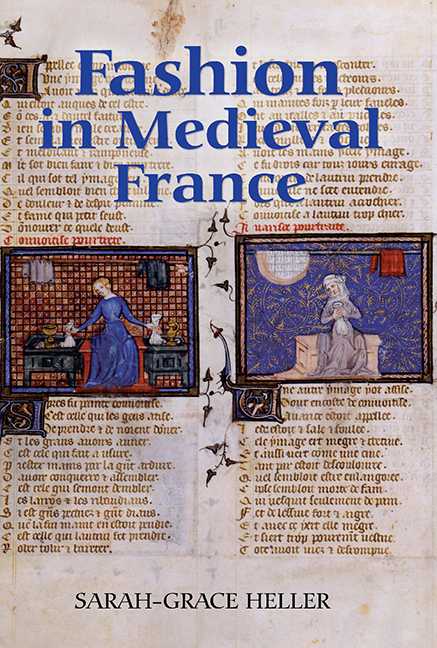
Fashion in Medieval France

-
Select format
-
- Publisher:
- Boydell & Brewer
- Publication date:
- 13 April 2017
- 19 April 2007
- ISBN:
- 9781846155413
- 9781843841104
- Dimensions:
- Weight & Pages:
- Dimensions:
- Weight & Pages:
- Subjects:
- Literature, Area Studies, European History 1000-1450, History, Anglo Saxon and Medieval Literature, European Studies
- Series:
- Gallica
You may already have access via personal or institutional login- Subjects:
- Literature, Area Studies, European History 1000-1450, History, Anglo Saxon and Medieval Literature, European Studies
- Series:
- Gallica
Show more authors 
You may already have access via personal or institutional login
Book description
How are we to distinguish between a culture organized around fashion, and one where the desire for novel adornment is latent, intermittent, or prohibited? How do fashion systems organize social hierarchies, individual psychology, creativity, and production? Medieval French culture offers a case study of "systematic fashion", demonstrating desire for novelty, rejection of the old in favor of the new, and criticism of outrageous display. Texts from the twelfth and thirteenth centuries describe how cleverly-cut garments or unique possessions make a character distinctive, and even offer advice on how to look attractive on a budget or gain enough spending money to shop for oneself. Such descriptions suggest fashion's presence, yet accepted notions date the birth of Western fashion to the mid-fourteenth-century revolution in men's clothing styles. A fashion system must have been present prior to this 'revolution' in styles to facilitate such changes, and abundant evidence for the existence of such a system is cogently set out in this study. Ultimately, fashion is a conceptual system expressed by words evaluating a style's ephemeral worth, and changes in visual details are symptomatic, rather than determinative.
SARAH-GRACE HELLER is an associate professor in Medieval French at Ohio State University.
Contents
Contents
Metrics
Altmetric attention score
Full text views
Full text views helpTotal number of HTML views: 0
Total number of PDF views: 0 *
 Loading metrics...
* Views captured on Cambridge Core between #date#. This data will be updated every 24 hours.
Usage data cannot currently be displayed.
Accessibility standard: Unknown
Why this information is here
This section outlines the accessibility features of this content - including support for screen readers, full keyboard navigation and high-contrast display options. This may not be relevant for you.
Accessibility Information
Accessibility compliance for the PDF of this book is currently unknown and may be updated in the future.