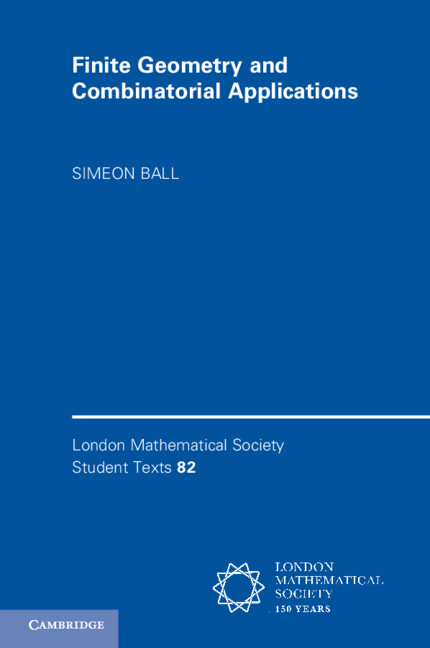
Finite Geometry and Combinatorial Applications

-
Select format
-
- Publisher:
- Cambridge University Press
- Publication date:
- 05 July 2015
- 26 June 2015
- ISBN:
- 9781316257449
- 9781107107991
- 9781107518438
- Dimensions:
- (228 x 152 mm)
- Weight & Pages:
- 0.57kg, 298 Pages
- Dimensions:
- (228 x 152 mm)
- Weight & Pages:
- 0.44kg, 295 Pages
You may already have access via personal or institutional login
Show more authors 
You may already have access via personal or institutional login
Book description
The projective and polar geometries that arise from a vector space over a finite field are particularly useful in the construction of combinatorial objects, such as latin squares, designs, codes and graphs. This book provides an introduction to these geometries and their many applications to other areas of combinatorics. Coverage includes a detailed treatment of the forbidden subgraph problem from a geometrical point of view, and a chapter on maximum distance separable codes, which includes a proof that such codes over prime fields are short. The author also provides more than 100 exercises (complete with detailed solutions), which show the diversity of applications of finite fields and their geometries. Finite Geometry and Combinatorial Applications is ideal for anyone, from a third-year undergraduate to a researcher, who wishes to familiarise themselves with and gain an appreciation of finite geometry.
Contents
Contents
Metrics
Altmetric attention score
Full text views
Full text views helpTotal number of HTML views: 0
Total number of PDF views: 0 *
 Loading metrics...
* Views captured on Cambridge Core between #date#. This data will be updated every 24 hours.
Usage data cannot currently be displayed.
Accessibility standard: Unknown
Why this information is here
This section outlines the accessibility features of this content - including support for screen readers, full keyboard navigation and high-contrast display options. This may not be relevant for you.
Accessibility Information
Accessibility compliance for the PDF of this book is currently unknown and may be updated in the future.