A First Course in Computational Fluid Dynamics

-
Select format
-
- Publisher:
- Cambridge University Press
- Publication date:
- 03 October 2017
- 12 October 2017
- ISBN:
- 9781316823736
- 9781107178519
- 9781316630969
- Dimensions:
- (247 x 174 mm)
- Weight & Pages:
- 0.96kg, 404 Pages
- Dimensions:
- (247 x 174 mm)
- Weight & Pages:
- 0.81kg, 404 Pages
You may already have access via personal or institutional login
Show more authors 
You may already have access via personal or institutional login
Book description
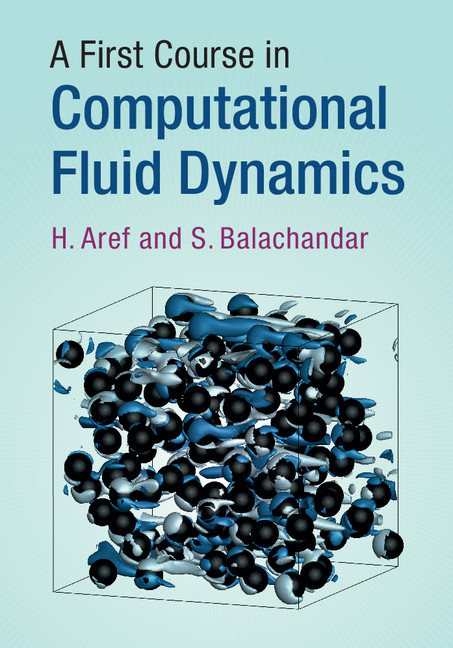
Fluid mechanics is a branch of classical physics that has a rich tradition in applied mathematics and numerical methods. It is at work virtually everywhere, from nature to technology. This broad and fundamental coverage of computational fluid dynamics (CFD) begins with a presentation of basic numerical methods and flows into a rigorous introduction to the subject. A heavy emphasis is placed on the exploration of fluid mechanical physics through CFD, making this book an ideal text for any new course that simultaneously covers intermediate fluid mechanics and computation. Ample examples, problems and computer exercises are provided to allow students to test their understanding of a variety of numerical methods for solving flow physics problems, including the point-vortex method, numerical methods for hydrodynamic stability analysis, spectral methods and traditional CFD topics.
Reviews
'The strength of this book lies in its emphasis on a complete presentation of the underlying theories followed by clear steps and concise formulation applied to a plethora of problems, which include basic numerical schemes such as Euler and Runge-Kutta methods and relatively advanced schemes such as the pseudo-spectral method, spectral methods with body fitted grids, and the immersed boundary method … These attributes make it highly attractive as a technical elective for engineering upperclassmen (following an introductory course in fluid mechanics) and forgraduate students, including those studying applied mathematics. Recommended.'
R. N. Laoulache Source: Choice
Contents
Contents
Metrics
Altmetric attention score
Full text views
Full text views helpTotal number of HTML views: 0
Total number of PDF views: 0 *
 Loading metrics...
* Views captured on Cambridge Core between #date#. This data will be updated every 24 hours.
Usage data cannot currently be displayed.
Accessibility standard: Unknown
Why this information is here
This section outlines the accessibility features of this content - including support for screen readers, full keyboard navigation and high-contrast display options. This may not be relevant for you.
Accessibility Information
Accessibility compliance for the PDF of this book is currently unknown and may be updated in the future.