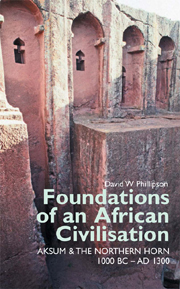
Foundations of an African Civilisation

-
Select format
-
- Publisher:
- Boydell & Brewer
- Publication date:
- 05 December 2015
- 31 August 2012
- ISBN:
- 9781846158735
- 9781847010414
- Dimensions:
- Weight & Pages:
- 00kg,
- Dimensions:
- Weight & Pages:
You may already have access via personal or institutional login
Show more authors 
You may already have access via personal or institutional login
Book description
Focuses on the Aksumite state of the first millennium AD in northern Ethiopia and southern Eritrea, its development, florescence and eventual transformation into the so-called medieval civilisation ofChristian Ethiopia. This book seeks to apply a common methodology, utilising archaeology, art-history, written documents and oral tradition from a wide variety of sources; the result is a far greateremphasis on continuity than previous studies have revealed. It is thus a major re-interpretation of a key development in Ethiopia's past, while raising and discussing methodological issues of the relationship between archaeology and other historical disciplines; these issues, which have theoretical significance extending far beyond Ethiopia, are discussed in full.
The last millennium BC is seen as a time when northern Ethiopia and parts of Eritrea were inhabited by farming peoples whose ancestry may be traced far back into the local 'Late Stone Age'. Colonisation from southern Arabia, towhich defining importance has been attached by earlier researchers, is now seen to have been brief in duration and small in scale, its effects largely restricted to élite sections of the community. Re-consideration of inscriptions shows the need to abandon the established belief in a single 'Pre-Aksumite' state. New evidence for the rise of Aksum during the last centuries BC is critically evaluated.
Finally, new chronological precision is provided for the decline of Aksum and the transfer of centralised political authority to more southerly regions. A new study of the ancient churches -both built and rock-hewn - which survive from this poorly-understood period emphasises once again a strong degree of continuity across periods that were previously regarded as distinct.
David W. Phillipson is Emeritus Professor of African Archaeology and former Director of the University Museum of Archaeology & Anthropology, Cambridge. In 2014 he was made an Associate Fellow of the Ethiopian Academy of Sciences.
Published in association with the British Institute in Eastern Africa.
Ethiopia: Addis Ababa University Press
Contents
Contents
Metrics
Altmetric attention score
Full text views
Full text views helpTotal number of HTML views: 0
Total number of PDF views: 0 *
 Loading metrics...
* Views captured on Cambridge Core between #date#. This data will be updated every 24 hours.
Usage data cannot currently be displayed.
Accessibility standard: Unknown
Why this information is here
This section outlines the accessibility features of this content - including support for screen readers, full keyboard navigation and high-contrast display options. This may not be relevant for you.
Accessibility Information
Accessibility compliance for the PDF of this book is currently unknown and may be updated in the future.