France under Fire

-
Select format
-
- Publisher:
- Cambridge University Press
- Publication date:
- 05 August 2012
- 12 July 2012
- ISBN:
- 9781139178037
- 9781107025325
- 9781107521254
- Dimensions:
- (228 x 152 mm)
- Weight & Pages:
- 0.66kg, 328 Pages
- Dimensions:
- (229 x 152 mm)
- Weight & Pages:
- 0.48kg, 330 Pages
You may already have access via personal or institutional login
Show more authors 
You may already have access via personal or institutional login
Book description
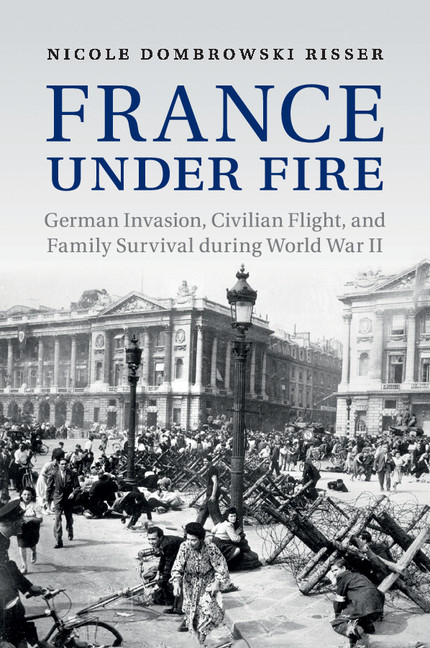
'We request an immediate favour of you, to build a shelter for us women and small children, because we have absolutely no place to take refuge and we are terrified!' This French mother's petition sent to her mayor on the eve of Germany's 1940 invasion of France reveals civilians' security concerns unleashed by the Blitzkrieg fighting tactics of World War II. Unprepared for air warfare's assault on civilian psyches, French planners were among the first in history to respond to civilian security challenges posed by aerial bombardment. France under Fire offers a social, political and military examination of the origins of the French refugee crisis of 1940, a mass displacement of eight million civilians fleeing German combatants. Scattered throughout a divided France, refugees turned to German Occupation officials and Vichy administrators for relief and repatriation. Their solutions raised questions about occupying powers' obligations to civilians and elicited new definitions of refugees' rights.
Reviews
‘Using dramatic personal testimony, Dombrowski Risser uncovers how the 1940 'Exodus' politicized women, what the longer-term repercussions of mass migration were, and how refugee return policies were used to exclude Jews and other 'undesirables'. France Under Fire significantly enriches historical scholarship on civilian displacement, German-French interplay during the French occupation, and ethnic cleansing during World War Two.’
Julia Torrie - St Thomas University
'Risser’s findings make a real contribution to our knowledge of this historical episode, now remote but still within living memory.'
Ian Birchall Source: European History Quarterly
'An ambitious book, [Dombrowski] Risser sets out to examine the intersection of the civilian and military experience under total war by looking at the mass exodus and internal displacement of domestic and foreign refugees in France during World War II.'
Lynne Taylor Source: H-France
Contents
Contents
-
6 - Paving the road for refugees’ return
pp 179-203 -
-
- You have access
- HTML
- Export citation
-
Metrics
Altmetric attention score
Full text views
Full text views helpTotal number of HTML views: 0
Total number of PDF views: 0 *
 Loading metrics...
* Views captured on Cambridge Core between #date#. This data will be updated every 24 hours.
Usage data cannot currently be displayed.
Accessibility standard: Unknown
Why this information is here
This section outlines the accessibility features of this content - including support for screen readers, full keyboard navigation and high-contrast display options. This may not be relevant for you.
Accessibility Information
Accessibility compliance for the HTML of this book is currently unknown and may be updated in the future.