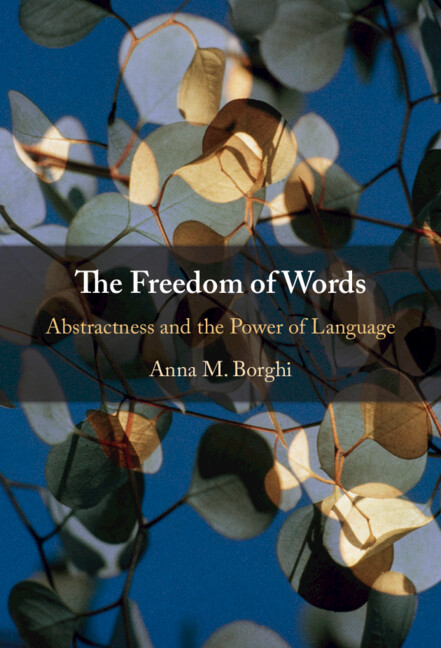
The Freedom of Words

-
Select format
-
- Publisher:
- Cambridge University Press
- Publication date:
- 20 July 2023
- 10 August 2023
- ISBN:
- 9781108913294
- 9781108842907
- 9781009663960
- Dimensions:
- (229 x 152 mm)
- Weight & Pages:
- 0.59kg, 312 Pages
- Dimensions:
- (229 x 152 mm)
- Weight & Pages:
- 0.454kg, 312 Pages
You may already have access via personal or institutional login
Show more authors 
You may already have access via personal or institutional login
Book description
The Freedom of Words is for anyone interested in understanding the role of body and language in cognition and how humans developed the sophisticated ability to use abstract concepts like 'freedom' and 'thinking'. This volume adopts a transdisciplinary perspective, including philosophy, semiotics, psychology, and neuroscience, to show how language, as a tool, shapes our minds and influences our interaction with the physical and social environment. It develops a theory showing how abstract concepts in their different varieties enhance cognition and profoundly influence our social and affective life. It addresses how children learn such abstract concepts, details how they vary across languages and cultures, and outlines the link between abstractness and the capability to detect inner bodily signals. Overall, the book shows how words – abstract words in particular, because of their indeterminate and open character – grant us freedom.
Contents
Contents
Metrics
Altmetric attention score
Full text views
Full text views helpTotal number of HTML views: 0
Total number of PDF views: 0 *
 Loading metrics...
* Views captured on Cambridge Core between #date#. This data will be updated every 24 hours.
Usage data cannot currently be displayed.
Accessibility standard: Unknown
Why this information is here
This section outlines the accessibility features of this content - including support for screen readers, full keyboard navigation and high-contrast display options. This may not be relevant for you.
Accessibility Information
Accessibility compliance for the HTML of this book is currently unknown and may be updated in the future.