
Skip to main content Accessibility help
×
  • Cited by 6
    • Show more authors
    • You may already have access via personal or institutional login
    • Select format
    • Publisher:
      Cambridge University Press
      Publication date:
      04 January 2019
      17 January 2019
      ISBN:
      9781108529426
      9781108423809
      9781108438384
      Dimensions:
      (228 x 152 mm)
      Weight & Pages:
      0.56kg, 294 Pages
      Dimensions:
      (228 x 152 mm)
      Weight & Pages:
      0.44kg, 294 Pages
    • Subjects:
      Social Theory, Anthropology, Sociology, Anthropological Theory
    You may already have access via personal or institutional login
  • Selected: Digital
    Add to cart View cart Buy from Cambridge.org
    Subjects:
    Social Theory, Anthropology, Sociology, Anthropological Theory

    Book description

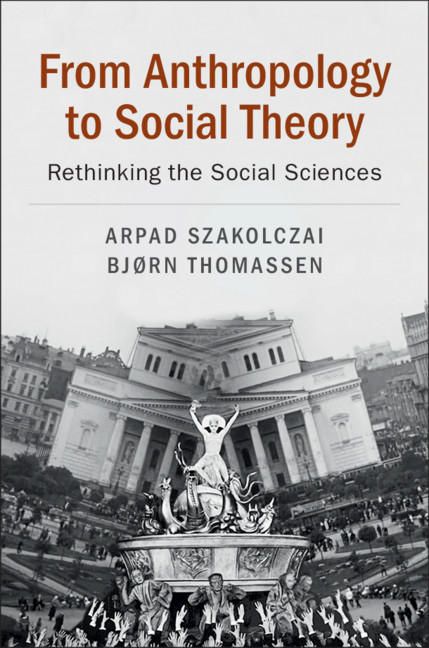
    Presenting a ground-breaking revitalization of contemporary social theory, this book revisits the rise of the modern world to reopen the dialogue between anthropology and sociology. Using concepts developed by a series of 'maverick' anthropologists who were systematically marginalised as their ideas fell outside the standard academic canon, such as Arnold van Gennep, Marcel Mauss, Paul Radin, Lucien Lévy-Bruhl and Gregory Bateson, the authors argue that such concepts are necessary for understanding better the rise and dynamics of the modern world, including the development of the social sciences, in particular sociology and anthropology. Concepts discussed include liminality, imitation, schismogenesis and trickster, which provide an anthropological 'toolkit' for readers to develop innovative understandings of the underlying power mechanisms of globalized modernity. Aimed at graduate students and researchers, the book is clearly structured. Part I introduces the 'maverick' anthropologists, while Part II applies the maverick tool-kit to revisit the history of sociological thought and the question of modernity.

    Reviews

    ‘This book examines thinkers whose work has been fossilised, forgotten or rendered insignificant by subsequent misreadings and provides us with histories of those misreadings and elisions while saliently indicating the profound theoretical capital for social analysis that has been squandered by those practices.'

    Glenn Bowman - Emeritus Professor of Socio-Historical Anthropology, University of Kent

    'With their call for the removal of subject-based ownership of techniques, Arpad Szakolczai and Bjørn Thomassen offer a convincing and increasingly urgent argument that the social sciences are in need of radical rejuvenation. This is not in order to 'retain relevance' (or some similarly anodyne phrase) but to allow social scientists to do what they should do best and help address dynamic real-world issues.'

    Simon Underdown Source: Times Higher Education

    Refine List

    Actions for selected content:

    Select all | Deselect all
    • View selected items
    • Export citations
    • Download PDF (zip)
    • Save to Kindle
    • Save to Dropbox
    • Save to Google Drive

    Save Search

    You can save your searches here and later view and run them again in "My saved searches".

    Please provide a title, maximum of 40 characters.
    ×

    Contents

    Metrics

    Altmetric attention score

    Full text views

    Total number of HTML views: 0
    Total number of PDF views: 0 *
    Loading metrics...

    Book summary page views

    Total views: 0 *
    Loading metrics...

    * Views captured on Cambridge Core between #date#. This data will be updated every 24 hours.

    Usage data cannot currently be displayed.

    Accessibility standard: Unknown

    Why this information is here

    This section outlines the accessibility features of this content - including support for screen readers, full keyboard navigation and high-contrast display options. This may not be relevant for you.

    Accessibility Information

    Accessibility compliance for the HTML of this book is currently unknown and may be updated in the future.
