From Open Secrets to Secret Voting

-
Select format
-
- Publisher:
- Cambridge University Press
- Publication date:
- 05 July 2015
- 17 June 2015
- ISBN:
- 9781316178539
- 9781107100213
- 9781107495296
- Dimensions:
- (228 x 152 mm)
- Weight & Pages:
- 0.52kg, 286 Pages
- Dimensions:
- (228 x 152 mm)
- Weight & Pages:
- 0.41kg, 286 Pages
You may already have access via personal or institutional login
Show more authors 
You may already have access via personal or institutional login
Book description
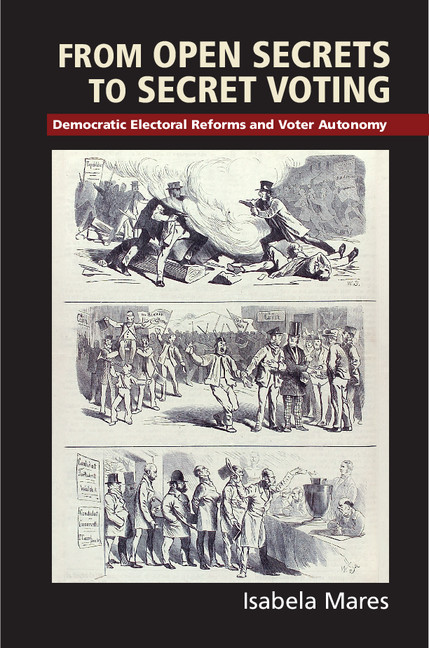
The expansion of suffrage and the introduction of elections are momentous political changes that represent only the first steps in the process of democratization. In the absence of institutions that protect the electoral autonomy of voters against a range of actors who seek to influence voting decisions, political rights can be just hollow promises. This book examines the adoption of electoral reforms that protected the autonomy of voters during elections and sought to minimize undue electoral influences over decisions made at the ballot box. Empirically, it focuses on the adoption of reforms protecting electoral secrecy in Imperial Germany during the period between 1870 and 1912. Empirically, the book provides a micro-historical analysis of the democratization of electoral practices, by showing how changes in district level economic and political conditions contributed to the formation of an encompassing political coalition supporting the adoption of electoral reforms.
Reviews
'An admirable piece of work that combines an impressive knowledge of German nineteenth-century history with skillful archival research and an astonishing command of quantitative methods. I find the idea of voter intimidation and the costs of voter repression as leading terms in a local-level quantitative analysis of electoral practices and reforms in an emerging nation-state a major step forward in the analysis of institutional change. The way the book moves between qualitative narratives of historical local conditions and sophisticated quantitative analyses is exemplary and sets a standard for social science taking history seriously.'
Wolfgang Streeck - Max Planck Institute for the Study of Societies
Contents
Contents
Metrics
Altmetric attention score
Full text views
Full text views helpTotal number of HTML views: 0
Total number of PDF views: 0 *
 Loading metrics...
* Views captured on Cambridge Core between #date#. This data will be updated every 24 hours.
Usage data cannot currently be displayed.
Accessibility standard: Unknown
Why this information is here
This section outlines the accessibility features of this content - including support for screen readers, full keyboard navigation and high-contrast display options. This may not be relevant for you.
Accessibility Information
Accessibility compliance for the PDF of this book is currently unknown and may be updated in the future.