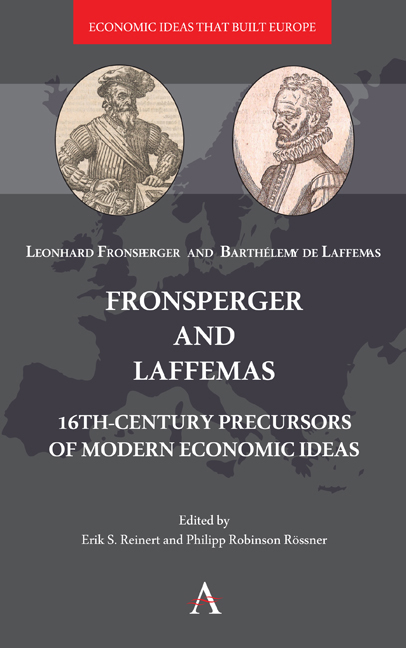
Fronsperger and Laffemas

-
Select format
-
- Publisher:
- Anthem Press
- Publication date:
- 28 February 2024
- 02 May 2023
- ISBN:
- 9781839987106
- 9781839987083
- Dimensions:
- Weight & Pages:
- Dimensions:
- Weight & Pages:
- Subjects:
- Economics, Industrial Economics, Economic Theory
- Series:
- Economic Ideas That Built Europe
You may already have access via personal or institutional login- Subjects:
- Economics, Industrial Economics, Economic Theory
- Series:
- Economic Ideas That Built Europe
Show more authors 
You may already have access via personal or institutional login
Book description
This volume introduces two unique and hitherto largely unknown contributions to the making of modern economic knowledge, and makes them available internationally for the first time in full English translation. Written in 1597 Barthelemy de Laffemas' General regulation for the establishment of manufacturers (originally in French: Reiglement général pour dresser les manufactures) is one of the earliest voices in the history of political economy emphasising the necessity of manufacturing and large-scale industry as the source of the wealth of nations. Located somewhat at the cross-roads between medieval Scholasticism and early mercantilism presents a basic version of the infant industry argument and European standard model of economic development which made it into later doctrines of thought including Enlightenment thinkers such as Colbert, Sir James Steuart or Friedrich List and nineteenth and twentieth century neomercantilism.
Leonhard Fronsperger's On the praise of self-interest (German original: Von dem Lob deß Eigen Nutzen, 1564) is the first documented instance of the 'Mandeville paradox', a theorem in modern economics usually associated with much later writings including Bernard de Mandeville's Fable of the Bees (1705/14), or Adam Smith's Theory of Moral Sentiments (1759) and Wealth of Nations (1776). Vested in Renaissance Humanism southern German military surgeon and polymath Fronsperger argues - without moving into the abstractions of neoliberalism - that possessive individualism and self-interest are key forces moving the human economy forward, contributing to virtuous cycles of enrichment and economic development.
Contents
Contents
Metrics
Full text views
Full text views helpTotal number of HTML views: 0
Total number of PDF views: 0 *
 Loading metrics...
* Views captured on Cambridge Core between #date#. This data will be updated every 24 hours.
Usage data cannot currently be displayed.
Accessibility standard: Unknown
Why this information is here
This section outlines the accessibility features of this content - including support for screen readers, full keyboard navigation and high-contrast display options. This may not be relevant for you.
Accessibility Information
Accessibility compliance for the PDF of this book is currently unknown and may be updated in the future.