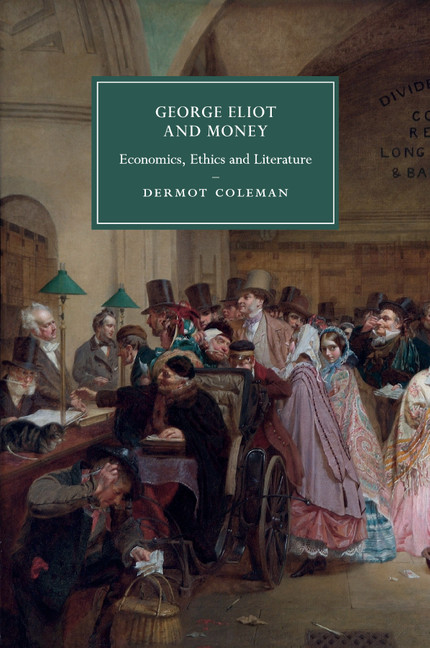
George Eliot and Money

-
Select format
-
- Publisher:
- Cambridge University Press
- Publication date:
- 05 July 2014
- 24 April 2014
- ISBN:
- 9781107298040
- 9781107057210
- 9781107666597
- Dimensions:
- (228 x 152 mm)
- Weight & Pages:
- 0.47kg, 240 Pages
- Dimensions:
- (229 x 152 mm)
- Weight & Pages:
- 0.36kg, 242 Pages
- Subjects:
- Literature, English Literature 1830-1900
You may already have access via personal or institutional login- Subjects:
- Literature, English Literature 1830-1900
Show more authors 
You may already have access via personal or institutional login
Book description
Unlike other Victorian novelists George Eliot rarely incorporated stock market speculation and fraud into her plots, but meditations on money, finance and economics, in relation both to individual ethics and to wider social implications, infuse her novels. This volume examines Eliot's understanding of money and economics, its bearing on her moral and political thought, and the ways in which she incorporated that thought into her novels. It offers a detailed account of Eliot's intellectual engagements with political economy, utilitarianism, and the new liberalism of the 1870s, and also her practical dealings with money through her management of household and business finances and, in later years, her considerable investments in stocks and shares. In a wider context, it presents a detailed study of the ethics of economics in nineteenth-century England, tracing the often uncomfortable relationship between morality and economic utility experienced by intellectuals of the period.
Contents
Contents
Metrics
Full text views
Full text views helpTotal number of HTML views: 0
Total number of PDF views: 0 *
 Loading metrics...
* Views captured on Cambridge Core between #date#. This data will be updated every 24 hours.
Usage data cannot currently be displayed.
Accessibility standard: Unknown
Why this information is here
This section outlines the accessibility features of this content - including support for screen readers, full keyboard navigation and high-contrast display options. This may not be relevant for you.
Accessibility Information
Accessibility compliance for the HTML of this book is currently unknown and may be updated in the future.