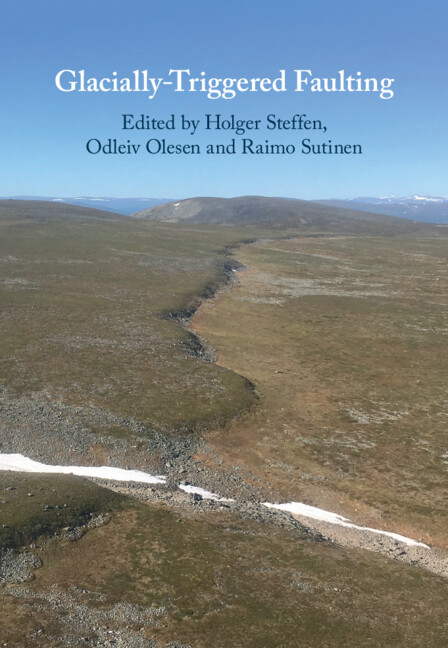
Glacially-Triggered Faulting

-
Select format
-
- Publisher:
- Cambridge University Press
- Publication date:
- 02 December 2021
- 16 December 2021
- ISBN:
- 9781108779906
- 9781108490023
- Dimensions:
- (244 x 170 mm)
- Weight & Pages:
- 1.08kg, 460 Pages
- Dimensions:
- Weight & Pages:
You may already have access via personal or institutional login
Show more authors 
You may already have access via personal or institutional login
Book description
Glacially triggered faulting describes movement of pre-existing faults caused by a combination of tectonic and glacially induced isostatic stresses. The most impressive fault-scarps are found in northern Europe, assumed to be reactivated at the end of the deglaciation. This view has been challenged as new faults have been discovered globally with advanced techniques such as LiDAR, and fault activity dating has shown several phases of reactivation thousands of years after deglaciation ended. This book summarizes the current state-of-the-art research in glacially triggered faulting, discussing the theoretical aspects that explain the presence of glacially induced structures and reviews the geological, geophysical, geodetic and geomorphological investigation methods. Written by a team of international experts, it provides the first global overview of confirmed and proposed glacially induced faults, and provides an outline for modelling these stresses and features. It is a go-to reference for geoscientists and engineers interested in ice sheet-solid Earth interaction.
Contents
Contents
Metrics
Altmetric attention score
Full text views
Full text views helpTotal number of HTML views: 0
Total number of PDF views: 0 *
 Loading metrics...
* Views captured on Cambridge Core between #date#. This data will be updated every 24 hours.
Usage data cannot currently be displayed.
Accessibility standard: Unknown
Why this information is here
This section outlines the accessibility features of this content - including support for screen readers, full keyboard navigation and high-contrast display options. This may not be relevant for you.
Accessibility Information
Accessibility compliance for the HTML of this book is currently unknown and may be updated in the future.