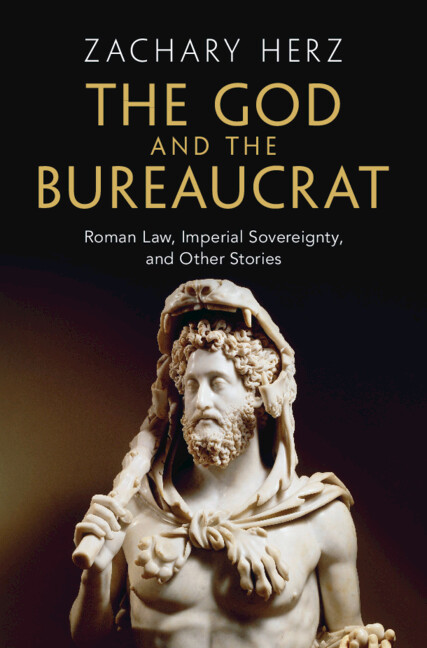
‘In The God and the Bureaucrat, Zachary Herz offers a powerful new vision of Roman law. Herz sees talk about law, and ultimately Roman legal literatures themselves, as a preeminent site for imagining the relationship between norms, politics and power. A richly theorized work, its close readings offer startling new perspectives on texts we thought we knew.’
Clifford Ando - University of Chicago
‘Herz's powerful and provocative book not only interrogates the stories that Romans told to themselves, but also the stories that we tell ourselves today. From Cicero to Joan Didion, by way of Ronald Dworkin and a starry roster of Roman emperors, Herz’s bold and original thesis is nothing less than an invitation to rethink the entire field of classical Roman political thought.’
Caroline Humfress - University of St Andrews and University of Michigan Law School
‘Roman law presents its readers with what at first sight appears to be a sturdy edifice for the structuring of social relations. With this penetrating book, Herz peers into its structural core to show that, far from being adamantine, the system was extraordinarily contingent and evanescent. Roman imperial law is best understood not as describing social realities, let alone constituting them by fiat. It served, rather, to construct an ideal world far beyond the realizable in response to the crises and contradictions inherent in autocracy.’
Noel Lenski - Yale University
‘Zachary Herz prompts us to rethink the dual nature of what we call ‘law’ as a particular discursive formation, which facilitated imaginative thinking in several domains, and as an institutional framework that regulated social relations and undergirded Rome's political order.’
Carlos F. Noreña - University of California, Berkeley
‘The present book by Zachary Herz is an ambitious, imaginative, and at times provocative study of the role of law in the configuration of Roman imperial power … The God and the Bureaucrat is a work of great originality, written with a remarkable ability to connect sources under a single interpretative logic and undoubtedly with a voice of its own.… required reading for all those who believe that one cannot write the history of Rome without its law, nor Roman law without its history.’
Jacobo Rodríguez Garrido
Source: Bryn Mawr Classical Review
‘Herz’s book is insightful and curiously moving. (His jurists dream of a world in which law matters more than it does amid the chaos of third-century Rome.) And it is grounded in deep knowledge of Roman law codes. Changes over time are not easy to discern in these texts, which weave together snippets of imperial pronounce ments from different periods and frag ments of expert legal opinion. But Herz analyses the shifts in phrasing across different imperial reigns to tease out some suggestive trends.'
Catharine Edwards
Source: Times Literary Supplement