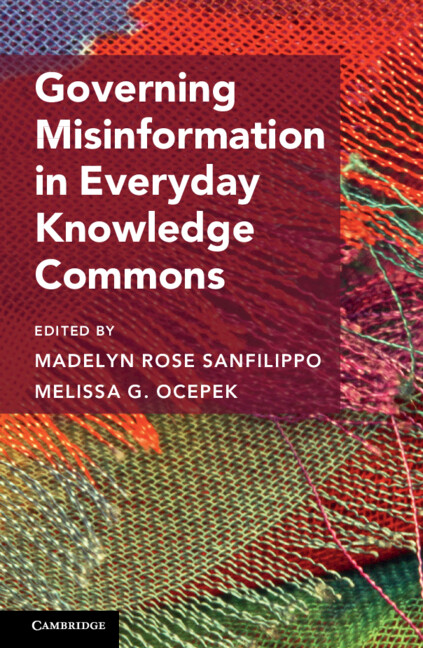
Governing Misinformation in Everyday Knowledge Commons

-
Select format
-
- Publisher:
- Cambridge University Press
- Publication date:
- 13 March 2025
- 20 March 2025
- ISBN:
- 9781009255165
- 9781009255158
- 9781009255141
- Creative Commons:
-
This content is Open Access and distributed under the terms of the Creative Commons Attribution licence CC-BY-NC-ND 4.0.


https://creativecommons.org/creativelicenses - Dimensions:
- (229 x 152 mm)
- Weight & Pages:
- 0.56kg, 292 Pages
- Dimensions:
- (229 x 152 mm)
- Weight & Pages:
- 292 Pages
Open AccessYou have digital access to this book
Show more authors 
You have digital access to this book
Book description
Governing Misinformation in Everyday Knowledge Commons delves into the complex issue of misinformation in our daily lives. The book synthesizes three scholarly traditions - everyday life, misinformation, and governing knowledge commons - to present 10 case studies of online and offline communities tackling diverse dilemmas regarding truth and information quality. The book highlights how communities manage issues of credibility, trust, and information quality continuously, to mitigate the impact of misinformation when possible. It also explores how social norms and intentional governance evolve to distinguish between problematic disinformation and little white lies. Through a coproduction of governance and (mis-)information, the book raises a set of ethical, economic, political, social, and technological questions that require systematic study and careful deliberation. This title is also available as Open Access on Cambridge Core.
Reviews
‘This is a useful new volume for any scholar interested in misinformation in the everyday information ecosystem … Recommended.’
B. R. Norwood Source: Choice
‘An exemplary edited collection presenting original ideas and case studies advancing misinformation research. … the research in this book is evidence of the transformational and innovative climate of misinformation research. The GKC framework featured in this work serves as an excellent guide for researchers to explore governing and investigating misinformation across diverse environments.’
Judas Kelley Source: International Journal of Communication
Contents
Full book PDFContents
-
Governing Misinformation in Everyday Knowledge Commons
pp i-i -
-
- You have access
- Open access
- HTML
- Export citation
-
-
Cambridge Studies on Governing Knowledge Commons - Series page
pp ii-ii -
-
- You have access
- Open access
- HTML
- Export citation
-
-
Governing Misinformation in Everyday Knowledge Commons - Title page
pp iii-iii -
-
- You have access
- Open access
- HTML
- Export citation
-
-
Copyright page
pp iv-iv -
-
- You have access
- Open access
- HTML
- Export citation
-
-
Contents
pp v-vi -
-
- You have access
- Open access
- HTML
- Export citation
-
-
Figures
pp vii-viii -
-
- You have access
- Open access
- HTML
- Export citation
-
-
Tables
pp ix-x -
-
- You have access
- Open access
- HTML
- Export citation
-
-
Contributors
pp xi-xii -
-
- You have access
- Open access
- HTML
- Export citation
-
-
Acknowledgments
pp xiii-xiv -
-
- You have access
- Open access
- HTML
- Export citation
-
-
1 - Introduction
pp 1-17 - Governing Everyday Misinformation
-
-
-
- You have access
- Open access
- HTML
- Export citation
-
-
4 - Information Hazing
pp 67-93 - An Examination through Computer Science Education
-
-
-
- You have access
- Open access
- HTML
- Export citation
-
-
5 - Common Nonsense about Password Security and the Expert–Layperson Knowledge Gap
pp 94-122 -
-
-
- You have access
- Open access
- HTML
- Export citation
-
-
6 - Hacks, Fakes, and Hot Takes
pp 123-147 - Moderating “Bad Actors” on Google Maps Local Guides Platform
-
-
-
- You have access
- Open access
- HTML
- Export citation
-
-
7 - The Human Infrastructure of Misinformation
pp 148-166 - A Case Study of Brazil’s Heteromated Labor
-
-
-
- You have access
- Open access
- HTML
- Export citation
-
-
8 - Hidden Virality and the Everyday Burden of Correcting WhatsApp Mis- and Disinformation
pp 167-187 -
-
-
- You have access
- Open access
- HTML
- Export citation
-
-
9 - “Do Your Own Research”
pp 188-213 - Everyday Misinformation and Conspiracy in Online Information Worlds
-
-
-
- You have access
- Open access
- HTML
- Export citation
-
-
12 - Co-constructing Misinformation and Community
pp 264-278 - Some Conclusions
-
-
-
- You have access
- Open access
- HTML
- Export citation
-
Metrics
Altmetric attention score
Full text views
Full text views helpTotal number of HTML views: 0
Total number of PDF views: 0 *
 Loading metrics...
* Views captured on Cambridge Core between #date#. This data will be updated every 24 hours.
Usage data cannot currently be displayed.
Accessibility standard: WCAG 2.2 AAA
Why this information is here
This section outlines the accessibility features of this content - including support for screen readers, full keyboard navigation and high-contrast display options. This may not be relevant for you.
Accessibility Information
The HTML of this book complies with version 2.2 of the Web Content Accessibility Guidelines (WCAG), offering more comprehensive accessibility measures for a broad range of users and attains the highest (AAA) level of WCAG compliance, optimising the user experience by meeting the most extensive accessibility guidelines.
Content Navigation
Table of contents navigation
Allows you to navigate directly to chapters, sections, or non‐text items through a linked table of contents, reducing the need for extensive scrolling.
Reading Order and Textual Equivalents
Single logical reading order
You will encounter all content (including footnotes, captions, etc.) in a clear, sequential flow, making it easier to follow with assistive tools like screen readers.
Full alternative textual descriptions
You get more than just short alt text: you have comprehensive text equivalents, transcripts, captions, or audio descriptions for substantial non‐text content, which is especially helpful for complex visuals or multimedia.
Visualised data also available as non‐graphical data
You can access graphs or charts in a text or tabular format, so you are not excluded if you cannot process visual displays.
Visual Accessibility
Use of high contrast between text and background colour
You benefit from high‐contrast text, which improves legibility if you have low vision or if you are reading in less‐than‐ideal lighting conditions.