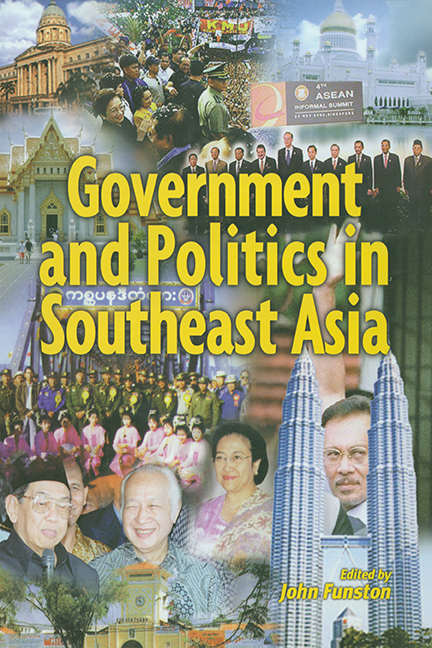
Government and Politics in Southeast Asia

-
Select format
-
- Publisher:
- ISEAS–Yusof Ishak Institute
- Publication date:
- 21 October 2015
- 23 October 2001
- ISBN:
- 9789812305046
- 9789812301345
- 9789812301338
- Dimensions:
- Weight & Pages:
- 00kg,
- Dimensions:
- Weight & Pages:
- 00kg,
Show more authors 
You may already have access via personal or institutional login
Book description
There has been an avalanche of publications on Southeast Asia in recent years, but no one volume provides an accurate and up-to-date account of political institutions and practices in the region. This book fills that gap. Each country chapter provides a broad overview of the historical, social and economic setting. It then analyses in detail the political "institutions" of that country -- the constitution, head of state, executive (cabinet and both military and civilian bureaucracies), the legislature, elections, the judiciary, political parties, ideology, civil society and human rights. Finally, it examines major traditional concerns of political scientists -- who rules, who benefits, and the extent of legitimacy -- before addressing the more modern preoccupation with governance.
Contents
Contents
Metrics
Altmetric attention score
Full text views
Full text views helpTotal number of HTML views: 0
Total number of PDF views: 0 *
 Loading metrics...
* Views captured on Cambridge Core between #date#. This data will be updated every 24 hours.
Usage data cannot currently be displayed.
Accessibility standard: Unknown
Why this information is here
This section outlines the accessibility features of this content - including support for screen readers, full keyboard navigation and high-contrast display options. This may not be relevant for you.
Accessibility Information
Accessibility compliance for the PDF of this book is currently unknown and may be updated in the future.