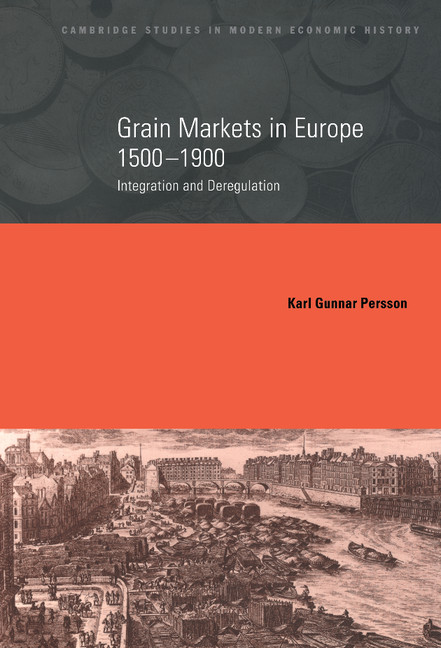
Grain Markets in Europe, 1500–1900

-
Select format
-
- Publisher:
- Cambridge University Press
- Publication date:
- 10 September 2009
- 09 December 1999
- ISBN:
- 9780511496820
- 9780521650960
- 9780521023887
- Dimensions:
- (228 x 152 mm)
- Weight & Pages:
- 0.46kg, 194 Pages
- Dimensions:
- (228 x 152 mm)
- Weight & Pages:
- 0.308kg, 196 Pages
You may already have access via personal or institutional login
Show more authors 
You may already have access via personal or institutional login
Book description
In this 1999 book, Karl Gunnar Persson surveys a broad sweep of economic history, examining one of the most crucial markets - grain. His analysis allows him to draw more general lessons, for example that liberalization of markets was linked to political authoritarianism. Grain Markets in Europe traces the markets' early regulation, their poor performance and the frequent market failures. Price volatility caused by harvest shocks was of major concern for central and local government because of the unrest it caused. Regulation became obsolete when markets became more integrated and performed better through trade triggered by falling transport costs. Persson, a specialist in economic history, uses insights from development economics, explores contemporary economic thought on the advantages of free trade, and measures the extent of market integration using the latest econometric methods. Grain Markets in Europe will be of value to scholars and students in economic history, social history and agricultural and institutional economics.
Reviews
"Of ... interest is the author's fruitful incorporation of recent work in welfare economics and price theory, as well as his fresh analysis of French Physiocrats and French and Sweedish deregulation after 1815." Choice
"Persson's book has placed farmers, consumers, agents, and regulators in an impressive analytical framework, and pointed to both the hard economic rationale behind early modern European policy-making and the true impact of its application." International History Review
Contents
Contents
Metrics
Altmetric attention score
Full text views
Full text views helpTotal number of HTML views: 0
Total number of PDF views: 0 *
 Loading metrics...
* Views captured on Cambridge Core between #date#. This data will be updated every 24 hours.
Usage data cannot currently be displayed.
Accessibility standard: Unknown
Why this information is here
This section outlines the accessibility features of this content - including support for screen readers, full keyboard navigation and high-contrast display options. This may not be relevant for you.
Accessibility Information
Accessibility compliance for the PDF of this book is currently unknown and may be updated in the future.