Grammars of Space

-
Select format
-
- Publisher:
- Cambridge University Press
- Publication date:
- 22 September 2009
- 14 September 2006
- ISBN:
- 9780511486753
- 9780521855839
- 9780521671781
- Dimensions:
- (228 x 152 mm)
- Weight & Pages:
- 1.132kg, 640 Pages
- Dimensions:
- (228 x 152 mm)
- Weight & Pages:
- 1.01kg, 640 Pages
- Series:
- Language Culture and Cognition (6)
You may already have access via personal or institutional login- Series:
- Language Culture and Cognition (6)
Show more authors 
You may already have access via personal or institutional login
Book description
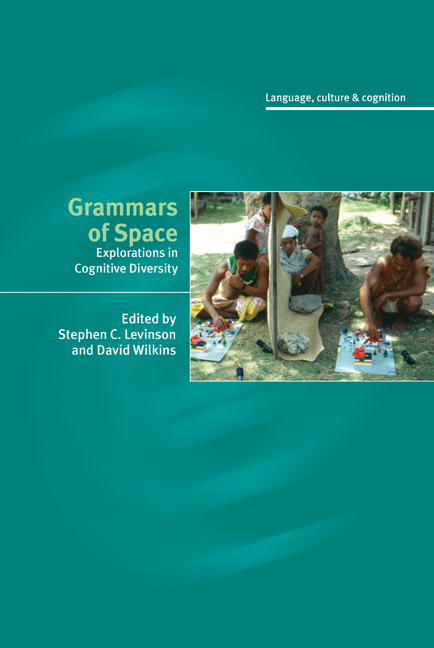
Spatial language - that is, the way languages structure the spatial domain – is an important area of research, offering insights into one of the most central areas of human cognition. In this collection, a team of leading scholars review the spatial domain across a wide variety of languages. Contrary to existing assumptions, they show that there is great variation in the way space is conceptually structured across languages, thus substantiating the controversial question of how far the foundations of human cognition are innate. Grammars of Space is a supplement to the psychological information provided in its companion volume, Space in Language and Cognition. It represents a new kind of work in linguistics, 'Semantic Typology', which asks what are the semantic parameters used to structure particular semantic fields. Comprehensive and informative, it will be essential reading for those working on comparative linguistics, spatial cognition, and the interface between them.
Contents
Contents
Metrics
Altmetric attention score
Full text views
Full text views helpTotal number of HTML views: 0
Total number of PDF views: 0 *
 Loading metrics...
* Views captured on Cambridge Core between #date#. This data will be updated every 24 hours.
Usage data cannot currently be displayed.
Accessibility standard: Unknown
Why this information is here
This section outlines the accessibility features of this content - including support for screen readers, full keyboard navigation and high-contrast display options. This may not be relevant for you.
Accessibility Information
Accessibility compliance for the PDF of this book is currently unknown and may be updated in the future.