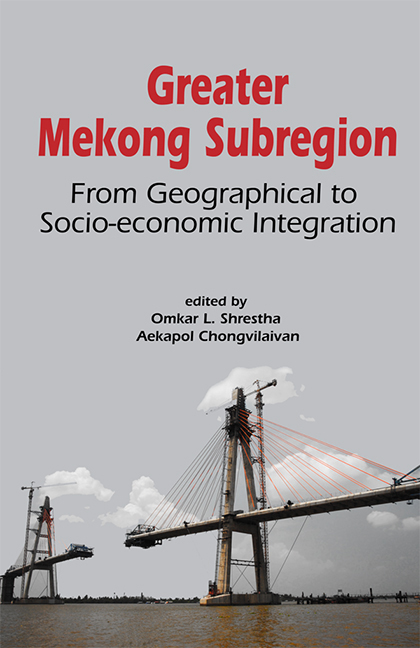
Greater Mekong Subregion

-
Select format
-
- Publisher:
- ISEAS–Yusof Ishak Institute
- Publication date:
- 21 October 2015
- 07 February 2013
- ISBN:
- 9789814379694
- 9789814379687
- Dimensions:
- Weight & Pages:
- Dimensions:
- Weight & Pages:
- 00kg,
You may already have access via personal or institutional login
Show more authors 
You may already have access via personal or institutional login
Book description
The large market size and abundant resources of the Greater Mekong Subregion (GMS), including a large, motivated and cheap workforce, a rich agricultural base, extensive timber and fisheries resources, considerable potential mineral resources, and vast energy resources have seen the subregion increasingly recognized as a new frontier of Southeast Asian economic strength. This book aims to assess the recent economic, social and political developments in the GMS and identify emerging opportunities and challenges facing the successful transition towards a market-driven economy. The countries of the GMS are at a critical juncture where subregional efforts and cooperation must be made to fully address the rapidly evolving issues that are vital to appropriate policy formation, yet which remain widely debatable. The deliberations here shed light on the development stages and offer policy recommendations for pushing forward subregional cooperation.
Contents
Contents
Metrics
Full text views
Full text views helpTotal number of HTML views: 0
Total number of PDF views: 0 *
 Loading metrics...
* Views captured on Cambridge Core between #date#. This data will be updated every 24 hours.
Usage data cannot currently be displayed.
Accessibility standard: Unknown
Why this information is here
This section outlines the accessibility features of this content - including support for screen readers, full keyboard navigation and high-contrast display options. This may not be relevant for you.
Accessibility Information
Accessibility compliance for the PDF of this book is currently unknown and may be updated in the future.