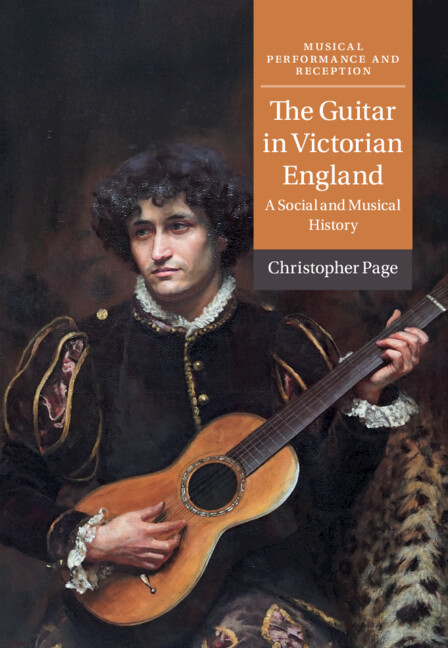
The Guitar in Victorian England

-
Select format
-
- Publisher:
- Cambridge University Press
- Publication date:
- 09 June 2025
- 26 June 2025
- ISBN:
- 9781009053884
- 9781316511800
- Dimensions:
- (244 x 170 mm)
- Weight & Pages:
- 0.6kg, 244 Pages
- Dimensions:
- Weight & Pages:
- Subjects:
- Music, Music Performance, Nineteenth-Century Music
You may already have access via personal or institutional login- Subjects:
- Music, Music Performance, Nineteenth-Century Music
Show more authors 
You may already have access via personal or institutional login
Book description
In 1893 Clara Lindow sang the ballad Dreamtide to her own guitar accompaniment in the Cumbrian hamlet of Lowick. A writer for the local newspaper not only admired her 'marked skill and ability' but also considered the concert to be a sign of 'the onward march of light and learning in our time'. Amateurs like Miss Lindow were at the heart of a Victorian revival of guitar playing, especially for accompanying the voice, which has never been fully acknowledged and has often been denied. This book is a ground-breaking history of the guitar and its players during the era when the Victorians were making modern Britain. The abundant newspaper record of the period, much of which is now searchable with digital tools, reveals an increasingly buoyant guitar scene from the 1860s onwards. No part of Victorian life, from palace to pavement, remained untouched by the revival.
Reviews
‘Christopher Page, in his exemplary, well-documented and exceptionally well-written book, gives a vivid, more nuanced and complete picture of the guitar's place in Britain's social and cultural life during a period with great differences in living conditions between the elected and the poor without a social safety net. At the same time, there was an energetic development in many areas of social life. Particularly interesting are Page's in-depth studies focusing on the guitar in the contemporary press, court records, etc. during the Victorian era, which provide new and important perspectives.’
Kenneth Sparr Source: Gitarr och Luta
‘Christopher Page has given us what must surely be regarded as the definitive four-part history of the (pre-C20) guitar in England … An excellent social and musical history of the nineteenth-century guitar.’
Paul Sparks Source: Galpin Society Journal
‘Page’s writing style is, as always, very readable and engaging, belying the academic rigor and depth of research that underpin this volume and its predecessors. … Page includes women in the narrative with no apparent effort and without making ‘a thing’ of it. This is absolutely as it should be, both in terms of how we approach writing history and in light of the importance of women in this particular narrative, with perhaps as many as eighty percent of players being female.’
Jenny Nex Source: Soundboard Scholar
Contents
References
Metrics
Altmetric attention score
Full text views
Full text views helpTotal number of HTML views: 0
Total number of PDF views: 0 *
 Loading metrics...
* Views captured on Cambridge Core between #date#. This data will be updated every 24 hours.
Usage data cannot currently be displayed.
Accessibility standard: Unknown
Why this information is here
This section outlines the accessibility features of this content - including support for screen readers, full keyboard navigation and high-contrast display options. This may not be relevant for you.
Accessibility Information
Accessibility compliance for the HTML of this book is currently unknown and may be updated in the future.