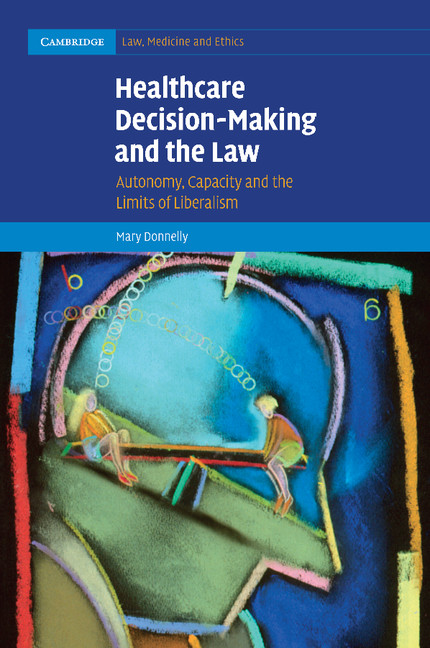
Healthcare Decision-Making and the Law

-
Select format
-
- Publisher:
- Cambridge University Press
- Publication date:
- 04 February 2011
- 18 November 2010
- ISBN:
- 9780511760679
- 9780521118316
- 9781107470927
- Dimensions:
- (228 x 152 mm)
- Weight & Pages:
- 0.66kg, 344 Pages
- Dimensions:
- (229 x 152 mm)
- Weight & Pages:
- 0.46kg, 346 Pages
You may already have access via personal or institutional login
Show more authors 
You may already have access via personal or institutional login
Book description
This analysis of the law's approach to healthcare decision-making critiques its liberal foundations in respect of three categories of people: adults with capacity, adults without capacity and adults who are subject to mental health legislation. Focusing primarily on the law in England and Wales, the analysis also draws on the law in the United States, legal positions in Australia, Canada, Ireland, New Zealand and Scotland and on the human rights protections provided by the ECHR and the Convention on the Rights of Persons with Disabilities. Having identified the limitations of a legal view of autonomy as primarily a principle of non-interference, Mary Donnelly questions the effectiveness of capacity as a gatekeeper for the right of autonomy and advocates both an increased role for human rights in developing the conceptual basis for the law and the grounding of future legal developments in a close empirical interrogation of the law in practice.
Contents
Contents
Metrics
Altmetric attention score
Full text views
Full text views helpTotal number of HTML views: 0
Total number of PDF views: 0 *
 Loading metrics...
* Views captured on Cambridge Core between #date#. This data will be updated every 24 hours.
Usage data cannot currently be displayed.
Accessibility standard: Unknown
Why this information is here
This section outlines the accessibility features of this content - including support for screen readers, full keyboard navigation and high-contrast display options. This may not be relevant for you.
Accessibility Information
Accessibility compliance for the PDF of this book is currently unknown and may be updated in the future.