
Skip to main content Accessibility help
×
  • Cited by 63
    • Show more authors
    • You may already have access via personal or institutional login
    • Select format
    • Publisher:
      Cambridge University Press
      Publication date:
      05 September 2013
      02 September 2013
      ISBN:
      9781139344333
      9781107030800
      9781107547193
      Dimensions:
      (228 x 152 mm)
      Weight & Pages:
      0.47kg, 311 Pages
      Dimensions:
      (229 x 152 mm)
      Weight & Pages:
      0.37kg, 248 Pages
    You may already have access via personal or institutional login
  • Selected: Digital
    Add to cart View cart Buy from Cambridge.org

    Book description

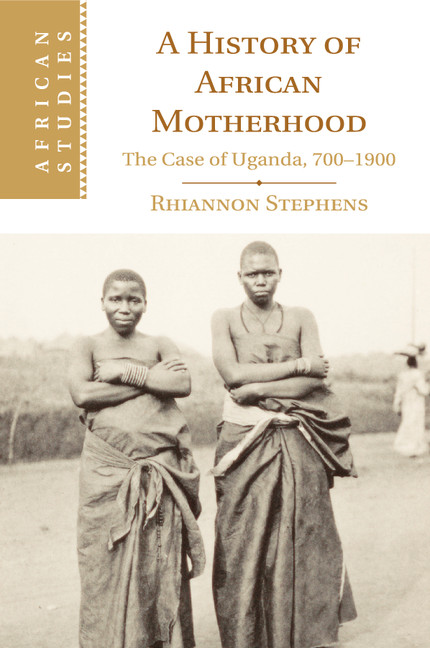
    This history of African motherhood over the longue durée demonstrates that it was, ideologically and practically, central to social, economic, cultural and political life. The book explores how people in the North Nyanzan societies of Uganda used an ideology of motherhood to shape their communities. More than biology, motherhood created essential social and political connections that cut across patrilineal and cultural-linguistic divides. The importance of motherhood as an ideology and a social institution meant that in chiefdoms and kingdoms queen mothers were powerful officials who legitimated the power of kings. This was the case in Buganda, the many kingdoms of Busoga, and the polities of Bugwere. By taking a long-term perspective from c.700 to 1900 CE and using an interdisciplinary approach - drawing on historical linguistics, comparative ethnography, and oral traditions and literature, as well as archival sources - this book shows the durability, mutability and complexity of ideologies of motherhood in this region.

    Reviews

    ‘This work is a major contribution to the expanding new, groundbreaking field of African historical studies, which aims to bring to light the hitherto neglected precolonial social history of the continent. The author shows a full and finely tuned grasp of the techniques of linguistic historical reconstruction and a complete knowledge of - and an ability to effectively incorporate - the literature and the historical sources.’

    Christopher Ehret - University of California, Los Angeles

    'This study provides a fascinating analysis of language regarding the nature of marriage and matrilateral relationships in patrilineal societies. It makes a convincing case for seeing marriage and motherhood as lying at the heart of alliance-building in precolonial Africa. This is the most readable and comprehensible text available based on African historical linguistics.'

    Shane Doyle - University of Leeds

    Refine List

    Actions for selected content:

    Select all | Deselect all
    • View selected items
    • Export citations
    • Download PDF (zip)
    • Save to Kindle
    • Save to Dropbox
    • Save to Google Drive

    Save Search

    You can save your searches here and later view and run them again in "My saved searches".

    Please provide a title, maximum of 40 characters.
    ×

    Contents

    Bibliography

    I. Unpublished Sources and Archival Collections

    Uganda

    Entebbe

    Summer Institute of Languages:

    • Logose, Gertrude. “Eirya lye Kigwere.” [“Gwere Marriage”]. Lugwere Bible Translation Project.

    • “Lugwere-English Wordlist.” Lugwere Bible Translation Project.

    Kampala

    Africana Library, Makerere University:

    Andrew, Wabwezi. “The Bagwere Proverbs.” BA diss., Makerere University, Kampala, 2004.
    Kiyimba, Abasi. “Gender Stereotypes in the Folktales and Proverbs of the Baganda.” PhD diss., University of Dar es Salaam, 2001.

    Archives of the Kampala Archdiocese, Rubaga:

    • Le Veux, Henri. “Au temps jadis: Le mariage des Baganda (au Victoria Nyanza).”

    United Kingdom

    London

    British Library:

    • Church Missionary Society Archive Section IV: African Missions. Part 20: Uganda Mission 1898–1934. Microfilm.

    London School of Economics Archives:

    • Audrey Isabel Richards (1899–1984) Collection.

    Liverpool

    Mill Hill Missionaries’ Archives:

    • Personal Files.

    • Kirk, Christopher.

    • Term, van, Anthony.

    • St. Joseph’s Advocate.

    • Uganda Collection.

    Italy

    Rome

    Archives de la Société des Missionaries d’Afrique (Pères Blancs) [White Fathers]:Diaires originaux, Rubaga.

    United States

    Ronald R. Atkinson Private Collection:

    • Atkinson, Ronald R. ed. “Bugwere Historical Texts.”

    • Long, W. H. “Notes of the Bugwere District,” c. 1933. J. R. McD. Elliot Papers, Rhodes House Library.

    David William Cohen Private Collection:

    • Cohen, David W. ed. “Collected Texts of Busoga Traditional History.”

    • Tantala, Renée. “Community and Polity in Southern Kigulu.”

    • Tantala, Renée “Gonza Bato and the Consolidation of Abaisengobi Rule in Southern Kigulu.”

    David L. Schoenbrun Private Collection:

    • Birusha, Aramazani. “Description de la langue Havu (bantou J52): Grammaire et lexique.” PhD diss., Université Libre de Bruxelles, 1984–1985.

    • Ehret, Christopher, Gary Okihiro , Terry Stamps , Barbara Turner , and Sherilyn Young. “Lacustrine History and Linguistic Evidence: Preliminary Conclusions.” University of California, Los Angeles, 1973.

    • Schoenbrun, David. “Field Notes.” Evanston, Ill.

    Chicago, Center for Research Libraries:

    Cohen, David W. ed. “Selected Texts of Busoga Traditional History.” Baltimore, 1969. Microfilm.

    Other Dissertations: de Luna, Kathryn. M. “Collecting Food, Cultivating Persons: Wild Resource Use in Central African Political Culture, c. 1000 B.C.E. to c. 1900 C.E.” PhD diss., Northwestern University, 2008.Kodesh, Neil. “Beyond the Royal Gaze: Clanship and Collective Well-Being in Buganda.” PhD diss., Northwestern University, 2004.Mould, Martin Joel. “Comparative Grammar Reconstruction and Language Subclassification: The North Victorian Bantu Languages.” PhD diss., University of California, Los Angeles, 1976.Musisi, Nakanyike Beatrice. “Transformations of Baganda Women: From the Earliest Times to the Demise of the Kingdom in 1966.” PhD diss., University of Toronto, 1992.Schoenbrun, David Lee. “Early History in Eastern Africa’s Great Lakes Region: Linguistic, Ecological, and Archaeological Approaches, ca. 500 B.C. to ca. A.D. 1000.” PhD diss., University of California, Los Angeles, 1990.Stephens, Rhiannon. “A History of Motherhood, Food Procurement and Politics in East-Central Uganda to the Nineteenth Century.” PhD diss., Northwestern University, 2007.Tantala, Renée Louise. “The Early History of Kitara in Western Uganda: Process Models of Religious and Political Change.” PhD diss., University of Wisconsin-Madison, 1989.Tappan, Jennifer. “‘A Healthy Children Comes From A Healthy Mother’: Mwanamugimu and Nutritional Science in Uganda, 1935–1973.” PhD diss., Columbia University, 2010.

    II. Published Sources

    Allman, Jean. “Rounding Up Spinsters: Gender Chaos and Unmarried Women in Colonial Asante.” In “Wicked” Women and the Reconfiguration of Gender in Africa, edited by Dorothy L. Hodgson and Sheryl A. McCurdy, 130–48. Portsmouth, N.H.: Heinemann, 2001.
    Allman, Jean, Susan Geiger, and Nakanyike Musisi, eds., Women in African Colonial Histories. Bloomington: Indiana University Press, 2002.
    Alpers, Edward A.Ivory and Slaves: Changing Pattern of International Trade in East Central Africa to the Later Nineteenth Century. Berkeley: University of California Press, 1975.
    Anthony, David W.The Horse, The Wheel, and Language: How Bronze-Age Riders from the Eurasian Steppes Shaped the Modern World. Princeton: Princeton University Press, 2007.
    Ashley, Ceri Z. “Towards a Socialised Archaeology of Ceramics in Great Lakes Africa.” African Archaeological Review 27, no. 2 (2010): 135–63.
    Atkinson, Clarissa W.The Oldest Vocation: Christian Motherhood in the Middle Ages. Ithaca: Cornell University Press, 1991.
    Atkinson, Quentin D., and Russell D. Gray. “How Old Is the Indo-European Language Family? Illumination or More Moths to the Flame?” In Phylogenetic Methods and the Prehistory of Languages, edited by Peter Forster and Colin Renfrew, 91–109. Cambridge: McDonald Institute for Archaeological Research, 2006.
    Barnes, Sandra T. “Gender and the Politics of Support and Protection in Precolonial West Africa.” In Queens, Queen Mothers, Priestesses, and Power: Case Studies in African Gender, edited by Flora Edouwaye S. Kaplan, 1–18. New York: New York Academy of Sciences, 1997.
    Bastin, Yvonne. Les relations sémantiques dans les langues bantoues, Classe des Sciences Morales et Politiques. Memoire in-8, N.S. 48, no. 4. Brussels: Académie Royale des Sciences d’Outre-Mer, 1985.
    Bastin, Yvonne, André Coupez, and Michael Mann. Continuity and Divergence in the Bantu Languages: Perspectives from a Lexicostatistic Study, Annales Sciences Humaines 162. Tervuren, Belgium: Musée Royal de l’Afrique Centrale, 1999.
    Bastin, Yvonne, and Thilo C. Schadeberg, eds. “Bantu Lexical Reconstructions 3.” Tervuren, Belgium: Musée Royale de l’Afrique Centrale. http://www.metafro.be/blr/ (Accessed 16 January 2013).
    Bay, Edna G. “Belief, Legitimacy and the Kpojito: An Institutional History of the ‘Queen Mother’ in Precolonial Dahomey.” Journal of African History 36, no. 1 (1995): 1–27.
    Beattie, J. M. “Nyoro Marriage and Affinity.” Africa: Journal of the International African Institute 28, no. 1 (1958): 1–22.
    Bellwood, Peter, James J. Fox, and Darrell Tryon, eds. The Austronesians: Historical and Comparative Perspectives. Canberra: Australian National University Press, 1995.
    Berger, Iris. “Fertility as Power: Spirit Mediums, Priestesses and the Precolonial State in the Interlacustrine East Africa.” In Revealing Prophets: Prophecy in Eastern African History, edited by David M. Anderson and Douglas H. Johnson, 65–82. London: James Currey, 1995.
    Beswick, Stephanie. Sudan’s Blood Memory: The Legacy of War, Ethnicity, and Slavery in Early South Sudan. Rochester, N.Y.: University of Rochester Press, 2004.
    Blier, Suzanne Preston. “The Path of the Leopard: Motherhood and Majesty in Early Danhomè.” Journal of African History 36, no. 3 (1995): 391–417.
    Bongaarts, John. “Does Family Planning Reduce Infant Mortality Rates?” Population and Development Review 13, no. 2 (1987): 323–34.
    Bourgeois, R.Banyarwanda et Barundi: Tome I, éthnographie. Classe des sciences morales et politiques. Mémoires In.8˚, N.S. 15. Brussels: Académie Royale des Sciences Coloniales, 1958.
    Bowers, Toni. The Politics of Motherhood: British Writing and Culture, 1680–1760. Cambridge: Cambridge University Press, 1996.
    Brierley, Jean, and Thomas Spear, “Mutesa, the Missionaries, and Christian Conversion in Buganda.” International Journal of African Historical Studies 21, no. 4 (1988): 601–18.
    Bukenya, A., and L. Kamoga. Standard Luganda–English Dictionary. Kampala: Fountain Publishers, 2009.
    Capen, Carole J.Bilingual Dholuo-English Dictionary. Tucson, A.Z.: C.A. Capen, 1998.
    Chrétien, Jean-Pierre. “Les années de l’éleusine, du sorgho et du haricot dans l’ancien Burundi: Écologie et idéologie.” African Economic History 7 (1979): 75–92.
    Chrétien, Jean-Pierre. The Great Lakes of Africa: Two Thousand Years of History. Translated by Scott Strauss. New York: Zone Books, 2003.
    Cohen, David William “The Cultural Topography of a ‘Bantu Borderland’: Busoga, 1500–1850.” Journal of African History 29, no. 1 (1988): 57–79.
    Cohen, David William “The Face of Contact: A Model of a Cultural and Linguistic Frontier in Early Eastern Uganda.” In Nilotic Studies: Proceedings of the International Symposium on Languages and History of the Nilotic Peoples, Cologne, January 4–6, 1982, part II, edited by Rainer Vossen and Marianne Bechhaus-Gerst, 339–55. Berlin: Dietrich Reimer Verlag, 1983.
    Cohen, David WilliamThe Historical Tradition of Busoga: Mukama and Kintu. Oxford: Clarendon Press, 1972.
    Cohen, David William “The Political Transformation of Northern Busoga, 1600–1900.” Cahiers d’Études Africaines 22, no. 87/88 (1982): 465–88.
    Cohen, David William “The River-Lake Nilotes from the Fifteenth to the Nineteenth Century.” In Zamani: A Survey of East African History, edited by B. A. Ogot, 135–49. Nairobi: East African Publishing House, 1968; 2nd edition, 1974.
    Cohen, David WilliamTowards a Reconstructed Past: Historical Texts from Busoga, Uganda. Oxford: Oxford University Press for the British Academy, 1986.
    Cohen, David WilliamWomunafu’s Bunafu: A Study of Authority in a Nineteenth-Century African Community. Princeton: Princeton University Press, 1977.
    Connah, Graham. Kibiro: The Salt of Bunyoro, Past and Present. London: British Institute in Eastern Africa, 1996.
    Coupez, A., Th. Kamanzi, S. Bizimana, G. Sematama, G. Rwabukumba, C. Ntazinda, and collaborators. Inkoranya y’íkinyarwanda: Dictionnaire rwanda–rwanda et rwanda–français mu kinyanrwanda nó mu gifaraansá. Tervuren, Belgium: Musée Royale de l’Afrique Centrale, 2005.
    Cox, John L. “Amakiro: A Ugandan Puerperal Psychosis.” Social Psychiatry and Psychiatric Epidemiology 14, no. 1 (1979): 49–52.
    Cunningham, J. F.Uganda and Its Peoples: Notes on the Protectorate of Uganda Especially the Anthropology of Its Indigenous Races. London: Hutchinson, 1905.
    Dammamm, E. “Inversiva und Repetitiva in Bantusprachen,” Afrika und Übersee 43 (1959): 116–27.
    Davis, Margaret. A Lunyoro–Lunyankole–English and English–Lunyoro–Lunyankole Dictionary. Kampala: Uganda Book Shop, 1952.
    De Langhe, E., R. Swenne, and D. Vuylsteke. “Plantain in the Early Bantu World.” Azania 29–30 (1994–1995): 147–60.
    Demand, Nancy. Birth, Death, and Motherhood in Classical Greece. Baltimore: Johns Hopkins University Press, 1994.
    Dictionary: Lusoga-English English-Lusoga. Jinja, Uganda: Cultural Research Centre, 2000.
    Dike, K. Onwuka. Trade and Politics in the Niger Delta, 1830–1885: An Introduction to the Economic and Political History of Nigeria. Oxford: Clarendon Press, 1956.
    Diop, Cheikh Anta. L’unité culturelle de l’Afrique noire: Domaines du patriarcat et du matriarcat dans l’antiquité classique. Paris: Présence Africaine, 1959.
    Doyle, Shane. “Sexual Behavioural Change in Ankole, Western Uganda, c. 1880–1980.” Journal of Eastern African Studies, 6, no.3 (2012): 490–506.
    Edgerton, Robert B.The Individual in Cultural Adaptation: A Study of Four East African Peoples. Berkeley: University of California Press, 1971.
    Ehret, Christopher. An African Classical Age: Eastern and Southern Africa in World History, 1000 B.C. to A.D. 400. Charlottesville: University of Virginia Press, 1998.
    Ehret, Christopher. “Bantu Expansions: Re-Envisioning a Central Problem of Early African History.” International Journal of African Historical Studies 34, no. 1 (2001): 5–41.
    Ehret, ChristopherA Historical-Comparative Reconstruction of Nilo-Saharan. Cologne: Rüdiger Köppe Verlag, 2001.
    Ehret, ChristopherHistory and the Testimony of Language. Berkeley: University of California Press, 2011.
    Ehret, Christopher “Language Change and the Material Correlates of Language and Ethnic Shift.” Antiquity 62, no. 238 (1988): 564–74.
    Ehret, ChristopherSouthern Nilotic History: Linguistic Approaches to the Study of the Past. Evanston, Ill.: Northwestern University Press, 1971.
    Ehret, Christopher “Writing African History From Linguistic Evidence.” In Writing African History, edited by John Edward Philips, 86–111. Rochester, N.Y.: University of Rochester Press, 2005.
    Engels, Frederick. The Origin of the Family, Private Property and the State: In the Light of the Researches of Lewis H. Morgan, edited by Eleanor Burke Leacock, translated by Alec West. New York: International Publishers, 1972.
    Fadlalla, Amal Hassan. Embodying Honor: Fertility, Foreignness, and Regeneration in Eastern Sudan. Madison: University of Wisconsin Press, 2007.
    Fallers, Lloyd A.Bantu Bureaucracy: A Century of Political Evolution among the Basoga of Uganda. 2nd ed. Chicago: University of Chicago Press, 1965.
    Fallers, Lloyd A. “Some Determinants of Marriage Stability in Busoga: A Reformulation of Gluck’s Hypothesis.” Africa: Journal of the International African Institute 27, no. 2 (1957): 106–23.
    Feierman, Steven. “A Century of Ironies in East Africa (c. 1780–1890).” In African History: From Earliest Times to Independence, edited by Philip Curtin, Steven Feierman, Leonard Thompson, and Jan Vansina, 352–76. 2nd ed. London: Longman, 1995.
    Feierman, Steven. Peasant Intellectuals: Anthropology and History in Tanzania. Madison: University of Wisconsin Press, 1990.
    Feierman, StevenThe Shambaa Kingdom: A History. Madison: University of Wisconsin Press, 1974.
    Feierman, Steven “Struggles for Control: The Social Roots of Health and Healing in Modern Africa.” African Studies Review 28, no. 2–3 (1985): 73–147.
    Fields-Black, Edda L.Deep Roots: Rice Farmers in West Africa and the African Diaspora. Bloomington: Indiana University Press, 2008.
    Forster, Peter, and Colin Renfrew, eds. Phylogenetic Methods and the Prehistory of Languages. Cambridge: McDonald Institute for Archaeological Research, 2006.
    Fraas, Pauline. A Nande–English and English–Nande Dictionary. Washington, D.C.: Laubach Literacy Fund, 1961.
    Gailey, Christine Ward. Kinship to Kingship: Gender Hierarchy and State Formation in the Tongan Islands. Austin: University of Texas Press, 1987.
    Garrett, Andrew. “Convergence in the Formation of Indo-European Subgroups: Phylogeny and Chronology.” In Phylogenetic Methods and the Prehistory of Languages, edited by Peter Forster and Colin Renfrew, 139–51. Cambridge: McDonald Institute for Archaeological Research, 2006.
    Gerring, John. “Ideology: A Definitional Analysis.” Political Research Quarterly 50, no. 4 (1997): 957–94.
    Goldschmidt, Walter. The Sebei: A Study in Adaptation. New York: Holt, Rinehart and Winston, 1986.
    Goldschmidt, Walter, with Gale Goldschmidt. Culture and Behavior of the Sebei: A Study in Continuity and Adaptation. Berkeley: University of California Press, 1976.
    Gonzales, Rhonda M.Societies, Religion, and History: Central East Tanzanians and the World They Created, c. 200 B.C.E. to 1800 C.E. New York: Columbia University Press, Gutenberg e-book, 2008. http://www.gutenberg-e.org/gonzales/ (Accessed 2 January 2013).
    Goody, Jack. “The Mother’s Brother and the Sister’s Son in West Africa.” Journal of the Royal Anthropological Institute of Great Britain and Ireland 89, no. 1 (1959): 61–88.
    Gorju, Julien L.Entre le Victoria l’Albert et l’Edouard: Ethnographie de la partie Anglaise du Vicariat de l’Uganda, Origines, histoire, religion, coutumes. Rennes: Oberthür, 1920.
    Gray, J. M. “Correspondence: Mutesa.” Uganda Journal 2, no. 1 (1934): 83–5.
    Gray, J. M. “Mutesa of Buganda, Uganda Journal 1, no. 1 (1934): 22–50.
    Green, Toby. The Rise of the Trans-Atlantic Slave Trade in Western Africa. New York: Cambridge University Press, 2012.
    Gulere, C.Lusoga–English Dictionary Eibwanio. Kampala: Fountain Publishers, 2009.
    Guthrie, Malcolm. Comparative Bantu: An Introduction to the Comparative Linguistics and Prehistory of the Bantu Languages, vols. 1–4. Farnborough, U.K.: Gregg International, 1967–1970.
    Guthrie, MalcolmA Vocabulary of Icibemba, edited by M. Mann. London: School of Oriental and African Studies, 1995.
    Guyer, Jane I., and Samuel M. Eno Belinga. “Wealth in People as Wealth in Knowledge: Accumulation and Composition in Equatorial Africa.” Journal of African History 36, no. 1 (1995): 91–120.
    Hage, Per, and Jeff Marck. “Proto-Bantu Descent Groups.” In Kinship, Language, and Prehistory: Per Hage and the Renaissance in Kinship Studies, edited by Doug Jones and Bojka Milicic, 75–8. Salt Lake City: University of Utah Press, 2011.
    Hall, Bruce S.A History of Race in Muslim West Africa, 1600–1960. New York: Cambridge University Press, 2011.
    Hanson, Holly Elisabeth. “Queen Mothers and Good Government in Buganda: The Loss of Women’s Political Power in Nineteenth-Century East Africa.” In Women in African Colonial Histories, edited by Jean Allman, Susan Geiger, and Nakanyike Musisi, 219–36. Bloomington: Indiana University Press, 2002.
    Hanson, Holly Elisabeth. Landed Obligation: The Practice of Power in Buganda. Portsmouth, N.H.: Heinemann, 2003.
    Hanson, Holly Elisabeth. “Stolen People and Autonomous Chiefs in Nineteenth-Century Buganda: The Social Consequences of Non-Free Followers.” In Slavery in the Great Lakes Region of East Africa, edited by Henri Médard and Shane Doyle, 161–73. Oxford: James Currey, 2007.
    Heine, Bernd. Ik Dictionary. Cologne: Rüdiger Köppe Verlag, 1999.
    Henige, David. “‘The Disease of Writing’: Ganda and Nyoro Kinglists in a Newly Literate World.” In The African Past Speaks: Essays on Oral Tradition and History, edited by Joseph C. Miller, 240–61. Folkestone: Dawson, 1980.
    Herbert, Eugenia W.Iron, Gender, and Power: Rituals of Transformation in African Societies. Bloomington: Indiana University Press, 1993.
    Hilders, J. H., and J. C. D. Lawrance. An English-Ateso and Ateso-English Vocabulary. Nairobi: Eagle Press, 1958.
    Hodgson, Dorothy L., and Sheryl A. McCurdy, eds. “Wicked” Women and the Reconfiguration of Gender in Africa. Portsmouth, N.H.: Heinemann, 2001.
    Hunt, Nancy Rose. “‘Le Bébé en Brousse’: European Women, African Birth Spacing and Colonial Intervention in Breast Feeding in the Belgian Congo.” International Journal of African Historical Studies 21, no. 3 (1988): 401–32.
    Huntingford, G. W. B. “The Orusyan Language of Uganda.” Journal of African Languages 4, no. 3 (1965): 145–69.
    Hunwick, John O. Sharī‘a In Songhay: The Replies of al-Maghīlī to the Questions of Askia al-Hājj Muhammad. Oxford: Oxford University Press for the British Academy, 1985.
    Irstam, Tor V. H.The King of Ganda: Studies in the Institutions of Sacral Kingship in Africa, trans. Donald Burton. Lund: H. Ohlssons boktr., 1944.
    Jackson, Frederick J.Early Days in East Africa. London: Edward Arnold, 1930.
    Johnson, Frederick. A Standard Swahili–English Dictionary (Founded on Madan’s Swahili–English Dictionary). Nairobi: Oxford University Press, 1939. Reprint 1996.
    Johnson-Hanks, Jennifer. Uncertain Honor: Modern Motherhood in an African Crisis. Chicago: University of Chicago Press, 2006.
    Johnston, Harry. The Uganda Protectorate: An Attempt to Give Some Description of the Physical Geography, Botany, Zoology, Anthropology, Languages and History of the Territories under British Protection in East Central Africa, between the Congo Free State and the Rift Valley and between the First Degree of South Latitude and the Fifth Degree of North Latitude. Vol. 2. London: Hutchinson, 1904.
    Joseph, Brian D., and Richard D. Janda, eds. The Handbook of Historical Linguistics. Oxford: Blackwell, 2003.
    Kagaya, Ryohei. A Gwere Vocabulary. Asian and African Lexicon 48. Tokyo: Research Institute for Languages and Cultures of Asia and Africa, Tokyo University of Foreign Studies, 2006.
    Kagwa, Apolo. Ekitabo kye Mpisa za Baganda [The Book of the Customs of the Baganda]. Kampala: Uganda Printing and Publishing, 1918.
    Kagwa, Apolo. Ekitabo kya Basekabaka be Buganda na be Bunyoro, na be Koki, na be Toro, na be Nkole [The Book of the Kings of Buganda and of Bunyoro, and of Koki, and of Toro, and of Nkole]. Kampala: Uganda Bookshop and Publishing House, 1927.
    Kagwa, ApoloThe Customs of the Baganda, translated by Ernest B. Kalibala, edited by May Mandelbaum (Edel). New York: Columbia University Press, 1934. Reprint, New York: AMS Press, 1969.
    Kagwa, ApoloEngero za Baganda [The Tales of the Baganda]. London: Sheldon Press, 1927.
    Kagwa, ApoloThe Kings of Buganda, translated by M. S. M. Kiwanuka. Nairobi: East African Publishing House, 1971.
    Kaji, Shigeki. A Haya Vocabulary. Asian and African Lexicon 37. Tokyo: Research Institute for Languages and Cultures of Asia and Africa, Tokyo University of Foreign Studies, 2000.
    Kaji, ShigekiLexique tembo I: Tembo–swahili du Zaïre–japonais– français. Asian and African Lexicon 16. Tokyo: Research Institute for Languages and Cultures of Asia and Africa, Tokyo University of Foreign Studies, 1986.
    Kaji, ShigekiA Runyankore Vocabulary. Asian and African Lexicon 44. Tokyo: Research Institute for Languages and Cultures of Asia and Africa, Tokyo University of Foreign Studies, 2004.
    Kaji, ShigekiVocabulaire hunde. Asian and African Lexicon 24. Tokyo: Research Institute for Languages and Cultures of Asia and Africa, Tokyo University of Foreign Studies, 1992.
    Kamusi ya Kiswahili Sanifu. Dar-es-Salaam: Oxford University Press for Taasisi ya Uchunguzi wa Kiswahili, 1981.
    Kaplan, Flora Edouwaye S., ed. Queens, Queen Mothers, Priestesses, and Power: Case Studies in African Gender. New York: New York Academy of Sciences, 1997.
    Karugire, Samwiri Rubaraza. A History of the Kingdom of Nkore in Western Uganda to 1896. Oxford: Clarendon Press, 1971.
    Karugire, Samwiri Rubaraza. A Political History of Uganda. Nairobi: Heinemann, 1980.
    Kiingi, K. B.Enkuluze y’Oluganda ey’e Makerere [The Makerere Treasury of Luganda]. Kampala: Fountain Publishers, 2007.
    Kimambo, Isaria N. A Political History of the Pare of Tanzania c. 1500–1900. Nairobi: East African Publishing House, 1969.
    Kirkpatrick, R. T. “Lake Choga and Surrounding Country.” Uganda Journal 10, no. 2 (1946): 160–2.
    Kiwanuka, M. S. M. Semakula. A History of Buganda: From the Foundation of the Kingdom to 1900. London: Longman, 1971.
    Klieman, Kairn A. “The Pygmies Were Our Compass”: Bantu and Batwa in the History of West Central Africa, Early Times to c. 1900 C.E. Portsmouth, N.H.: Heinemann, 2003.
    Knight, Kathleen. “Transformations in the Concept of Ideology in the Twentieth Century.” American Political Science Review 100, no. 4 (2006): 619–26.
    Kodesh, Neil. “History from the Healer’s Shrine: Genre, Historical Imagination, and Early Ganda History.” Comparative Studies in Society and History 49, no. 3 (2007): 527–52.
    Kodesh, Neil. Beyond the Royal Gaze: Clanship and Public Healing in Buganda. Charlottesville: University of Virginia Press, 2010.
    Kottak, Conrad P. “Ecological Variables in the Origin and Evolution of African States: The Buganda Example.” Comparative Studies in Society and History 14, no. 3 (1972): 351–80.
    Kuhanen, Jan. Poverty, Health and Reproduction in Early Colonial Uganda. University of Joensuu Publications in the Humanities 37. Joensuu, Finland: University of Eastern Finland Electronic Publications, 2005. http://urn.fi/URN:ISBN:952–458–898–6/ (Accessed 9 January 2013).
    Kyomuhendo, Grace Bantebya, and Marjorie Keniston McIntosh. Women, Work & Domestic Virtue in Uganda, 1900–2003. Oxford: James Currey, 2006.
    Laight, Miss., and Y. K. Lubogo. “Basoga Death and Burial Rites.” Uganda Journal 2, no. 2 (1934/1935): 120–32. (Note that this was initially erroneously published under the name of Ezekeri Zibondo. A letter rectifying the error was published in Uganda Journal 2, no. 3 (1935): 255.)
    Lamphear, John. The Traditional History of the Jie of Uganda. Oxford: Clarendon Press, 1976.
    Langlands, B. W. “The Banana in Uganda – 1860–1920.” Uganda Journal 30, no. 1 (1966): 39–63.
    Lawrance, J. C. D.The Iteso: Fifty Years of Change in a Nilo-Hamitic Tribe of Uganda. London: Oxford University Press, 1957.
    Leacock, Eleanor. “Interpreting the Origins of Gender Inequality: Conceptual and Historical Problems.” Dialectical Anthropology 7, no. 4 (1983): 263–84.
    Lejju, B. Julius, Peter Robertshaw, and David Taylor. “Africa’s Earliest Bananas?” Journal of Archaeological Science 33, no. 1 (2006): 102–13.
    Le Veux, Père. Manuel de langue luganda comprenant la grammaire et un recueil de contes et de légendes. Maison-Carrée, Algeria: Imprimerie des Missionaires d’Afriques (Pères Blancs), 1914.
    Le Veux, Père. Premier essai de vocabulaire luganda – français d’après l’ordre étymologique. Maison-Carrée, Algeria: Imprimerie des Missionaires d’Afrique (Pères Blancs), 1917.
    Lindsay, Lisa A., and Stephan F. Miescher, eds. Men and Masculinities in Modern Africa. Portsmouth, N.H.: Heinemann, 2003.
    Lubogo, Y. K.A History of Busoga, translated by Eastern Province (Bantu Language) Literature Committee. Jinja: East African Literature Bureau, 1960.
    MacGaffey, Wyatt. “Changing Representations in Central African History.” Journal of African History 46, no. 2 (2005): 189–207.
    Mair, L. P.Native Marriage in Buganda. London: Oxford University Press for the International Institute of African Languages and Cultures, 1940.
    Mair, L. P.An African People in the Twentieth Century. London: Routledge and Kegan Paul, 1934. Reprint, New York: Russell and Russell, 1966.
    Marck, Jeff. Topics in Polynesian Language and Culture History. Canberra: Pacifica Linguistics, Australian National University, 2000.
    Marck, Jeff, and Koen Bostoen, “Proto-Oceanic Society (Austronesian) and Proto-East Bantu Society (Niger-Congo) Residence, Descent, and Kin Terms, ca. 1000 BC.” In Kinship, Language, and Prehistory: Per Hage and the Renaissance in Kinship Studies, edited by Doug Jones and Bojka Milicic, 83–94. Salt Lake City: University of Utah Press, 2011.
    Mark, Peter. “Portuguese” Style and Luso-African Identity: Precolonial Senegambia, Sixteenth-Nineteenth Centuries. Bloomington: Indiana University Press, 2002.
    Maroney, Heather Jon. “Embracing Motherhood: New Feminist Theory.” In The Politics of Diversity: Feminism, Marxism and Nationalism, edited by Roberta Hamilton and Michèle Barrett, 398–423. London: Verso, 1986.
    McCaskie, T. C. “Denkyira in the Making of Asante, c. 1660–1720.” Journal of African History 48, no. 1 (2007): 1–25.
    McMahon, April, and Robert McMahon. Language Classification by Numbers. Oxford: Oxford University Press, 2005.
    McMahon, April, and Robert McMahon. “Why Linguists Don’t Do Dates: Evidence from Indo-European and Australian Languages.” In Phylogenetic Methods and the Prehistory of Languages, edited by Peter Forster and Colin Renfrew, 153–60. Cambridge: McDonald Institute for Archaeological Research, 2006.
    McMaster, David N.A Subsistence Crop Geography of Uganda. Bude, U.K.: Geographical Publications, 1962.
    Médard, Henri. Le royaume du Buganda au XIXe siècle: Mutations politiques et religieuses d’un ancien État d’Afrique de l’Est. Paris: Karthala, 2007.
    Médard, Henri, and Shane Doyle, eds. Slavery in the Great Lakes Region of East Africa. Oxford: James Currey, 2007.
    Meillassoux, Claude. Maidens, Meal, and Money: Capitalism and the Domestic Community, translated by author. Cambridge: Cambridge University Press, 1981.
    Merrett-Balkos, Leanne. “Just Add Water: Remaking Women through Childbirth, Anganen, Southern Highlands, Papua New Guinea.” In Maternities and Modernities: Colonial and Postcolonial Experiences in Asia and the Pacific, edited by Kalpana Ram and Margaret Jolly, 213–38. Cambridge: Cambridge University Press, 1998.
    Miers, Suzanne, and Igor Kopytoff, eds. Slavery in Africa: Historical and Anthropological Perspectives. Madison: University of Wisconsin Press, 1977.
    de Moraes Farias, P. F.Medieval Inscriptions from the Republic of Mali: Epigraphy, Chronicles and Songhay-Tuāreg History. Oxford: Oxford University Press for the British Academy, 2003.
    Morgan, Lewis H. Ancient Society or Researches in the Lines of Human Progress from Savagery through Barbarism to Civilization. Chicago: Charles H. Kerr, 1877.
    Mukasa, Ham. “Ebifa ku Mulembe gwa Kabaka Mutesa [The History of the Reign of Kabaka Mutesa],” translated by A. H. C. Uganda Journal 1, no. 2 (1934): 116–33.
    Muniko, S. M., B. Muita oMagige, and MalcolmRuel. Kuria–English Dictionary. Hamburg: LIT, 1996.
    Murdock, George Peter. Africa: Its Peoples and Their Culture History. New York: McGraw-Hill, 1959.
    Muriuki, Godfrey. A History of the Kikuyu, 1500–1900. Nairobi: Oxford University Press, 1974.
    Murphy, John D.Luganda–English Dictionary, Publications in the Languages of Africa 2. Washington, D.C.: Consortium Press for Catholic University of America, 1972.
    Musisi, Nakanyike B. “Women, ‘Elite Polygyny,’ and Buganda State Formation.” Signs 16, no. 4 (1991): 757–86.
    Nabirye, Minah. Eiwanika ly’Olusoga: Eiwanika ly’Aboogezi b’Olusoga n’Abo Abenda Okwega Olusoga [A Treasury of Lusoga: A Treasury for Speakers of Lusoga and Those Who Want to Learn Lusoga]. Kampala: Menha Publishers, 2009.
    Nannyonga-Tamusuza, Sylvia A.Baakisimba: Gender in the Music and Dance of the Baganda People of Uganda. New York: Routledge, 2005.
    Neumann, Katharina, and Elisabeth Hildebrand. “Early Bananas in Africa: The State of the Art.” Ethnobotany Research and Applications 7 (2009): 353–62.
    Newbury, Catharine. The Cohesion of Oppression: Clientship and Ethnicity in Rwanda, 1860–1960. New York: Columbia University Press, 1988.
    Newbury, David. Kings and Clans: Ijwi Island and the Lake Kivu Rift, 1780–1840. Madison: University of Wisconsin Press, 1991.
    Nsimbi, N. B. “Baganda Traditional Personal Names.” Uganda Journal 14, no. 2 (1950): 204–14.
    Nurse, Derek, and Gérard Philippson. “The Bantu Languages of East Africa: A Lexicostatistical Survey.” In Language in Tanzania, edited by Edgar C. Polomé and C. P. Hill, 26–67. Oxford: Oxford University Press for the International African Institute, 1980.
    Nurse, Derek, and Thomas Spear. The Swahili: Reconstructing the History and Language of an African Society, 800–1500. Philadelphia: University of Pennsylvania Press, 1985.
    Nwokeji, G. Ugo. The Slave Trade and Culture in the Bight of Biafra: An African Society in the Atlantic World. New York: Cambridge University Press, 2010.
    Nyakoe O’Matenyo, F.English-Ekegusii Companion. Nairobi: Bookwise, 1981.
    Ochieng’, William Robert. A Pre-colonial History of the Gusii of Western Kenya: From c. A.D. 1500 to 1914. Kampala: East African Literature Bureau, 1974.
    Odaga, Asenath Bole. English-Dholuo Dictionary. Kisumu, Kenya: Lake Publishers & Enterprises, 1997.
    Odonga, Alexander. Lwo-English Dictionary. Kampala: Fountain Publishers, 2005.
    Ogot, Bethwell A.History of the Southern Luo. Volume One: Migration and Settlement 1500–1900. Nairobi: East African Publishing House, 1967.
    Ogunyemi, Chikwenye Okonjo. Africa Wo/Man Palava: The Nigerian Novel by Women. Chicago: Chicago University Press, 1996.
    Oliver, Roland. “Ancient Capital Sites of Ankole.” Uganda Journal 23, no. 1 (1959): 51–63.
    Oliver, Roland “The Problem of the Bantu Expansion.” Journal of African History 7, no. 3 (1966): 361–76.
    Oliver, Roland “The Royal Tombs of Buganda.” Uganda Journal 23, no. 2 (1959): 124–33.
    Oliver, Roland “The Traditional Histories of Buganda, Bunyoro, and Nkole.” Journal of the Royal Anthropological Institute 85, no. 1/2 (1955): 111–17.
    O’Neil, Robert. Mission to the Upper Nile: The Story of the St Joseph’s Missionary Society of Mill Hill in Uganda. London: Mission Book Service, 1999.
    Ongodia, S. P., and A. Ejiet. Ateso–English Dictionary. Kampala: Fountain Publishers, 2008.
    Oyěwùmí, Oyèrónké. “Family Bonds/Conceptual Binds: African Notes on Feminist Epistemologies.” Signs 25, no. 4 (2000): 1093–8.
    Pagel, Mark, and Andrew Meade. “Estimating Rates of Lexical Replacement on Phylogenetic Trees of Languages.” In Phylogenetic Methods and the Prehistory of Languages, edited by Peter Forster and Colin Renfrew, 173–82. Cambridge: McDonald Institute for Archaeological Research, 2006.
    Pankhurst, Richard. A Social History of Ethiopia: The Northern and Central Highlands from Early Medieval Times to the Rise of Emperor Téwodros II. Trenton, N.J.: Red Sea Press, 1992.
    Polak-Bynon, Louise. Lexique shi–français suivi d’un index français–shi. Tervuren, Belgium: Musée Royale de l’Afrique Central, 1978.
    Portal, Gerald. The British Mission to Uganda in 1893. London: Edward Arnold, 1894.
    Radcliffe-Brown, A. R. “Introduction.” In African Systems of Kinship and Marriage, edited by A. R. Radcliffe-Brown and Daryll Forde, 1–85. London: Oxford University Press for the International African Institute, 1950.
    Rapp, Reyna. “Gender and Class: An Archaeology of Knowledge Concerning the Origin of the State.” Dialectical Anthropology 2, no. 4 (1977): 309–16.
    Ray, Benjamin C.Myth, Ritual, and Kingship in Buganda. New York: Oxford University Press, 1991.
    Reid, Andrew. “Bananas and the Archaeology of Buganda.” Antiquity 75, no. 290 (2001): 811–12.
    Reid, Andrew. “Lake Victoria before Buganda.” African Heritage and Archaeology. London: University College London, 2007. http://www.ucl.ac.uk/archaeology/aha/reid/buganda-lakev.htm/ (Accessed 4 January 2013).
    Reid, Andrew. “Ntusi and the Development of Social Complexity in Southern Uganda.” In Aspects of African Archaeology: Papers from the 10th Congress of the Panafrican Association for Prehistory and Related Studies, edited by Gilbert Pwiti and Robert Soper, 621–7. Harare: University of Zimbabwe Publications, 1996.
    Reid, Andrew, and Ceri Z. Ashley. “A Context for the Luzira Head.” Antiquity 82, no. 315 (2008): 99–112.
    Reid, Richard. Political Power in Pre-Colonial Buganda: Economy, Society and Warfare in the Nineteenth Century. Oxford: James Currey, 2002.
    Reid, Andrew, and Ceri Z. Ashley. “Human Booty in Buganda: Some Observations on the Seizure of People in War, c. 1700–1890.” In Slavery in the Great Lakes Region of East Africa, edited by Henri Médard and Shane Doyle, 145–60. Oxford: James Currey, 2007.
    Robertshaw, Peter. “The Ancient Earthworks of Western Uganda: Capital Sites of a Cwezi Empire.” Uganda Journal 48 (2002): 17–32.
    Robertshaw, Peter. “Beyond the Segmentary State: Creative and Instrumental Power in Western Uganda.” Journal of World Prehistory 23, no. 4 (2010): 255–69.
    Robertshaw, Peter. “Women, Labor and State Formation in Western Uganda.” Archeological Papers of the American Anthropological Association 9, no. 1 (1999): 51–65.
    Robertshaw, Peter, and David Taylor. “Climate Change and the Rise of Political Complexity in Western Uganda.” Journal of African History 41, no. 1 (2000): 1–28.
    Robertshaw, Peter, David Taylor, Shane Doyle, and Rachel Marchant. “Famine, Climate and Crisis in Western Uganda.” In Past Climate Variability through Europe and Africa, edited by Richard W. Batterbee, Françoise Gasse, and Catherine E. Stickley, vol. 6, 535–49. Dordrecht, Netherlands: Springer, 2004.
    Rodegem, F. M.Dictionnaire rundi–français. Tervuren, Belgium: Musée Royal de l’Afrique Centrale, 1970.
    Roscoe, John. The Baganda: An Account of Their Native Customs and Beliefs. London: Macmillan, 1911.
    Roscoe, John. The Bagesu and Other Tribes of the Uganda Protectorate: The Third Part of the Report of the Mackie Ethnological Expedition to Central Africa. Cambridge: University Press, 1924.
    Roscoe, JohnThe Northern Bantu: An Account of Some Central African Tribes of the Uganda Protectorate. Cambridge: University Press, 1915.
    Rossel, Gerda. Taxonomic-Linguistic Study of Plantain in Africa. Leiden, Netherlands: CNWS Publications, 1998.
    Rycroft, D. K.Concise SiSwati Dictionary: SiSwati–English/English–SiSwati. Pretoria: J. L. van Schaik, 1981.
    Sacks, Karen. Sisters and Wives: The Past and Future of Sexual Equality. Westport, Conn.: Greenwood Press, 1979.
    Saidi, Christine. Women’s Authority and Society in Early East-Central Africa. Rochester, N.Y.: University of Rochester Press, 2010.
    Sanchez-Mazas, Alicia, Roger Blench, Malcolm D. Ross, Ilia Peiros, and Marie Lin, eds. Past Human Migrations in East Asia: Matching Archaeology, Linguistics and Genetics. New York: Routledge, 2008.
    Schadeberg, Thilo C. “Derivation.” In The Bantu Languages, edited by Derek Nurse and Gérard Philippson, 71–89. London: Routledge, 2003.
    Schiller, Laurence D. “The Royal Women of Buganda.” International Journal of African Historical Studies 23, no. 3 (1990): 455–73.
    Schoenbrun, David Lee. “Cattle Herds and Banana Gardens: The Historical Geography of the Western Great Lakes Region, ca. AD 800–1500.” African Archaeological Review 11, no. 1 (1993): 39–72.
    Schoenbrun, David Lee. “Gendered Histories between the Great Lakes: Varities and Limits.” International Journal of African Historical Studies 29, no. 3 (1996): 461–92.
    Schoenbrun, David Lee. “Great Lakes Bantu: Classification and Settlement Chronology.” Sprache und Geschichte in Afrika 15 (1994): 91–152.
    Schoenbrun, David Lee. A Green Place, A Good Place: Agrarian Change, Gender, and Social Identity in the Great Lakes Region to the 15th Century. Portsmouth, N.H.: Heinemann, 1998.
    Schoenbrun, David Lee. The Historical Reconstruction of Great Lakes Bantu Cultural Vocabulary: Etymologies and Distributions. Cologne: Rüdiger Köppe Verlag, 1997.
    Schoenbrun, David Lee. “Treating an Interdisciplinary Allergy: Methodological Approaches to Pollen Studies for the Historian of Early Africa.” History in Africa 18 (1991): 323–48.
    Schoenbrun, David Lee. “Violence, Marginality, Scorn and Honour: Language Evidence of Slavery to the Eighteenth Century.” In Slavery in the Great Lakes Region of East Africa, edited by Henri Médard and Shane Doyle, 38–76. Oxford: James Currey, 2007.
    Schoenbrun, David Lee. “We Are What We Eat: Ancient Agriculture between the Great Lakes.” Journal of African History 34, no. 1 (1993): 1–31.
    Scott, James C.The Art of Not Being Governed: An Anarchist History of Upland Southeast Asia. New Haven, Conn.: Yale University Press, 2009.
    Scott, Joan W. “Gender: A Useful Category of Historical Analysis.” American Historical Review 91, no. 5 (1986): 1053–75.
    Semley, Lorelle D.Mother Is Gold, Father Is Glass: Gender and Colonialism in a Yoruba Town. Bloomington: Indiana University Press, 2011.
    Shipton, Parker. The Nature of Entrustment: Intimacy, Exchange, and the Sacred in Africa. New Haven, Conn.: Yale University Press, 2007.
    Siertsema, Berthe. Masaba Word List: English-Masaba, Masaba-English. Tervuren, Belgium: Musée Royal de l’Afrique Centrale, 1981.
    Snoxall, R.A. ed. Luganda-English Dictionary. Oxford: Clarendon Press, 1967.
    Southwold, Martin. “Succession to the Throne in Buganda.” In Succession to High Office, edited by Jack Goody, 82–126. Cambridge: Cambridge University Press, 1966.
    Speke, John Hanning. Journal of the Discovery of the Source of the Nile. New York: Harper and Brothers, 1864.
    Stanley, Henry M.Through the Dark Continent or The Sources of the Nile Around the Great Lakes of Equatorial Africa and Down the Livingstone River to the Atlantic Ocean, vol. I. New York: Harper and Brothers, 1878.
    Starosin, Sergei. “Comparative-Historical Linguistics and Lexicostatistics,” translated by N. Evans and I. Peiros. In Time Depth in Historical Linguistics, edited by Colin Renfrew, April McMahon, and R. Larry Trask, 223–65. Cambridge: McDonald Institute for Archaeological Research, 2000.
    Stephens, Rhiannon. “Birthing Wealth? Motherhood and Poverty in East-Central Uganda, c. 700–1900.” Past and Present 215 (2012): 235–68.
    Stephens, Rhiannon. “Lineage and Society in Precolonial Uganda.” Journal of African History 50, no. 2 (2009): 203–21.
    Swadesh, Morris. “Lexico-Statistic Dating of Prehistoric Ethnic Contacts: With Special Reference to North American Indians and Eskimos.” Proceedings of the American Philosophical Society 96, no. 4 (1952): 452–63.
    Swadesh, Morris. “Towards Greater Accuracy in Lexicostatistic Dating.” International Journal of American Linguistics 21, no. 2 (1955): 121–37.
    Tantala, Renée L. “Verbal and Visual Imagery in Kitara (Western Uganda): Interpreting ‘The Story of Isimbwa and Nyinamwiru.’” In Paths Toward the Past: African Historical Essays in Honor of Jan Vansina, edited by Robert W. Harms, Joseph C. Miller, David S. Newbury, and Michele D. Wagner, 223–43. Atlanta, Ga.: African Studies Association Press, 1994.
    Taylor, Charles. A Simplified Runyankore–Rukiga–English and English–Runyankore–Rukiga Dictionary in the 1955 Revised Orthography with Tone-Markings and Full Entries under Prefixes. Kampala: Eagle Press for the East African Literature Bureau, 1959.
    Thomas, H. B. “Captain Eric Smith’s Expedition to Lake Victoria in 1891.” Uganda Journal 23, no. 2 (1959): 134–52.
    Thomas, Lynn M.Politics of the Womb: Women, Reproduction, and the State in Kenya. Berkeley: University of California Press, 2003.
    Trussell, James and Anne R. Pebley, “The Potential Impact of Changes in Fertility on Infant, Child, and Maternal Mortality.” Studies in Family Planning 15, no. 6 (1984): 267–80.
    Tuck, Michael W. “Women’s Experiences of Enslavement and Slavery in Late Nineteenth- and Early Twentieth-Century Uganda.” In Slavery in the Great Lakes, edited by Henri Médard and Shane Doyle, 174–88. Oxford: James Currey, 2007.
    Twaddle, Michael. “Slaves and Peasants in Buganda.” In Slavery and Other Forms of Unfree Labour, edited by Léonie J. Archer, 118–29. London: Routledge, 1988.
    Twaddle, Michael. Kakungulu and the Creation of Uganda, 1868–1928. London: James Currey, 1993.
    Vansina, Jan. Antecedents to Modern Rwanda: The Nyiginya Kingdom, translated by author. Madison: University of Wisconsin Press, 2004.
    Vansina, Jan. How Societies Are Born: Governance in West Central Africa before 1600. Charlottesville: University of Virginia Press, 2004.
    Vansina, JanOral Tradition: A Study in Historical Methodology, translated by H. M. Wright. Chicago: Aldine Publishing, 1965.
    Vansina, JanPaths in the Rainforests: Toward a History of Political Tradition in Equatorial Africa. Madison: University of Wisconsin Press, 1990.
    Vansina, JanThe Tio Kingdom of the Middle Congo: 1880–1892. London: Oxford University Press for the International African Institute, 1973.
    Vansina, Jan “The Use of Process-Models in African History.” In The Historian in Tropical Africa: Studies Presented and Discussed at the Fourth International African Seminar at the University of Dakar Senegal 1961, edited by J. Vansina, R. Mauny, and L. V. Thomas, 375–89. Oxford: Oxford University Press for the International African Institute, 1964.
    Vincent, Joan. Teso in Transformation: The Political Economy of Peasant and Class in Eastern Africa. Berkeley: University of California Press, 1982.
    Walser, Ferdinand. Luganda Proverbs. Berlin: Reimer Verlag, 1982.
    Webster, J. B. “Usuku: The Homeland of the Iteso.” In The Iteso During the Asonya, edited by J. B. Webster, C. P. Emudong, D. H. Okalany, and N. Egimu-Okuda, xv–80. Nairobi: East African Publishing House, 1973.
    Were, Gideon S. A History of the Abaluyia of Western Kenya. Nairobi: East African Publishing House, 1967.
    White, Luise. Speaking with Vampires: Rumor and History in Colonial Africa. Berkeley: University of California Press, 2000.
    Wrigley, Christopher. “Bananas in Buganda.” Azania 24 (1989): 64–70.
    Wrigley, Christopher. “The Kinglists of Buganda.” History in Africa 1 (1974): 129–39.
    Wrigley, ChristopherKingship and State: The Buganda Dynasty. Cambridge: Cambridge University Press, 1996.

    Metrics

    Altmetric attention score

    Full text views

    Total number of HTML views: 0
    Total number of PDF views: 0 *
    Loading metrics...

    Book summary page views

    Total views: 0 *
    Loading metrics...

    * Views captured on Cambridge Core between #date#. This data will be updated every 24 hours.

    Usage data cannot currently be displayed.

    Accessibility standard: Unknown

    Why this information is here

    This section outlines the accessibility features of this content - including support for screen readers, full keyboard navigation and high-contrast display options. This may not be relevant for you.

    Accessibility Information

    Accessibility compliance for the HTML of this book is currently unknown and may be updated in the future.
