
Skip to main content Accessibility help
×
  • Cited by 11
    • Show more authors
    • You may already have access via personal or institutional login
    • Select format
    • Publisher:
      Cambridge University Press
      Publication date:
      27 January 2022
      27 January 2022
      ISBN:
      9781009075886
      9781316513705
      9781009074674
      Dimensions:
      (216 x 138 mm)
      Weight & Pages:
      0.71kg, 434 Pages
      Dimensions:
      (216 x 140 mm)
      Weight & Pages:
      0.537kg, 440 Pages
    You may already have access via personal or institutional login
  • Selected: Digital
    Add to cart View cart Buy from Cambridge.org

    Book description

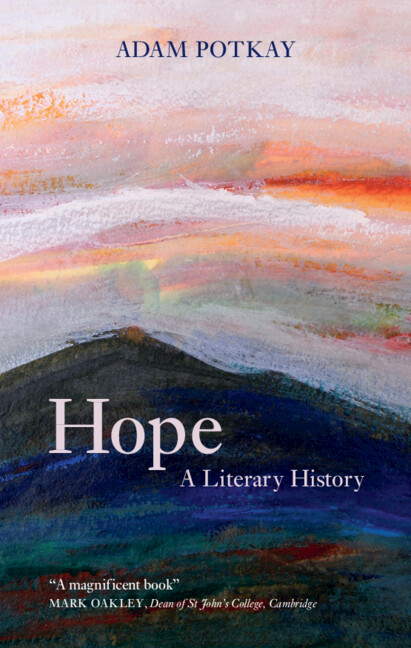
    Hope for us has a positive connotation. Yet it was criticized in classical antiquity as a distraction from the present moment, as the occasion for irrational and self-destructive thinking, and as a presumption against the gods. To what extent do arguments against hope today remain useful? If hope sounds to us like a good thing, that reaction stems from a progressive political tradition grounded in the French Revolution, aspects of Romantic literature and the influence of the Abrahamic faiths. Ranging both wide and deep, Adam Potkay examines the cases for and against hope found in literature from antiquity to the present. Drawing imaginatively on several fields and creatively juxtaposing poetry, drama, and novels alongside philosophy, theology and political theory, the author brings continually fresh insights to a subject of perennial interest. This is a bold and illuminating new treatment of a long-running literary debate as complex as it is compelling.

    Awards

    Shortlisted, 2022 Wordsworth-Coleridge Association Marilyn Gaull Prize, Wordsworth-Coleridge Association

    Reviews

    'Adam Potkay traces the fascinating, tangled history of hope through the centuries, from classical antiquity to the present day, moving with apparently effortless intellectual grace between literature, philosophy, political thought, and theology. It is a work of great humanity as well as immense but lightly worn erudition, a truly memorable account of this most ambiguous of all the virtues.'

    Seamus Perry - University of Oxford

    'How hopeless is it to be hopeful? In this magnificent book, Adam Potkay takes us on a literary tour to discover how some have thought hope to be an illusion best avoided, whilst others have believed it to be a virtue that saves souls or effects political change. At a time when hope is spoken of as a positive emotion, but somewhat lacking in substance, this is an important contribution to help clarify whether reality is ultimately trustworthy enough to revitalise the concept for a new generation.'

    Mark Oakley - Dean of St John’s College, Cambridge

    'Hope: A Literary History is an impressive accomplishment, unusual in its breadth, deeply learned, and engagingly humane in sensibility. Hope is a virtue in common parlance, the optimistic face we turn against a bleak fate. But Potkay traces the origins of this virtue to an equally deeply rooted sense of hope as an irrational flight from reality. These contesting and opposed ideas of hope make for dramatic movements in intellectual history, from the classical and pre-Christian eras through the Enlightenment, Romanticism, and the successive modernisms and post-modernisms of the twentieth century. Potkay’s unique gifts as a historian and reader make him an ideal and genial guide through vast and fascinating cultural territory.'

    Nancy Yousef - Rutgers University

    'Hope has a history. Potkay traces this history through central literary texts from Greek antiquity to Camus and Beckett, appropriately supported by philosophical, theological and political reflections on hope. Presenting the shifting cases for and against hope with clarity and engagement, he invites his readers to face the challenge of hoping in a world of diverse desires. A great book!'

    Werner G. Jeanrond - University of Oslo

    ‘Hope is seen as ‘an unqualified good’ today, Adam Potkay writes in his excellent history of the idea, … Potkay is a careful reader who makes fine, never forcing texts to say what they don’t, and provides sufficient detail without muddying key distinctions. He shows that as long as there are humans, there will be hope, and that this is both a gift and a curse.’

    Micah Mattix Source: The Spectator

    ‘A startling achievement.'

    Madoc Cairns Source: Times Literary Supplement

    ‘… [an] uncommonly insightful exploration of how the world’s literature - from the ancient through the modern - thematizes in enduring works of compelling art the phenomena of hope and, by implication, its ever-present negation, despondency. Potkay adroitly illuminates this familiar, excruciatingly painful dialectic, as old as collective memory itself … Highly recommended.’

    H. I. Einsohn Source: Choice

    ‘… an impressively multifaceted survey of cases for and against hope, ranging from ancient sources to modernist touchstones … encompassing imaginative fiction (poetry, novels, drama) as well as works of philosophy, theology, and political theory … Potkay is adept at drawing out intellectual lines of affinity and making surprising connections across centuries and genres.’

    Christopher R. Miller Source: The Wordsworth Circle

    ‘[Potkay] combines a probing historical imagination, a sharp critical discernment, and a deft eye for textual explication, along with the gifts of a good storyteller, to provide a thoroughly accessible yet intellectually engaging account.’

    A. W. Lee Source: Modern Philology

    Refine List

    Actions for selected content:

    Select all | Deselect all
    • View selected items
    • Export citations
    • Download PDF (zip)
    • Save to Kindle
    • Save to Dropbox
    • Save to Google Drive

    Save Search

    You can save your searches here and later view and run them again in "My saved searches".

    Please provide a title, maximum of 40 characters.
    ×

    Contents

    Metrics

    Altmetric attention score

    Full text views

    Total number of HTML views: 0
    Total number of PDF views: 0 *
    Loading metrics...

    Book summary page views

    Total views: 0 *
    Loading metrics...

    * Views captured on Cambridge Core between #date#. This data will be updated every 24 hours.

    Usage data cannot currently be displayed.

    Accessibility standard: Unknown

    Why this information is here

    This section outlines the accessibility features of this content - including support for screen readers, full keyboard navigation and high-contrast display options. This may not be relevant for you.

    Accessibility Information

    Accessibility compliance for the HTML of this book is currently unknown and may be updated in the future.
